Rose Revolution

2003

This AI-generated translation may not be completely accurate.
Rose Revolution
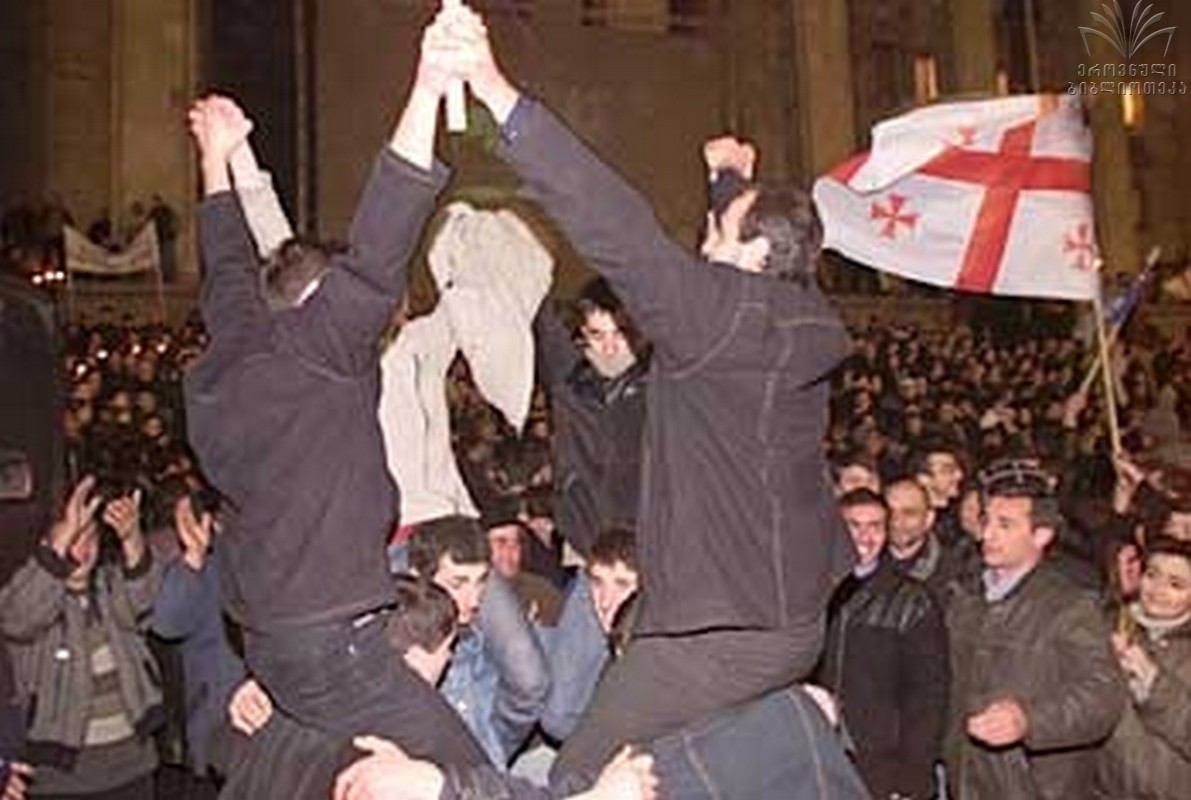
On November 23, 2003, months of nationwide protests in Georgia culminated in a revolution and a change of power. Known as the Rose Revolution, the movement cemented the country’s pro-Western trajectory and opened a path toward democratic development. While demonstrations took place throughout 2003, the escalation began after the November 2 parliamentary elections.
Parliamentary elections of 2003
On November 2, 2003, Georgia held parliamentary elections alongside a referendum asking: “Do you agree to reduce the number of MPs from 235 to 150?” A 7% threshold was in place. The Council of Europe and U.S. President George W. Bush urged Georgian authorities to ensure free, transparent, and fair elections.
Incidents targeting opposition parties occurred before election day. On November 1, the “Akhali Memarjveneebi” (New Rights) party office in Akhaltsikhe was bombed, injuring two people. Earlier, on October 29, gunfire was directed at the car of the New Rights majoritarian candidate Zviad Chokheli, and his vehicle was blown up.
Pro-government blocs competing were For a New Georgia (an alliance created by the Citizens’ Union with socialists and smaller parties) led by incumbent President Eduard Shevardnadze, and the Union for Democratic Revival (“Agordzineba”) led by Aslan Abashidze of the Autonomous Republic of Adjara.
The opposition included the National Movement led by Mikheil Saakashvili, who had resigned as justice minister in 2001 after accusing senior officials and Tbilisi police chief Soso Alavidze of corruption. Saakashvili left the Citizens’ Union to found the National Movement; the “United National Movement” bloc also included the Republican and Conservative parties.
Also in 2001, Zurab Zhvania resigned as speaker of parliament and soon founded the United Democrats in July 2002. In the November 2 election, his group ran as the Burjanadze-Democrats with Nino Burjanadze, the sitting speaker of parliament.
Another opposition force, the New Rights, founded by Davit Gamkrelidze and Levan Gachechiladze, had also split from the Citizens’ Union in 2001.
The Labour Party, led by Shalva Natelashvili, and Industry Will Save Georgia, led by Gogi Topadze, were also on the ballot.
Election day
A record number of international observers arrived to monitor the vote. To help prevent fraud, Georgia used voter inking, exit polls, and parallel vote tabulation for the first time.
Heavy turnout caused long lines. Zurab Zhvania of the Burjanadze-Democrats asked the Central Election Commission (CEC) to extend voting hours. The CEC kept polling stations open until 21:00 in Tbilisi (instead of 20:00) and until midnight in Kutaisi.
That night, before official results were announced, the National Movement celebrated based on exit polls: National Movement 20.8%; For a New Georgia 12.9%; Labour 12.8%; Burjanadze-Democrats 7.6%.
Parallel vote tabulation by the NGO Fair Elections (ISFED) was similar: National Movement 26.26%; For a New Georgia 18.92%; Labour 17.36%; Burjanadze-Democrats 10.15%; Revival 8.13%; New Rights 7.99%.
Preliminary CEC figures differed: For a New Georgia led with 27.6%, followed by the National Movement 23%; Labour 16.1%; Burjanadze-Democrats 9.6%; New Rights 8.7%.
The opposition declared the election fraudulent. Rustavi 2, viewed as sympathetic to the opposition, aired evidence of irregularities. “We were shocked by what we saw at Tbilisi polling stations on November 2: people certain they were on the voter list until Saturday were denied the right to vote on Sunday,” said Tom Cox, head of the Council of Europe Parliamentary Assembly delegation.
According to ISFED, the authorities failed to properly administer the vote. Problems included inaccuracies in voter lists that deprived citizens of their right to vote, pressure on observers, and ballot stuffing. The United States expressed concern over violations. The Council of Europe and OSCE secretary-generals Walter Schwimmer and Jan Kubiš stated that Georgia lacked the political will to meet international standards.
Opposition unites
On November 4, Mikheil Saakashvili, Nino Burjanadze, and Zurab Zhvania met at the Tbilisi City Council and agreed to form a united front to defend the vote. Jumber Patiashvili, leader of Unity, joined them. They gave the authorities and the CEC until 18:00 to publish the “objective results” and called a rally for that hour. Zhvania urged supporters to gather at the Philharmonic Hall.
Before the crowds arrived, the Interior Ministry deployed special units in central Tbilisi. Zhvania and Burjanadze went to the Philharmonic. At the rally’s end, Zhvania called on supporters to begin a peaceful march—first to the CEC, then to parliament—where, he warned, the pro-government bloc sought to “occupy” the chamber. He urged them to join the National Movement supporters assembled near City Hall.
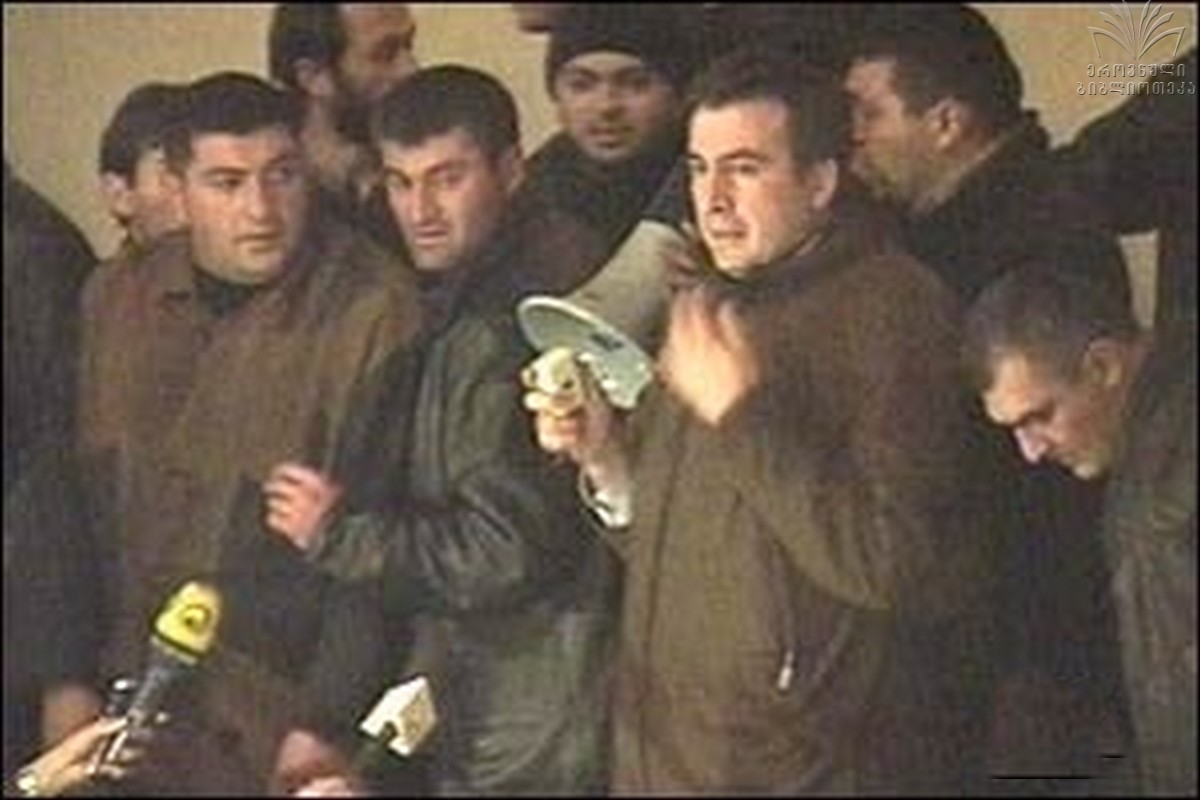
Thousands also gathered on Freedom Square, where Saakashvili presented their demand: “Either the president acknowledges the opposition’s victory or he must resign by tomorrow morning.” The New Rights did not join the rally, and Labour condemned it. President Shevardnadze called for dialogue, warning: “Threats that the president must resign if a given party doesn’t win a certain percentage are unacceptable. Everyone must know that any use of force against the authorities will be punished by law.” The rally dispersed that evening, giving the authorities until noon the next day to release “objective results.”
A rising protest wave
By the opposition’s deadline, nothing had changed, and protests continued. Revival announced a rally of its own in Tbilisi. On November 7, the Supreme Council of Adjara amended the region’s constitution to grant Aslan Abashidze the status of top political and military leader, allowing him to maintain armed formations. On November 9, Russian President Vladimir Putin phoned Shevardnadze, pledging full support. Abashidze also voiced support for Shevardnadze.
On November 13, the CEC revoked accreditation for Rustavi 2, citing the broadcast of a youth movement Kmara video that warned the CEC not to assist the authorities in rigging the vote.
By November 11, some opposition figures (members of the National Movement and MPs Giorgi Kheviashvili and Lado Chipashvili) began a hunger strike demanding the president recognize the opposition’s victory. Vasil Maghlaperidze of the Burjanadze-Democrats later joined. On November 12, a petition campaign began calling for the president’s resignation.
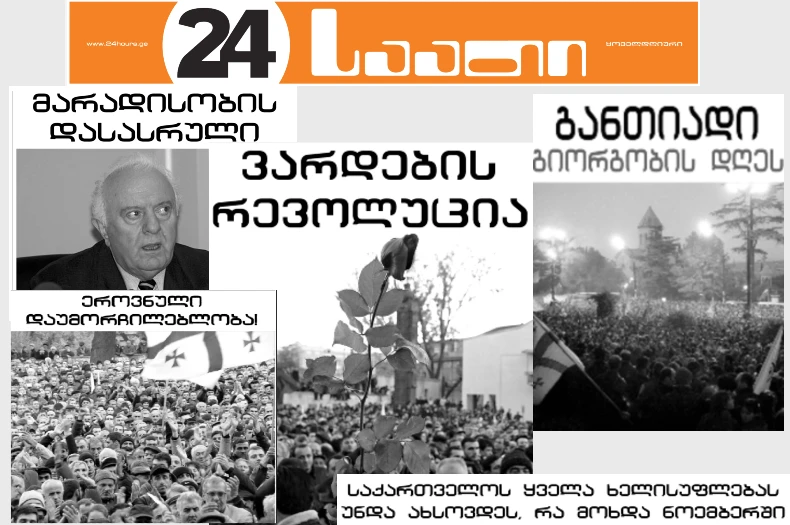
On November 14, Interior Minister Koba Narchemashvili said security forces were ready to use force if necessary. The opposition urged civil servants to engage in mass civil disobedience. That day’s rally ended with the State Chancellery encircled by tens of thousands forming a human chain, chanting “Resign” and “Leave.” Newspaper 24 Saati estimated up to 50,000 participants.
On November 18, U.S. Deputy Assistant Secretary of State for European and Eurasian Affairs Lynn Pascoe arrived and met the opposition. The authorities assembled supporters from Adjara at the Sports Palace and then outside parliament for a joint rally of the pro-government bloc and Revival under the slogan of preventing bloodshed and preserving constitutional order. To avoid confrontation, opposition supporters gathered separately on Freedom Square.
On November 19, Zaza Shengelia, head of the state TV and Radio Department, resigned and criticized Shevardnadze. His resignation followed the president’s public dissatisfaction with state television.
Students join the protest
In parallel, the youth movement Kmara and members of the “Civil Disobedience Committee” (a group of writers and artists) fueled campus activism. Prominent figures included writers Lasha Bugadze, Dato Turashvili, Dato Magradze, Dato Gogibedashvili, Achiko Guledani, Vakho Babunashvili, Gigi Tevzadze, Goga Khaindrava, and poet Irakli Kakabadze.
On November 19, they held a meeting with students in Tbilisi State University’s main hall. Despite initial resistance from the administration, writers and students entered the building. Their message: “If you don’t engage in politics, others will decide your fate for you.” Afterward, students joined protest committees. According to 24 Saati, as a student union leader shouted to clear the hall for a KVN rehearsal, few paid attention.
Students also gathered in the yard of the Tbilisi State Academy of Arts, unfurling a long sheet of fabric and painting together. Friends encouraged them with drumbeats as they created images reflecting mixed emotions: the number 666 in a black circle with arrows and the word “STOP,” suns and flowers, and a nearby black figure labeled “Go, brother.”
Protests spread to Tbilisi State University and the Ilia Chavchavadze State University of Languages and Culture (now Ilia State University). Students expressed solidarity with their peer Giorgi Mzhavanadze and demanded his release. He had observed the election in Adjara with the Young Lawyers’ Association and was detained after discovering forged ballots. “He is a student like us. If we stay silent today, tomorrow the same could happen to us,” said third-year student Levan Ghambashidze.
Another “Disobedience Committee” meeting took place in TSU’s High-Rise Building on November 21; according to 24 Saati, no lecturers were present in the hall. By contrast, many professors gathered at the Tbilisi State Medical University hall, opening doors to the upper tier as the crowd swelled.
At the Academy of Arts, Lasha Bugadze told the audience: “We are not fighting Shevardnadze the person—we are fighting Shevardnadze as a corrupt category.” Poet Zurab Rtveliashvili shouted from the hall: “Listen to me! I am the vineyard, not you!”
Uninterrupted demonstrations
Protests continued on Rustaveli Avenue despite the November rains. Musicians dubbed “the Rain Musicians” kept spirits high from a makeshift truck-stage: Green Room (Achiko Guledani), Soft Eject (Vakho Babunashvili), Zumba (Zaza Korinteli), Irakli Charkviani, 33a (Niaz Diasamidze), Robi Kukhianidze, and others. People danced at the rallies.
The youth group Kmara provided food for demonstrators. Rustavi 2, critical of the government, offered intensive coverage. Newspaper 24 Saati, which shared ownership and editorial alignment with the TV station, distributed a free four-page special edition to protesters; years later publisher Mamuka Pachuasvhili told Radio Free Europe that while the paper maintained professional standards in regular issues, these special editions were propagandistic and supportive of the protests.
Meanwhile, courts issued rulings favorable to the opposition: Tbilisi City Court ordered a recount of votes cast abroad and annulled the CEC decision to exclude invalid ballots from proportional calculations—a change that would have helped Industry Will Save Georgia and New Rights clear the threshold.
On November 20, the CEC announced final results: For a New Georgia 21.32%; Union for Democratic Revival 18.84%; Saakashvili – National Movement 18.8%; Labour 12.04%; Burjanadze-Democrats 8.79%; New Rights 7.35%. Pro-government supporters of For a New Georgia and Revival applauded outside parliament.
Protest centers emerged in the regions as well. Many traveled from the regions to Rustaveli Avenue, with a mass arrival after Saakashvili toured western Georgia, addressed crowds, and led a motorcade to Tbilisi. The west-to-Tbilisi convoy on November 21 became one of the revolution’s iconic images—dubbed by 24 Saati the “March of Angry Georgians.”
The day of the revolution
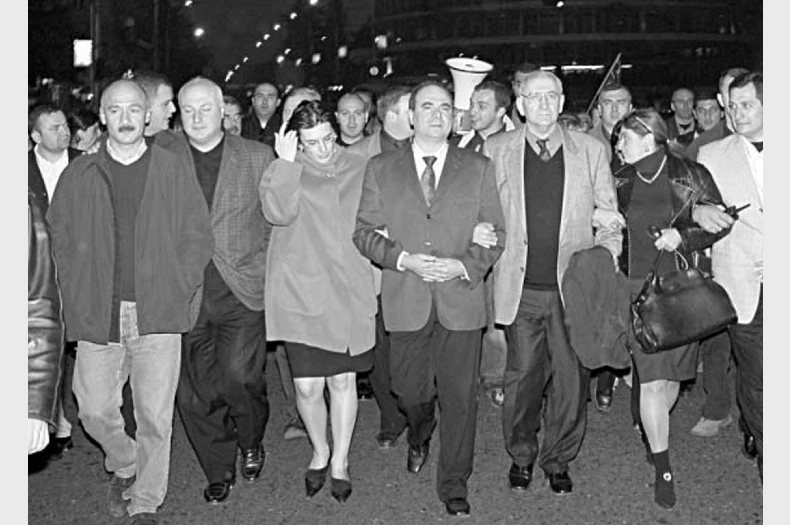
The first sitting of the new (5th convocation) parliament was set for November 22 at 16:00. Pro-government supporters gathered outside parliament; opposition supporters assembled on Freedom Square. Protest leaders decided to move toward parliament. One column, led by Saakashvili, went to the back entrance via Ingorokva Street; another, led by Zhvania and Burjanadze, advanced along Rustaveli Avenue.
Inside the chamber, there was no quorum because the National Movement, Burjanadze-Democrats, Labour, and New Rights were absent. Neither the diplomatic corps nor Patriarch Ilia II attended.
At 16:50, before the session formally began, New Rights leader Davit Gamkrelidze and several allies entered the hall. The president declared there was “more than enough” quorum. Years later, Gamkrelidze said Shevardnadze personally asked him to come, promising to support new elections—a promise not kept.
Shevardnadze approached the rostrum and began with congratulations. At that moment, the doors opened and Saakashvili entered with supporters, shouting “Resign!” The president tried to finish his speech, but security escorted him out. Members of For a New Georgia and Revival also left.
Participants later recalled little resistance from police cordons; some officers even urged protesters to press forward. Demonstrators felt units near parliament sympathized with the movement.
Former Interior Minister Koba Narchemashvili reflected two decades later: “It mattered greatly how we behaved; it could set an example for how people would treat each other afterward. Society would not forgive a show of force by the police.”
Acting speaker Nino Burjanadze entered the chamber. Saakashvili, urging calm, ceded the podium to her. She declared the president responsible for what had happened in the chamber and later announced she would assume the functions of head of state until the president’s capacity was clarified and new presidential and parliamentary elections were scheduled.
Only a few doors and windows were broken during the storming of parliament; according to the head of facilities, repairs would take just two days. Parallel actions unfolded at the State Chancellery, where opposition leaders Givi Targamadze and Giorgi Baramidze entered with supporters.
That night, Saakashvili appeared via Rustavi 2 from the 24 Saati studio. Host Natia Zambakhidze introduced him as “one of the leaders of the Rose Revolution.” Saakashvili replied, “Rose Revolution is a brilliant term,” and the November events received their enduring name.
On November 23, St. George’s Day, demonstrators lit candles outside parliament.
Shevardnadze steps down
Late on November 22, Shevardnadze called the events an attempted coup and said he was ready to declare a state of emergency. The next morning, after hearing what bloodshed might follow an attempt to clear parliament and the Chancellery by force, he reconsidered. As Narchemashvili later recalled, Shevardnadze said: if such casualties are possible, “what need do we have for power?” He decided against extending the state of emergency.
On November 23, Russian Foreign Minister Igor Ivanov arrived in Tbilisi, visited the rally outside parliament, and then met both the opposition and Shevardnadze at the Krtsanisi presidential residence. Newspaper 24 Saati wrote that Russia “was first on the scene,” seeking to present itself as close while others were far.
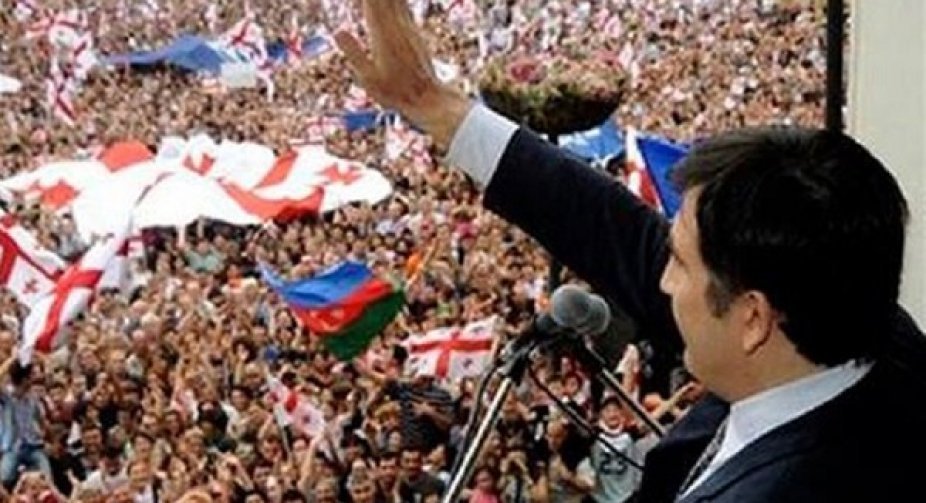
On November 24, a massive rally again filled the space in front of parliament. Saakashvili told the crowd that if Shevardnadze did not resign, they would march on the Krtsanisi residence.
Zhvania and Saakashvili headed to Krtsanisi, followed by demonstrators. About an hour later, Saakashvili emerged to announce Shevardnadze’s resignation. He added, “The president should remain in the country; it is a matter of national dignity that a former president can live here with full security guarantees. I believe he took a courageous step—he prevented bloodshed.”
Shevardnadze then appeared before journalists: “I have never betrayed my people, and now, in this situation, perhaps it is better for the president to resign so that all this ends and blood is not spilled.” Asked, “Where are you going, Mr. Eduard?” he answered, “Home!” The brief exchange became one of the day’s memorable moments, quashing rumors that he would go to Moscow or move to Adjara. He did indeed go home. The resignation sparked nationwide celebration.
On November 24, the Supreme Court annulled the CEC’s final protocol on the proportional part of the election following a suit filed by ISFED.
Roses and other symbols of the revolution
It is unclear exactly how roses appeared outside parliament in mid-November, but by November 23 demonstrators entered the chamber holding roses. One participant, David Mumladze, recalled that near the back entrance, a vendor offered roses; he bought and distributed them to protesters moments before they entered the building.
Another iconic image captured Mikheil Saakashvili sipping tea at the rostrum left behind by Shevardnadze. Music also colored the day’s mood: when chaos mounted in the hall, a state sound engineer played “Freedom is the Fate of Lions,” which turned the atmosphere from turmoil into celebration. “If everyone sings one song, we will build a house,” performed by musicians of different genres, became another rally anthem, and pop singers later recorded a “Hymn of the Rose Revolution.” In the aftermath, Rustavi 2 branded itself “the television of the victorious people,” running celebratory footage for weeks.
Aftermath
On January 4, 2004, the presidential election took place. Mikheil Saakashvili won with 96.2%. In the March 28 repeat parliamentary elections, the National Movement-Democrats won 66.4% and secured a majority; the coalition included the United Democrats (Burjanadze and Zhvania), the Republican Party, and the National Forces Union (Conservatives). The National Movement governed until 2012, and Saakashvili left the presidency in 2013.