No to the Russian Law 2

2024

This AI-generated translation may not be completely accurate.
No to the Russian Law 2
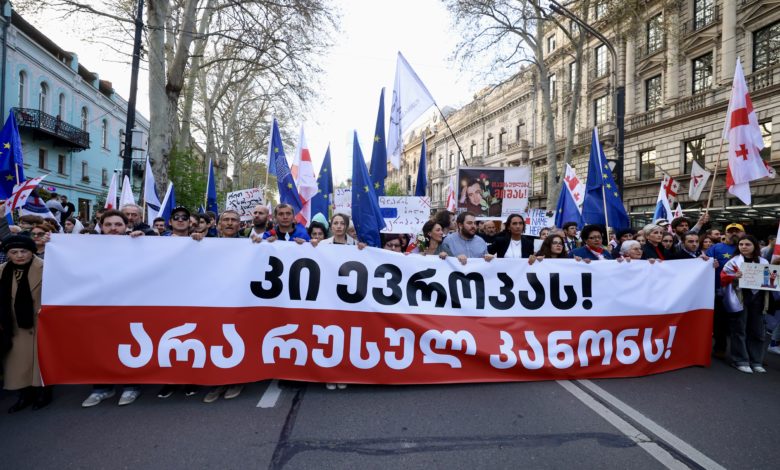
On April 3, 2024, Mamuka Mdinaradze, the Executive Secretary of the ruling party, held a briefing and told journalists that “Georgian Dream” would once again register the “agents law,” which the previous year had brought tens of thousands of people into the streets. He noted that the only difference between this new bill and last year’s withdrawn version was one term: instead of “agent of foreign influence,” the law would use the phrase “organization carrying the interests of a foreign power.” According to the initiative, any organization that received more than 20% of its non-commercial income from abroad would be required to register as an organization carrying the interests of a foreign power. The law’s main targets again became independent media outlets and non-governmental organizations, which carried out projects with the support of Western donor foundations and embassies.
At a time when Georgia was supposed to prepare for opening negotiations on accession to the European Union, opposition parties, the president, and non-governmental organizations viewed the initiative as a deviation from the path of European integration. The initiative also received criticism from international partners.
Back to Parliament
The first protest against this bill was held on April 4 in front of Parliament. On April 8, journalists gathered at Parliament, and prior to that, more than 400 NGOs and media organizations had issued a joint statement.
NGOs explained to citizens why the law was “Russian in essence,” while the ruling party, similar to the previous year, began to persuade people that the law was “European.”
Members of the parliamentary majority claimed that the goal of the law was transparency, yet during the bill’s hearings in Parliament, only TV journalists were allowed inside; representatives of other media outlets were not. During the committee meeting, the chair, Anri Okhanashvili, turned off the microphones of every opposition MP who called the bill a “Russian law.”
While the bill was being discussed, thousands of people gathered outside Parliament, chanting “No to the Russian law.” The Ministry of Internal Affairs deployed police forces around the building to ensure MPs could leave the legislature quietly.
Against the protesters
On the first day of demonstrations, police detained 14 people. The protests continued for days, and the Ministry of Internal Affairs kept deploying police forces, including the use of special measures to disperse people. On April 16, during the dispersal of the rally, special forces beat citizens and journalists from the outlets “Publika,” “Tabula,” and “Aprili.”
Following the mass violence, well-known athletes publicly voiced support for Georgia’s European integration. Government representatives insisted that this aligned with the government’s own position—that the government also wanted EU integration.
Police detained dozens of people during the protests against the “Russian law,” and most were later fined by the court, including those who blocked Tbilisi streets. Criminal cases were opened against nearly ten people.
On April 19, demonstrators marched through central Tbilisi, blocking Rustaveli Avenue, Freedom Square, the right embankment road, and Heroes Square. “I swear we will never give up the freedom that was won at the cost of their lives,” declared young people at Heroes Square, taking an oath initiated by Zviad Tsetskhladze, leader of the organization “Daphioni.” Zviad Tsetskhladze was later arrested during renewed pro-European protests in November 2024 and sentenced to 2 years and 6 months in prison.
In the spring of 2024, instruction was suspended at some universities. Protests were also held in other regions.
Violence
Violence began targeting representatives of political parties participating in the protests—on May 9, in the village of Tsereteli in the Marneuli district, four individuals physically assaulted Giorgi Mumladze, a member of the United National Movement. According to him, the attackers had parked near his house and watched him; they assaulted him after he began taking photos and videos with his phone. Later in Tbilisi, members of “Girchi – More Freedom,” Boris Chele Kurua, and of the party “Akhali,” Nodar Chachanidze, were beaten.
On the night of May 8, three more participants of the protest movement against the “agents law” were physically attacked: UNM member Dimitri Chiqovani, international relations specialist Gia Japaridze, and activist Lasha Ghvinianidze.
An ambush was set up for the leader of “Girchi – More Freedom,” Zurab Japaridze, during which the politician fired a warning shot.
In addition to physical violence, hostile messages and posters appeared at night on the walls of NGO offices, at the houses of civic activists, on the doors of political parties, and residential buildings of journalists. The cars of journalists and activists were damaged. Representatives of civil society and opposition parties believed that the ruling party, “Georgian Dream,” was behind the violence.
Mass protest
At the most crowded protests in recent years, held in April and May, opposition parties did not organize the transportation of activists—people came to the streets on their own. Street graffiti spread virally in Tbilisi and other cities: “No to the Russian law!” “Where are we going? – To Europe.” “Whose country is Georgia? – Ours.” These chants were heard at rallies.
The largest protest took place on May 11, 2024. People gathered in three locations—Republic Square, Marjanishvili Square, and the 300 Aragvians metro station. All three streams merged at Rike Park. According to On.ge, by 10 p.m., more than 140,000 people had gathered. According to Visioner, throughout the day, the crowd may have reached 300,000. Large crowds continued for several days afterward.
Authorities continued detaining activists, and police units continued using force. On May 14, anti-occupation movement leader Davit Katsarava was brutally beaten. Earlier, on May 1, opposition MPs Aleko Elisashvili and Levan Khabeishvili had been assaulted. The founder of the advertising agency “Lemon,” Giorgi Okmelashvili, was arrested on criminal charges of attacking a police officer and later sentenced to five years in prison. Nine additional people were arrested on criminal charges: Giorgi Shanidze, Fridon Bubuteishvili, Andrei Rautberg, Giorgi Kuchashvili, Davit Koldari, Saba Mepharishvili, Omar Okribelashvili, and Irakli Megvinetukhutsesi. President Salome Zurabishvili soon pardoned Giorgi Shanidze. Others were released via plea agreements, while the remaining seven continue serving sentences.
Helping each other
The April–May protests were remarkable in many ways:
- Volunteers created a Facebook group called “Daitove,” where people arriving from the regions could find free places to stay in Tbilisi. Others offered free rides.
- The “Nanuka Fund,” established by TV host Nanuka Zhorzholiani, also provided support: they bought food for protesters and raincoats for rainy days, making them visually stand out from the black-clad riot police.
- The protests reached theaters as well: Marjanishvili Theatre, Movement Theatre, Atoneli Theatre, New Theatre, and others joined the demonstrations.
- The protest had its own music. The song “Homeland” by the band “Everyone” became the anthem sung at rallies.
- The anger and protest triggered by the reintroduction of the “Russian law” spread to TikTok, where young influencers explained why the law was dangerous for Georgia.
- Original graffiti became viral. Many messages targeted the 83 MPs who voted for the bill, reading: “83 slaves,” “83 traitors,” “83 cheap and dirty,” “83 penguins.”
- YouTubers recorded a collective video against the “agents law,” involving around 60 Georgian YouTube channels whose combined audience reached millions.
Despite resistance, “Georgian Dream” still passed the law. President Salome Zurabishvili vetoed it, but the ruling party overturned the veto on May 28, 2024. The law went into force on June 3, 2024, after the Speaker of Parliament, Shalva Papuashvili, signed it instead of the president. The last protest was held on June 2. A charity concert-protest raised money to help those fined by the courts.
Parliamentary elections were ahead in October 2024, and protests ceased, though activists continued confronting MPs by calling them “slaves” at meetings and posting the encounters online.