“No to the Russian Law” – First Initiative

2023

This AI-generated translation may not be completely accurate.
“No to the Russian Law” – First Initiative
At the end of 2022, on December 29, members of the parliamentary majority faction People’s Power — known for their strongly anti-Western rhetoric — announced that they were working on a draft law to establish a “register of agents of foreign influence.” The registry would include NGOs and other organizations receiving foreign funding. On February 14, 2023, the draft law, titled “On Transparency of Foreign Influence,” was made public.
According to the bill, media outlets and NGOs receiving 20% or more of their funding from abroad would be labeled “agents of foreign influence.” The law referred to donor countries and organizations as “foreign powers.” Although the ruling Georgian Dream party claimed not to have authored the bill, they expressed support for its adoption.
Protests began almost immediately — on February 20, a small group of online media representatives entered parliament and unfurled banners reading: “You still can’t silence us,” “The Russian law is not Georgia’s choice,” and “You are the real foreign agents.” Civil society soon began calling it the “Russian law,” drawing parallels to similar legislation in Russia.
The government insisted the bill was modeled after the U.S. Foreign Agents Registration Act (FARA), but for the public, the resemblance to Russia’s repressive law was more striking. Western partners warned the government that the bill would undermine Georgia’s EU integration prospects, especially as the country awaited a decision on its candidate status. Media organizations operating in Georgia warned that the adoption of the law would disrupt their work, while non-governmental organizations said it would prevent them from continuing to assist their beneficiaries. All opposition groups represented in Parliament opposed the bill, with the sole exception of the European Socialists. The Public Defender and the President of Georgia also spoke out against the legislation.
On March 2, tensions erupted during a parliamentary committee discussion — journalists were barred from entering the session, so they protested in the hallway with signs reading “No to the Russian law!” Outside parliament, demonstrations grew, and police detained 36 people, including two journalists.
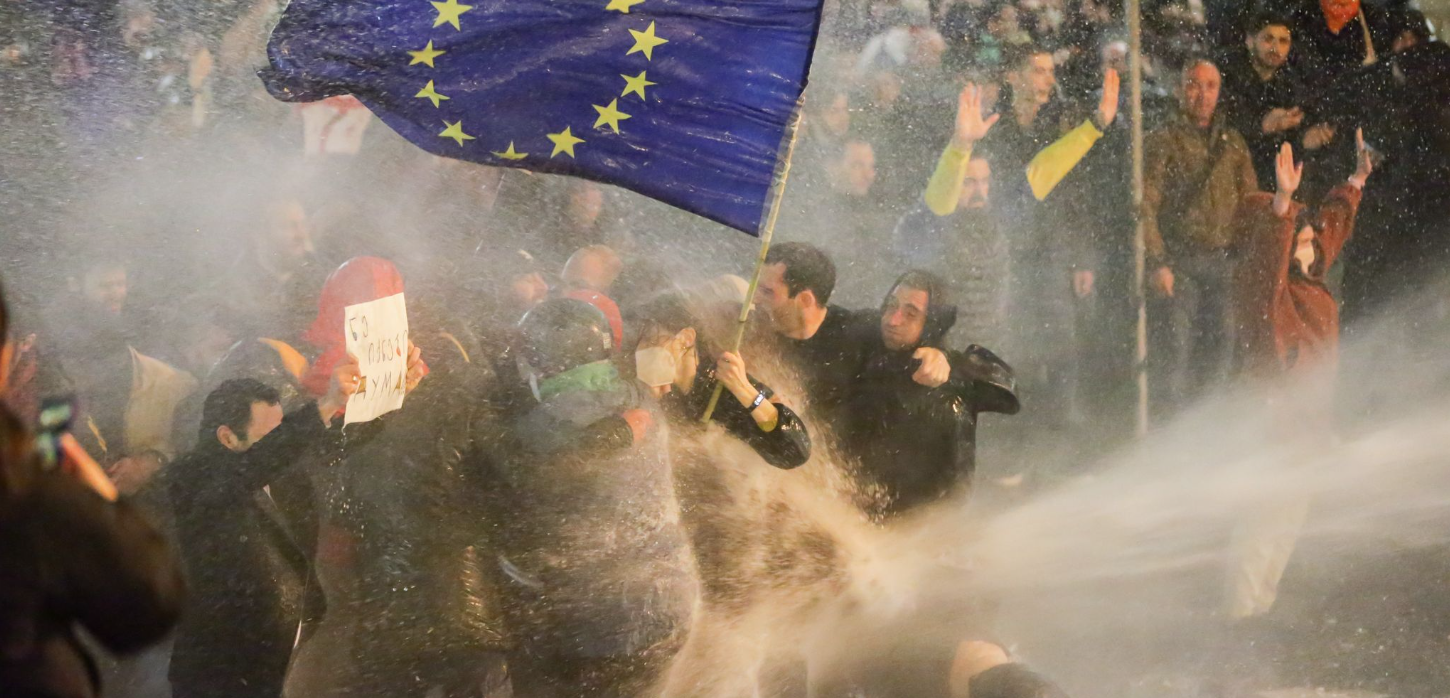
On March 7, unexpectedly, the Georgian Dream majority fast-tracked the bill for a plenary vote. As news spread, thousands took to Rustaveli Avenue. Despite the massive turnout, parliament passed the bill in its first reading. Police used water cannons and tear gas to disperse the crowd, but protesters refused to leave.
The demonstrations, led largely by Gen Z activists, continued through the night and into March 8. During these protests, demonstrators threw “Molotov cocktails” for the first time in Georgia’s history. Later, police arrested 23-year-old Lazare Grigoriadis on these charges. From the night of March 7–8, many striking images were preserved: a girl dancing in front of a water cannon, a woman holding an EU flag, people dancing to the sound of sirens, and inventive protest posters included:
- “At least let the Patriarchate bless the water cannons so we don’t catch a cold.”
- “They tried to bury us, but forgot we are seeds.”
- “300 Aragvians, 76 snakes.”
- “We’re not afraid of Megrelian pepper.”
- “My husband isn’t afraid of me; you won’t scare us with pepper spray.”
- “People are going to Mars, and I’m supposed to go to Moscow?”
- “Hello, this is 112, there are 76 of us, we passed some law and screwed everyone over…”
- “I’m more afraid of the slipper my grandmother throws than of you.”
These and many other phrases, scrawled on banners, sheets of paper, and every imaginable surface, reflected the personal anger of ordinary demonstrators and their immediate protest response. On Rustaveli Avenue, some protesters wore small banners around their necks, while others—seeking more emphasis—held them high above their heads with raised arms.
On the morning of March 9, amid growing public pressure, Georgian Dream announced it would withdraw the bill. The following day, March 10, parliament formally voted to reject it. The session lasted only a few minutes, and opposition MPs were not allowed to speak.
After the bill’s withdrawal, protests in the streets ceased, but tensions shifted to universities, where students began boycotting lectures and posting signs on classroom doors to protest professors who had publicly supported or signed the bill.