May 26 crackdown

2011

This AI-generated translation may not be completely accurate.
May 26 crackdown
In early May 2011, the People’s Assembly (Sakhalkho Kreba), whose executive board included Nino Burjanadze, announced a series of protest rallies. The demonstrations began on May 21 with a large gathering at Freedom Square in Tbilisi. That day, Burjanadze told the press that activists in the regions were being pressured and prevented from traveling to the capital. After speeches concluded, one of the leaders, Irakli Batiashvili, called on thousands of demonstrators to march to the Georgian Public Broadcaster’s headquarters on Kostava Street, demanding airtime during the 8 p.m. news to address the public. Activists blocked Kostava Street and spent the night outside the television station.
A simultaneous protest was held in Batumi, where demonstrators also demanded airtime from Adjara TV. Unknown individuals began throwing stones, prompting police to violently disperse the crowd.
On May 22, police in Tbilisi broke up the protest outside the Public Broadcaster after demonstrators damaged police cars with flags. Officers used rubber bullets, tear gas, and water cannons to disperse the protesters.
That same day, leaders of the People’s Assembly and the Georgian Party met to coordinate their actions. Georgian Party leader Sozar Subari declared that their “decisive struggle to overthrow the regime” would begin on May 25, calling it “the day of the Georgian people’s wrath.” Activists from the Georgian Party joined the ongoing protest outside the broadcaster, while smaller demonstrations spread to other regions.
President Mikheil Saakashvili called the rallies a “masquerade,” and the Ministry of Defense stated that the Independence Day parade on May 26 would proceed “as planned.”
After five days of protests at the broadcaster, People’s Assembly supporters marched toward Freedom Square on May 25 but stopped near Parliament. That evening, TV channel Imedi aired a covertly recorded video from the Interior Ministry showing some protesters allegedly discussing the use of Molotov cocktails.
Later that night, Burjanadze urged Saakashvili to relocate the Independence Day parade. Tbilisi City Hall, however, instructed protesters to move instead, citing that their permit was valid only through May 25. Under Georgia’s Law on Assemblies and Demonstrations, organizers were required to notify authorities if protests affected traffic or public movement. Since the parade was scheduled for May 26, City Hall said the rally must end the night before.
Morning of May 26
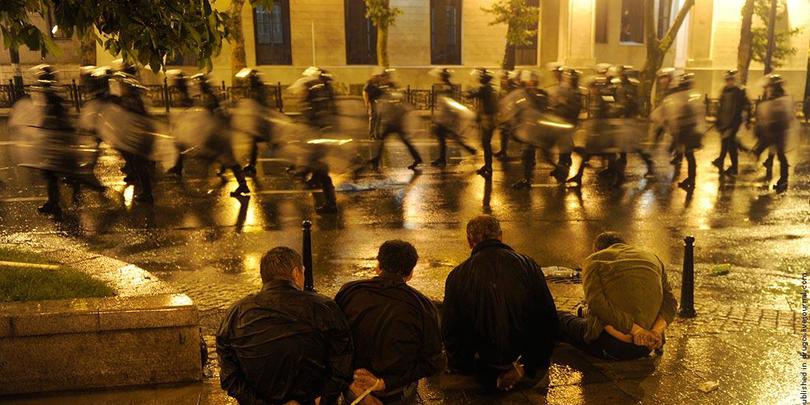
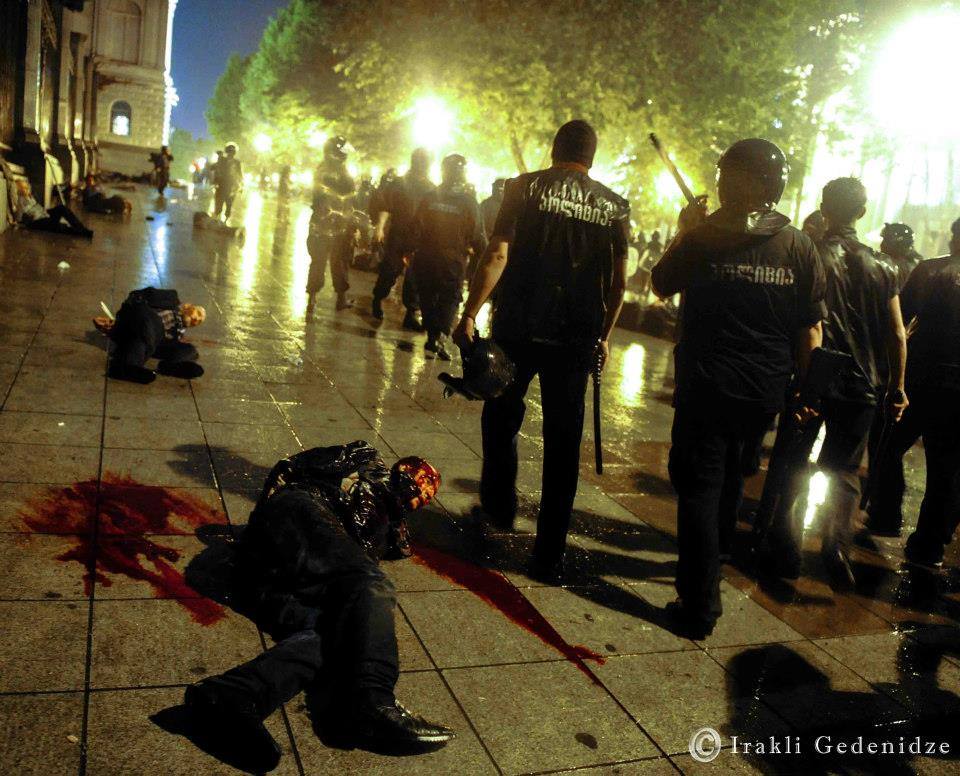
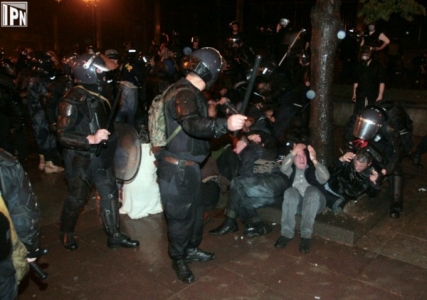
Just after midnight on May 26, police violently dispersed the remaining demonstrators on Rustaveli Avenue using water cannons, tear gas, and rubber bullets. Witnesses reported physical beatings. According to official data, 37 people were injured—eight police officers, one journalist, and twenty-seven civilians.
The crackdown resulted in two deaths. According to the Ministry of Internal Affairs, Burjanadze left the scene with her escort, and a speeding car in her convoy struck and killed one protester and one police officer. Police detained 105 people administratively.
Opposition leaders said police trapped demonstrators in a “cordon,” preventing them from escaping. Nino Burjanadze described it as a deliberate assault, while Irakli Batiashvili went missing for several hours. Later, he stated that he had been beaten, shot at, and forced to hide on a rooftop near the Rustaveli cinema for about 15 hours during the Independence Day parade.
The day after the dispersal of the protest, it became known that two more people had died on May 26. According to the official version, the two demonstrators climbed onto the roof of a nearby store during the dispersal, where they were electrocuted after coming into contact with a damaged power cable.
Reactions to the crackdown
Human rights organizations condemned the violent dispersal. The Georgian Young Lawyers’ Association (GYLA) and Transparency International Georgia said police had used excessive force and committed criminal acts. Amnesty International called for an investigation, saying there was no justification for beating unarmed protesters.
President Saakashvili insisted that Georgia was a “fully functioning state” and that protesters had tried to disrupt the parade under a “foreign-scripted scenario.” After clearing the avenue, the government held the parade marking Georgia’s 20th Independence Day anniversary, removing only the planned final performance—Sukhishvili’s “Khorumi” dance—in respect for the two deaths.
Families of detained protesters said they were not officially informed of their relatives’ whereabouts. On May 30, GYLA published a list of 50 people it considered “missing” after the May 26 crackdown. The Interior Ministry denied receiving any missing persons reports.
On June 14, hours before the Ombudsman’s report to Parliament, women’s organizations held a peaceful protest outside Parliament, demanding accountability, the release of the detained, an end to degrading treatment, and the discovery of the missing. The same day, Ombudsman Giorgi Tugushi announced that all individuals reported missing after May 26 had been located by his office in temporary detention facilities.