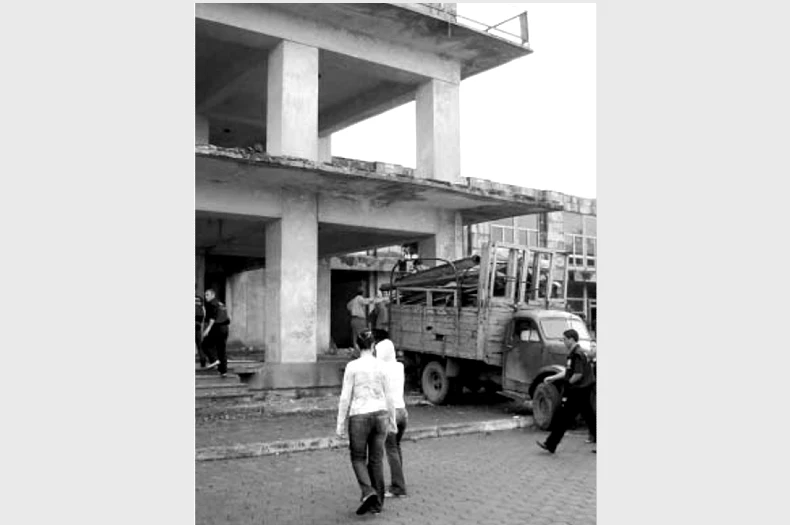
IDPs protest due to forced eviction

2006

This AI-generated translation may not be completely accurate.
IDPs protest due to forced eviction
Kazakh investors purchased the “Medea” and “Meskheti” hotels in Batumi, where internally displaced persons (IDPs) had been living. Out of 2,000 displaced families, 300 refused to sign contracts, demanding higher compensation. Authorities began forcibly evicting them, creating unbearable living conditions by cutting off electricity and water and starting the demolition of the buildings. Police dispersed protesting IDPs by force, arresting several young people.
One of the main reasons for the IDPs’ discontent was the sharp increase in housing prices in Batumi. Many argued that the $7,000 compensation offered to each family was far too little to start a new life. The investors, however, insisted they were paying $14 million in total compensation and refused to increase the amount.
Tensions also grew over the official compensation list compiled by the Adjara Ministry of Health, which included 1,921 families. Several families were left off the list, leading many IDPs to accuse the authorities of deliberately manipulating records for corrupt purposes.
Evictions began on June 16, 2006. Displaced residents organized protests, declaring they would not leave the buildings until their demands were met. The demolitions led to clashes between residents and law enforcement. Two IDPs, Bachuki Bigvava and Dato Arziani, were arrested and sentenced to four days in detention for disobeying police orders.
Before demolition began, police detained several young residents from the “Medea” and “Meskheti” hotels, some of whom were taken for drug testing. One detainee’s mother recounted: “He was asleep when police dragged him from bed. When I asked why, they said, ‘Why are they sitting outside Medea until late at night?’ My son grew up here; he was just saying goodbye to his friends.”
The youths said police pressured them to accept the $7,000 compensation. “The terror has started — they take kids to the station and force them to sign. It’s psychological pressure on both children and parents. The kids did nothing wrong,” said Zviad Esakia, an IDP living in the “Medea” hotel.
These detentions led to further clashes between residents and police. “Police also took away Gia Phaghava because he defended the kids. They beat him and released him later — he suffered a concussion and needed medical help,” residents said.
On June 28, one IDP attempted self-immolation with his disabled grandchild in protest. Police intervened with force to prevent the act. Several protesters were injured in the scuffles, and one woman was briefly detained. That evening, around 50 IDPs marched toward the Enguri Bridge, declaring their intention to seek asylum from the de facto authorities in Abkhazia.
The eviction process in Batumi continued alongside the demolition of the “Medea” and “Meskheti” hotels. Some families accepted the compensation and signed agreements with the investors, while about 200 families continued to protest and refused to leave. The struggle of displaced persons for adequate housing lasted many more years.
As of 2022, out of 92,079 internally displaced families from the occupied territories, the Georgian state had provided housing to only about 50,000.