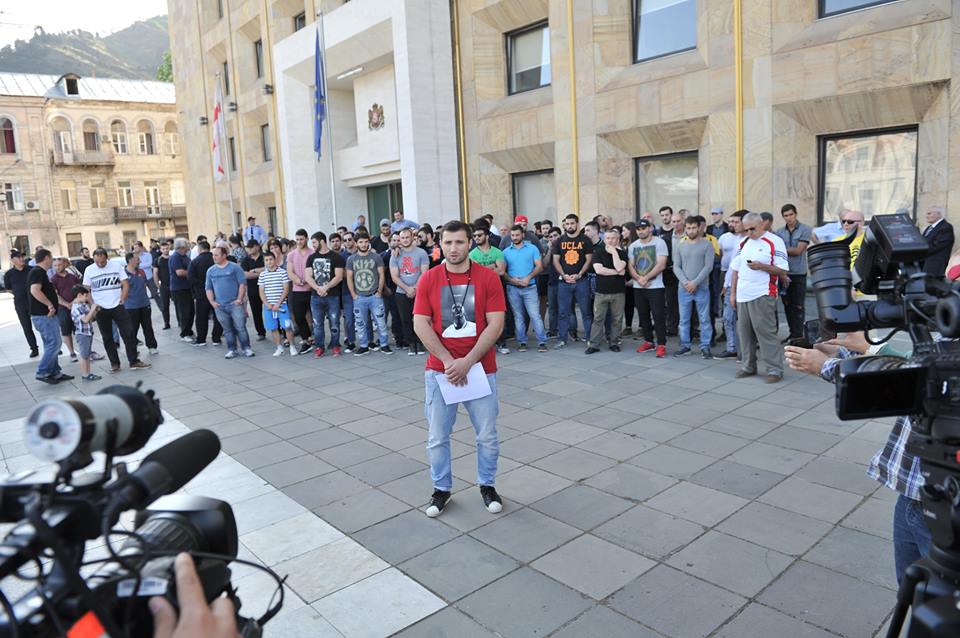
Protest of Georgian judokas

2018

This AI-generated translation may not be completely accurate.
Protest of Georgian judokas
In early May 2018, several Georgian judokas held a protest outside the Judo Federation building, demanding the resignation of Federation President Davit Kevkhishvili. They accused him of authoritarian leadership, nepotism, and financial misconduct.
The conflict between the Federation’s leadership and athletes had first erupted in January 2016. Olympic champion and then-Member of Parliament Zurab Zviadauri criticized the poor training conditions of the national team during a parliamentary committee meeting, accusing Kevkhishvili of “taking Georgian judo back to the 1990s.” Zviadauri said he was speaking based on information from experienced team members.
Shortly after, active athletes also voiced complaints. Three-time European champion Varlam Liparteliani stated that team members had to train in freezing gyms wearing jackets and socks due to lack of proper equipment and heating.
In 2016, the contract of head coach Irakli Razmadze was not renewed, and he was replaced by Irakli Tsirekidze—a decision that fueled further discontent. The team’s performance began to decline, and Georgia left several international tournaments without medals. At the 2018 European Championship in Tel Aviv, held from April 26–28, Georgia failed to win a single medal for the first time since 1992. Upon returning, the athletes demanded Kevkhishvili’s resignation on May 4.
In response, Kevkhishvili dismissed members of the coaching staff and called for an extraordinary assembly of the Federation.
On May 10, Minister of Culture and Sports Mikheil Giorgadze announced that a special commission had been created—comprising the Ministry, the parliamentary sports committee, and the National Olympic Committee—to examine the situation in the Judo Federation and make recommendations.
The athletes’ protest gained wide support, with Georgian and international sports figures sharing solidarity messages on social media.
Before his official briefing, Minister Giorgadze met with Olympic Committee President Leri Khabelov, MPs Mikheil Kavelashvili and Shota Khabareli, and Anzor Chubinidze, head of the Special State Protection Service.
Radio Free Europe/Radio Liberty later noted that Chubinidze’s presence “angered already frustrated athletes,” as he was rumored to be Kevkhishvili’s protector and one of the most influential figures in Georgian sports.
An hour after Giorgadze’s statement, the extraordinary assembly began. The Federation’s hired security guards initially blocked protesting athletes from entering, but after scuffles and intervention from delegates, they were allowed inside. The meeting quickly broke down, and several athletes were expelled from the hall within minutes. MP Mikheil Kavelashvili left early, having expressed his support for Kevkhishvili—along with the majority of delegates.
As no government action followed, protests resumed on May 22. The athletes symbolically removed Kevkhishvili’s chair from his office, placed it next to a garbage bin, and barricaded the door with wooden planks. Federation officials called the police.
On May 31, during another confrontation between the opposing sides, veteran judoka Ioseb Tselauri—one of the protesters demanding Kevkhishvili’s resignation—was shot and wounded. Police later arrested former Federation vice-president and youth coach Lomer Zhorzholiani for illegal possession and use of a firearm. According to some reports, Kevkhishvili himself was present at the scene and fled immediately after the incident.
On June 2, 2018, Davit Kevkhishvili resigned as president of the Georgian Judo Federation. In addition to his role in sports, Kevkhishvili was also active in politics—he had been elected chairman of the Kvareli Municipal Council in 2016 and served as the ruling Georgian Dream party’s top-listed candidate in Kvareli during the 2017 local elections.