Protests Against the Namakhvani HPP

2018

This AI-generated translation may not be completely accurate.
Protests Against the Namakhvani HPP
The construction of the Namakhvani Hydropower Plant was planned even before the collapse of the Soviet Union. In 1985, a project was approved for the construction of a 161-meter-high arch dam with a capacity of 500 megawatts. Due to the dissolution of the Soviet Union and subsequent events, the project was shelved.
The Georgian government revisited the Namakhvani HPP project in 2009, when it planned to cooperate with a Turkish-Korean consortium. However, that consortium soon abandoned the project.
Discussions about the need for and importance of the hydropower plant resumed at the end of 2015. The state company “Namakhvani HPP Cascade” prepared an entirely new version of the project. According to the new plan, two dams on the Rioni River would together generate 433 megawatts of power, producing up to 1.5 billion kilowatt-hours of electricity annually. On December 24, 2015, the Georgian Energy Development Fund announced an expression of interest for the construction of the 433 MW Namakhvani HPP. Only the Norwegian company “Clean Energy Group” expressed interest, and on January 17, 2017, it was declared the winner.
In the spring of 2019, 90 percent of the Norwegian company’s shares were purchased by the Turkish company ENKA, which assumed responsibility for implementing the project. In 2019, a contract was signed between the Georgian government and ENKA Renewables (formerly Clean Energy Group). The project’s value was estimated at 850 million USD, and it was said that the Namakhvani HPP could generate about 11% of Georgia’s electricity consumption.
The NGO “Green Alternative” pointed to ENKA’s Russian connections. Their investigation showed that ENKA had never built a hydropower plant before and that most of its portfolio consisted of construction projects in Russia, including the reconstruction of the Russian Federation’s Parliament (the Duma) and the Government House (the White House).
Local opposition to the Namakhvani project began as soon as it was revived.
The first protests
In 2018, a rally was held in Kutaisi under the slogans: “No to Big Dams!”, “Don’t Drown Us!”, “The Sun and Wind as Alternatives to Dams!”, and “Save Kutaisi from the Namakhvani Threat!” Citizens gathered on the Chain Bridge to coincide with International Rivers Day on March 14.
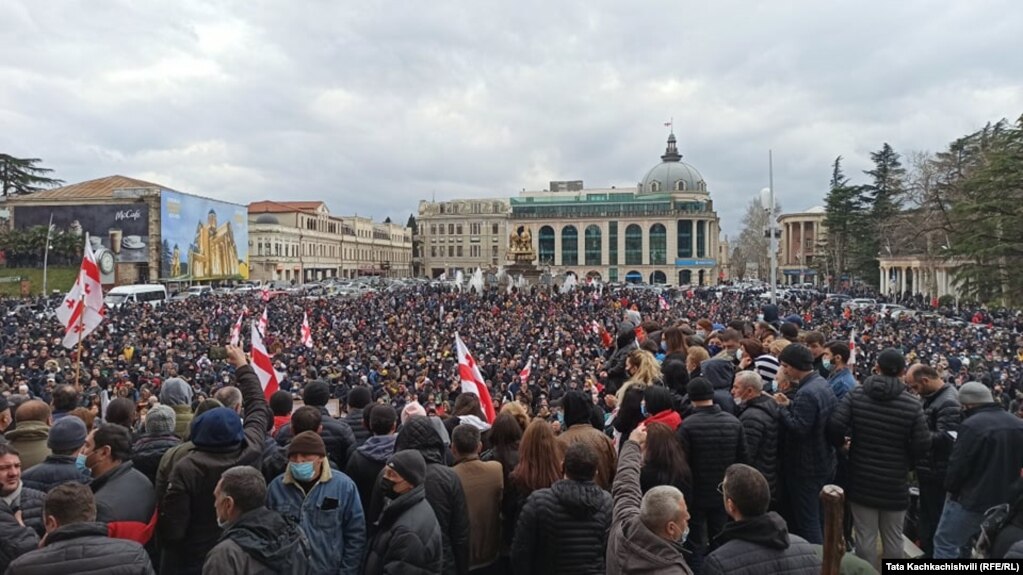
“This is a bomb planted under Upper Racha,” said Tamta Metreveli during a protest in front of the government administration building on May 24, 2020. That day, several dozen people gathered to demand the cancellation of construction permits for large dams in the Racha and Lechkhumi regions. In August 2020, the movement “Save the Rioni Valley” was established. The dam was to be built between the villages of Alpana (Tsageri Municipality) and Zhoneti (Tskaltubo Municipality). Protests in Zhoneti began as soon as construction started in October 2020. On October 25, locals set up tents near the village of Namakhvani, where the construction company was carrying out preparatory works, and stayed overnight to demand a halt to construction. The media soon called them the “Guardians of the Rioni Valley.”
Meanwhile, environmental NGOs demanded proper environmental impact assessments and additional studies. Only the Lower Namakhvani HPP’s impact had been assessed; the Upper HPP’s environmental impact remained unexamined.
On October 29, during the first major protest against the Namakhvani HPP, participants erected a cross at the construction site. People would often gather there to sing hymns.
The situation escalated on November 14, when protesters chained themselves together and blocked the road between Kutaisi and Lechkhumi. The police dispersed them.
After this, not only environmental NGOs but also human rights organizations, including EMC (the Social Justice Center) and the Georgian Young Lawyers’ Association, joined the protests. Along with “Green Alternative,” they issued a joint statement condemning the government for using “repressive methods and police force” to suppress peaceful protest. They called on the authorities to suspend the project until proper consultations with local communities and the release of full environmental and risk documentation were carried out.
The NGOs highlighted the risks described in the environmental impact assessment for the Lower Namakhvani HPP: the 610-hectare reservoir would flood significant land areas, displacing around 100 families and affecting many more indirectly. Experts also warned of serious seismic risks, noting that the Namakhvani and Tvishi dams could not withstand an earthquake above magnitude 5.
Ongoing resistance
The protest did not stop. Demonstrators continued to gather daily at the tent site, maintaining a single demand: stop the construction and remove the company’s machinery.
The 27-year-old Varlam Goletiani became the movement’s leader, using Facebook Live to share updates and videos showing construction activity that, according to activists, was “destroying nature.”
“At one meeting, our opponents asked how it was possible to oppose all 100 planned hydropower plants. Our answer was that all 100 environmental impact assessments were done by the same company, Gama Consulting. And if we look closely at the contract between the state and the company, environmental issues might seem secondary compared to the 99-year land use agreement, mineral rights, and tariffs,” Goletiani said.
The third major protest took place in Zhoneti on November 22, with participants from different municipalities marching from the construction site.
By February 2021, the company had paid compensation to 278 families in the valley, totaling 32 million GEL. Protesters argued that no one had calculated the long-term impact of the hydropower cascade on local livelihoods, agriculture, flora, fauna, or even local grape varieties.
On January 30, 2021, police attempted to remove the cross and tents. They blocked access roads and dismantled the protest camp, citing rising water levels. Activists relocated slightly upstream near Namakhvani village, on the field of local resident Lali Ephremidze — the only remaining unsold plot in the area. It became the new site of resistance.
On February 18, Goletiani addressed parliament, explaining to MPs why locals opposed the dam and calling for a public debate on the project.
On February 21, the “Guardians of the Rioni Valley” held a large rally in Kutaisi, joined by activists, environmentalists, opposition figures, and citizens from across Georgia.
Government response
Following the massive rally, Prime Minister Irakli Garibashvili instructed the environment and economy ministers to meet with the protesters. Parliament also announced hearings on the issue. On March 5, local resident Maka Suladze told the visiting ministers, “You were so late that the special forces got here twice before you did.” Economy Minister Natia Turnava said the government would try to convince everyone of the dam’s importance.
On March 9, parliament discussed a petition signed by over 10,000 people opposing the project. MP Irakli Zarkua stated, “If we let ecologists run the country, nothing will ever be built. We’ll all just live with the flora and fauna.” Minister Turnava added that “no fundamental review or moratorium” on the project was planned, as “its approval was final.”
Later that month, Prime Minister Garibashvili announced that dam construction would be suspended for 9–12 months — a promise that was never fulfilled.
ENKA resumed work, leading to new clashes on April 3, 2021. Police arrested several people, deployed more than 500 officers and riot units, and blocked access roads to Namakhvani. Seven villages in the valley were effectively sealed off, and residents’ movement was restricted.
Police later demolished the tents, citing flooding risks. On April 12, protesters broke through barriers and attempted to reach the original protest site but were stopped again. Thirteen NGOs expressed solidarity, urging the government to listen to citizens’ voices. Support rallies were also held in Batumi, Rustavi, Gori, and Pankisi.
The movement in Tbilisi
At the March 14 rally in Kutaisi, Goletiani announced that if the government ignored public demands, the next protest would be held in front of parliament in Tbilisi. On May 23, 2021, the “Guardians of the Rioni Valley” arrived in the capital, joined by supporters from across Georgia. For the first time, a large banner read: “The People’s River Will Not Stop – Flowing from the Heart of the Country.” The same slogan would later reappear at Georgia’s pro-European rallies in 2024.
The main stage was set at First Republic Square. Protesters gave the government until noon the next day to meet their demands: ENKA must leave the Rioni Valley, its contract with the government must be terminated, all project-related permits since 2015 must be revoked, a moratorium on new energy projects must be declared, and Economy Minister Natia Turnava must resign.
Protesters camped overnight at the square, later blocking roads near the Ministry of Justice, where the Economy Ministry was located.
The demonstration was socially diverse — featuring Orthodox priests, traditionalists, and queer activists. However, at the end of the rally, queer participants were expelled after one wore an armband with an LGBT symbol.
On May 26, protesters returned to the Rioni Valley to block ENKA’s work. Confrontations broke out near police barricades in Gumati. Eight people were detained, and an investigation was launched after barriers were damaged. On May 29, during further clashes, two protesters were shot — one with a rubber bullet and one with live ammunition.
Who were the Guardians of the Rioni Valley?
After the Tbilisi rally, it became clear that the movement’s demands were unacceptable to both the government and opposition parties. Apart from a few NGOs, they received little institutional support.
While their actions brought national media attention, questions arose about funding and coordination. Some politicians accused them of being influenced by Russia, others by the government or opposition. The ruling party chairman, Irakli Kobakhidze, questioned how the group could afford to travel to Tbilisi and rent a stage for three days.
The activists responded that their movement was funded entirely through small donations, mainly from Georgians abroad. They later published an audit showing they had received 283,498 GEL in donations between October 15, 2020, and July 31, 2021, mostly from Georgian citizens. Supporters launched the social media campaign #მეგადავრიცხე (“I donated”) to prove that the movement was people-funded.
Interest also grew around the movement’s leader, Varlam Goletiani. Dozens of Facebook groups appeared under titles such as “Varlam Goletiani – A Georgian Hero” and “The Immortal Georgian Spirit,” some of which were later found to be fake accounts manipulating public sentiment.
Against Pride
Public perception of the movement worsened when its members joined anti-Pride protests in July 2021. During Tbilisi Pride Week, homophobic groups mobilized against LGBTQ activists, and some of the Rioni Valley protesters joined them, claiming that Pride “threatened national unity.”
The violent events of July 5, 2021, saw attacks on journalists and activists. Fifty-three reporters were assaulted, and the offices of Tbilisi Pride and the Shame Movement were ransacked. TV cameraman Lekso Lashkarava later died from injuries sustained that day. The Rioni Valley protesters had aligned themselves with the anti-Pride demonstrators.
Environmental NGOs, including “Green Alternative,” immediately distanced themselves from the movement, ending cooperation. The Social Justice Center (formerly EMC) also withdrew, stating: “We cannot fight against the dam while closing our eyes to violence.”
The contract is canceled
The Energy Community, which promotes EU energy law implementation in non-member states, appointed a mediator to address the Namakhvani dispute. Protesters demanded the removal of police blockades near Gumati as a precondition for dialogue. The blockade was lifted, and the parties agreed to assess risks and draft a ten-year national energy security policy.
On June 25, Prime Minister Garibashvili announced that the dam was being built under unacceptable conditions and that the agreement needed revision. Mediation continued for three months without results. On September 17, the “Guardians of the Rioni Valley” withdrew from the process.
On September 22, ENKA unexpectedly announced that it would terminate the contract and abandon the Namakhvani HPP project. The agreement was officially canceled on March 24, 2022, leading to international arbitration. ENKA demanded compensation, and in December 2024, Georgia lost the case. According to ENKA’s statement, the awarded compensation totaled 383.2 million USD. The company then appealed to the U.S. District Court for the District of Columbia to enforce the judgment, noting that by July 7, 2025, the amount exceeded 450 million USD, with interest continuing to accrue.