Against Imereti regional landfill

2019

This AI-generated translation may not be completely accurate.
Against Imereti regional landfill
On January 30, 2019, a presentation of a landfill project planned near the village of Chognari, close to Kutaisi, was canceled due to public protests. Local residents opposed the construction, claiming it would endanger nearby villages and threaten water sources and pastures. They collected signatures demanding that the project be stopped.
Despite the protests, the Solid Waste Management Company initially planned to begin work in March. Company representatives stated that the landfill would meet all international standards and would not harm people or the environment. It was part of a broader initiative to replace all municipal landfills across Georgia with eight regional facilities—the first of which was to be located in Chognari, serving the regions of Imereti, Racha-Lechkhumi, and Lower Svaneti. The project had a budget of €26 million, financed through cooperation with Germany and the German Development Bank (KfW).
Residents of Chognari, Godogani, and Odilaure villages expressed concern that they would lose access to clean water and grazing land:“Our water will be polluted, and we’ll lose pastures and food for livestock,” said one protester. “No one can get rid of the insects and stench.”
They also distrusted promises that the landfill would be built to high standards:“There’s no guarantee that standards will be followed—this is Georgia. They first promised us a recycling plant, but it turned out to be a lie.”
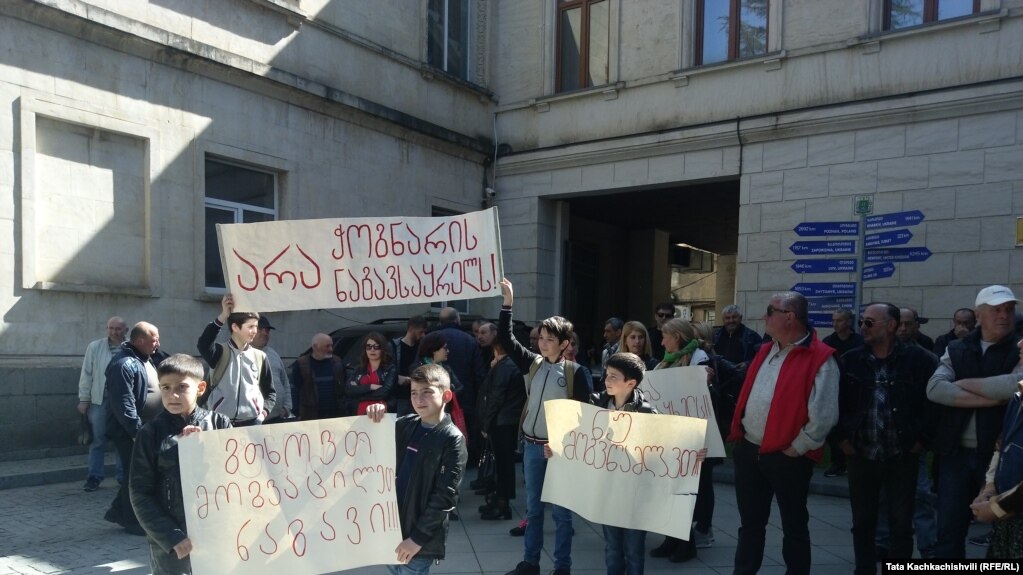
Protests continued. On March 20, residents held their seventh demonstration in Kutaisi, carrying banners reading “No to the Chognari Landfill,” “Remove the Garbage,” and “Don’t Poison Us.” They urged Kutaisi residents to join them, arguing that a landfill serving 700,000 people, located only a few kilometers from the city, would affect them as well.
On May 15, 2019, the Solid Waste Management Company announced it was suspending construction of the regional landfill in Chognari. According to the company’s adviser, Khatuna Chikviladze, officials were now searching for an alternative location that would better meet environmental and geological requirements.