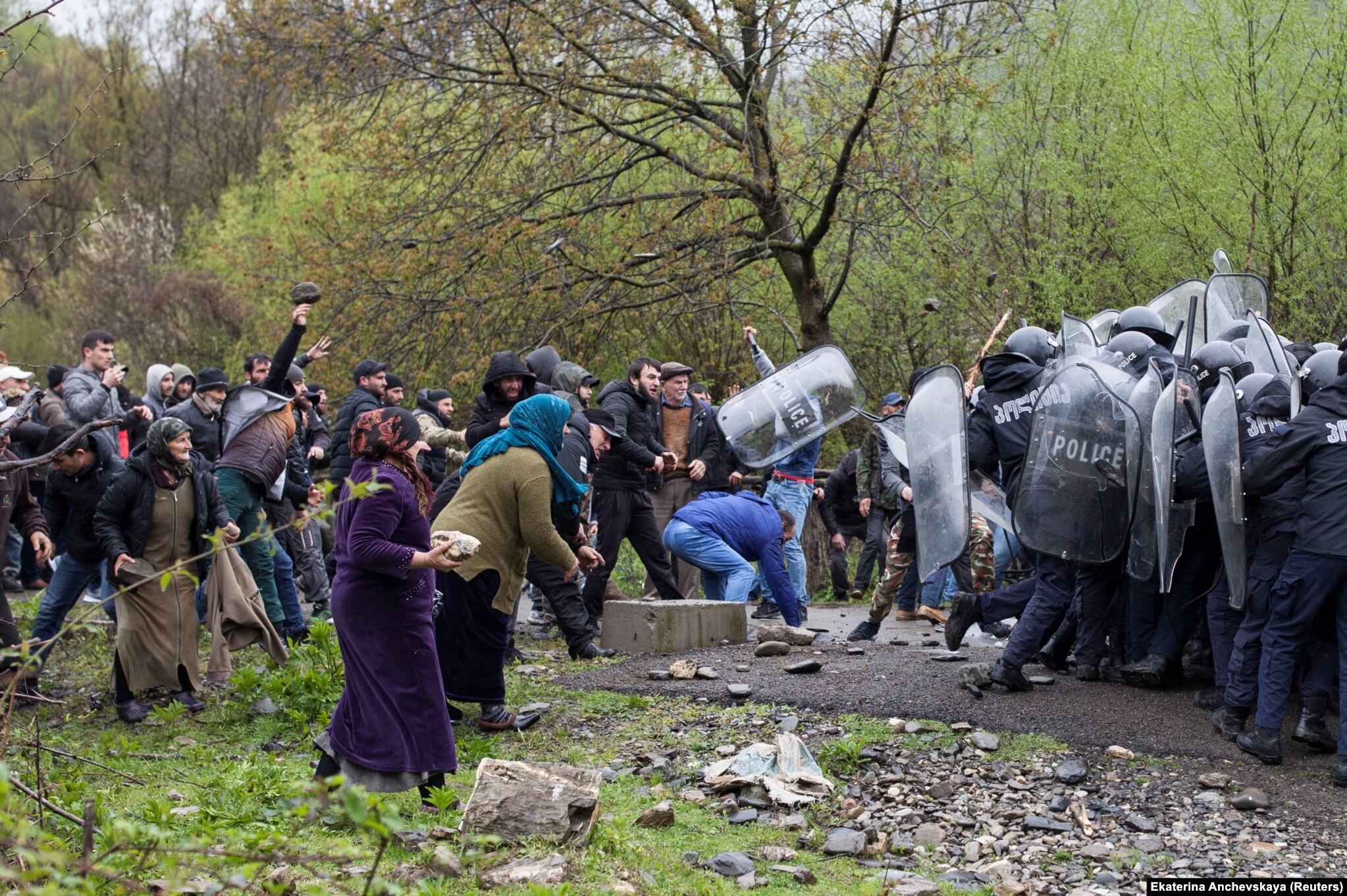
Protest In Pankisi against HPP

2019

This AI-generated translation may not be completely accurate.
Protest In Pankisi against HPP
In 2017, the Ministry of Economy of Georgia granted permission for the construction of three hydropower plants in the Pankisi Valley. Two of them, Khadori 1 and Khadori 2, were completed, while the construction of Khadori 3 was suspended after the NGO Human Rights Education and Monitoring Center (now the Social Justice Center) challenged the permit in court. The organization argued that the environmental impact assessment failed to consider the cumulative risks posed by all three plants.
Khadori 3 was being built by Alazani Energy near the village of Birkiani. According to the project, about 90 percent of the river’s flow would be diverted into a 4.5 km-long pipeline. Locals complained that this would reduce water levels, harming pastures and worsening the existing drinking water shortage. From the start, residents opposed the cascade of hydropower plants. On February 2, 2019, Pankisi residents gathered again to express their dissatisfaction and sent a letter to the prime minister requesting his intervention.
Locals believed that the environmental effects of the construction, especially on the water supply, had not been properly studied. The Pankisi Valley depends on the Alazani River for both drinking and irrigation water, and residents feared that the hydropower project would make the water insufficient for either purpose, rendering life in the area unviable.
On April 21, 2019, the appearance of a tractor in the valley signaled the beginning of the project’s construction, sparking protests and clashes with police. Locals vowed to continue their resistance and began round-the-clock shifts to monitor the site.
The Ministry of Internal Affairs deployed police and special forces to the area. Following early-morning clashes between protesters and police, government representatives — including Interior Minister Giorgi Gakharia, Regional Development and Infrastructure Minister Maia Tskitishvili, and Environment Minister Levan Davitashvili — traveled to Telavi to discuss the situation.
While the ministers met with community elders, tensions in the valley escalated. Locals threw stones at police, prompting special forces to use tear gas and rubber bullets twice. Protesters responded with stones and sticks. According to the Interior Ministry, 55 people were injured during the confrontation, including 38 police officers.
After meeting with the elders, Interior Minister Gakharia announced that the hydropower plant would not be built unless 90 percent of the local population supported it. The ministry launched an investigation into the attacks on police and the damage to police vehicles.
That same day, a small group of citizens gathered in Batumi holding signs reading “The System is Violent,” “No to HPPs,” and “Adjara Stands with You.” The activists expressed solidarity with the residents of Pankisi and condemned the police’s violent actions during the clashes.