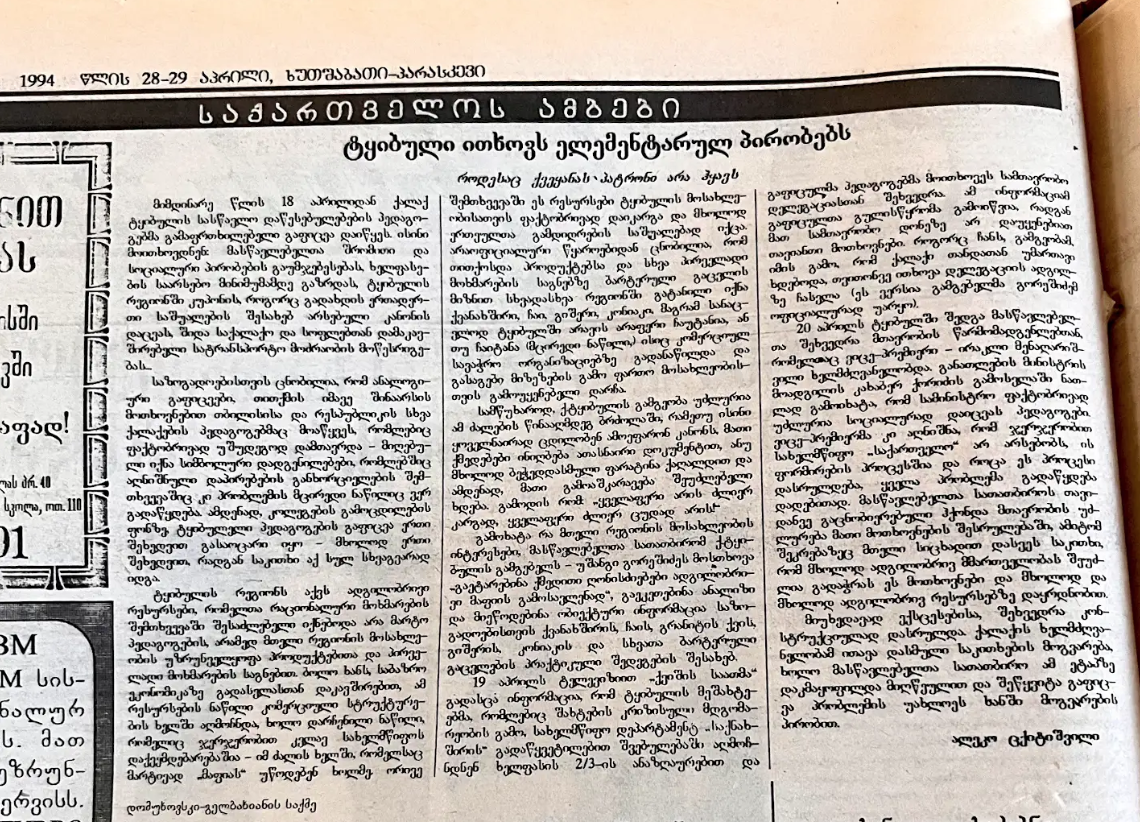
Teachers’ Strike in Tkibuli

1994

This AI-generated translation may not be completely accurate.
Teachers’ Strike in Tkibuli
On April 18, 1994, teachers from educational institutions in Tkibuli launched a warning strike. They demanded improved working and social conditions, salary increases to at least the subsistence minimum, enforcement of the law on using the coupon as the sole means of payment in the Tkibuli region, and the regulation of public transportation within the city and to nearby villages. Similar teacher strikes had already taken place in Tbilisi and other regions with identical demands, but they ended unsuccessfully, resulting only in symbolic resolutions that could not solve the problems.
According to the newspaper Resonansi, the Tkibuli teachers’ strike differed from others in one important aspect: the Tkibuli district possessed local resources that, if used rationally, could provide not only for teachers but also for the entire regional population with food and basic goods. With the transition to a market economy, part of these resources ended up in the hands of commercial structures, while the rest, still under state control, fell into the grip of the “mafia.” “In both cases, these resources were practically lost to the people of Tkibuli and became merely a source of enrichment for a few individuals. Unofficial sources suggest that coal, tea, obsidian, and brandy were sent to other regions for barter exchanges involving food and basic goods, but nothing was ever brought back to Tkibuli in return,” wrote journalist Aleko Tsqitishvili.
The teachers’ council demanded that Tkibuli governor Ushangi Goreshidze take effective measures to expose the mafia and disclose information about the barter exchanges. Striking teachers also requested a meeting with a government delegation. On April 20, the teachers met with government representatives led by Vice Premier Irakli Menagharishvili. Resonance reported: “In the speech of Deputy Minister of Education Kakhaber Khoridze, it became clear that the ministry was practically powerless to provide social protection for teachers. The vice premier, meanwhile, noted that the state of ‘Georgia’ does not exist; it is still in the process of formation, and when this process is completed, all problems will be resolved positively.”