Ukraine Solidarity Rally

2022

This AI-generated translation may not be completely accurate.
Ukraine Solidarity Rally
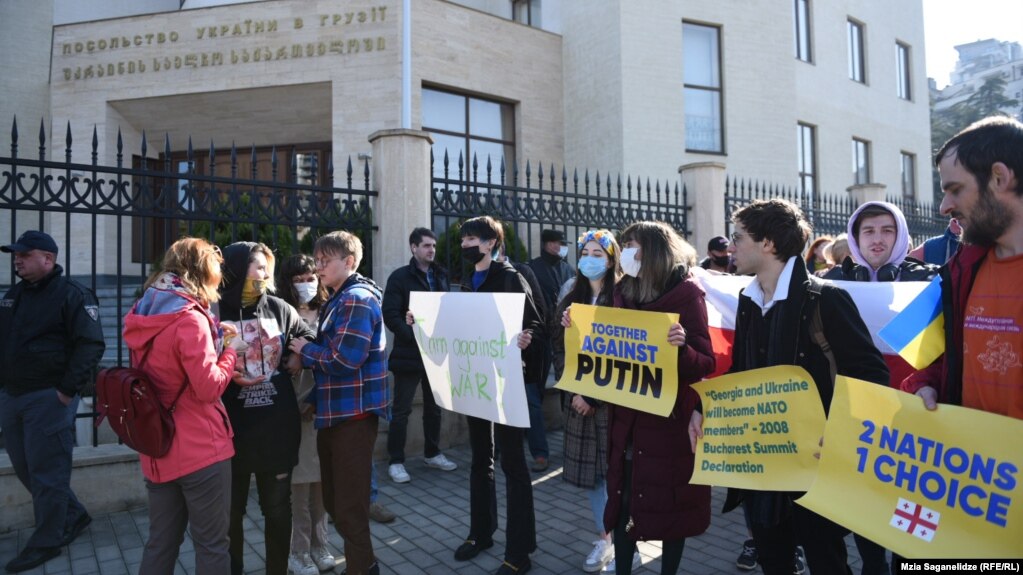
On the morning of February 24, 2022, Russia launched a full-scale invasion of Ukraine. Russian President Vladimir Putin called it a “special military operation,” claiming its purpose was to “protect people” who had allegedly been suffering from “genocide by the Kyiv regime” for eight years. Just days before the invasion, Putin had recognized the so-called independence of two Ukrainian territories — the “People’s Republics” of Luhansk and Donetsk. Because of this recognition, a solidarity rally was already held outside the Ukrainian Embassy in Tbilisi on February 22, but a much larger protest began on the very first day of the invasion. Demonstrations took place in various Georgian cities — Tbilisi, Batumi, Zugdidi, and Gori.
On the second day of the war, Georgian Prime Minister Irakli Garibashvili announced that Georgia, “considering national interests,” would not join international sanctions against Russia. He also said that visiting Ukraine would “not achieve anything.” In response, Ukrainian MP Oleksiy Honcharenko reminded him that during the August 2008 war, the Ukrainian president had stood on Rustaveli Avenue alongside the Georgian people.
That same day, a protest demanding the prime minister’s resignation was held outside the Government Administration of Georgia, after which large crowds moved to the Parliament building, where demonstrations continued for several days. On February 27, a Russian citizen publicly burned their passport.
The protesters gathered on Rustaveli Avenue demanded that Georgia show stronger solidarity with Ukraine, express clear support for the friendly nation, and take concrete steps to help, including closing its airspace to Russian planes and applying for EU membership.
On March 1, the sixth day of the war, Ukraine — Georgia’s longtime partner — recalled its ambassador from Tbilisi, citing the Georgian government’s “immoral position” regarding sanctions against Russia and its obstruction of volunteers who wanted to go fight in Ukraine. Government officials tried to portray the situation as if the West were pressuring Georgia to join the war against Russia, which they said justified staying out of sanctions.
Prime Minister Garibashvili (claiming “Today the same people are shouting at us to join the war, to impose sanctions on Russia, to take part in the war in Ukraine, and so on…”) and the Head of the Government Administration, Ilia Darchiashvili, claimed that the opposition party, the United National Movement, wanted Georgia to enter the war by sanctioning Russia. Darchiashvili stated in a video address that Georgia had sent 100 tons of humanitarian aid to Ukraine, and thus, he could not understand the ambassador’s recall decision.
Ordinary Georgians began collecting food and clothing to support Ukrainians affected by the war — bringing preserved fruits, pickles, jams, non-perishable goods, and hygiene items. Companies and educational institutions joined the effort as well.
On March 4, protesters were addressed by both the Georgian and Ukrainian presidents. That day’s rally was organized by the TV company Formula, which also established a charitable fund and donated 500,000 GEL — an amount that later grew to 677,000 GEL. The Georgian Public Broadcaster also held a telethon, raising about 700,000 GEL. Other media outlets expressed solidarity by coloring their logos in the blue and yellow of the Ukrainian flag. With help from international partners, a platform called Dopomoga Ukraini (“Help for Ukraine”) was created to provide information about available services for Ukrainians in Georgia.
On April 6, a performance protest was held outside Parliament in memory of civilians killed by occupying forces in Bucha and other Ukrainian cities — protesters lay on the ground representing the hand-bound bodies seen in the photos from Bucha.
On December 6, Andriy Kasianov, Ukraine’s acting ambassador to Georgia, held a briefing stating that the Georgian government had ignored requests to help with power generators. On December 22, Georgia sent 25 high-capacity generators to Ukraine.
Despite Georgia’s participation in several pro-Ukraine international documents and the dispatch of humanitarian aid, many citizens still felt that the Georgian government was not standing firmly enough by Ukraine because of the tone and content of statements made by the ruling Georgian Dream leaders.
A rally in support of the Ukrainian people was also held in Georgia on the first anniversary of the war’s outbreak.