Shooting at Rallies Supporting Gamsakhurdia

1992
This AI-generated translation may not be completely accurate.
Shooting at Rallies Supporting Gamsakhurdia
By January 1992, a civil war was underway in Tbilisi, the country was ruled by “Mkhedrioni” under the leadership of Jaba Ioseliani and “Gvardia” under the leadership of Tengiz Kitovani.
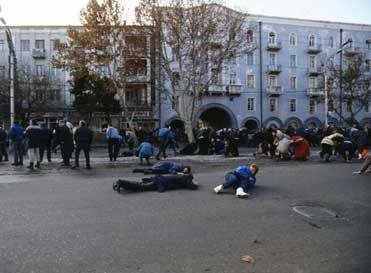
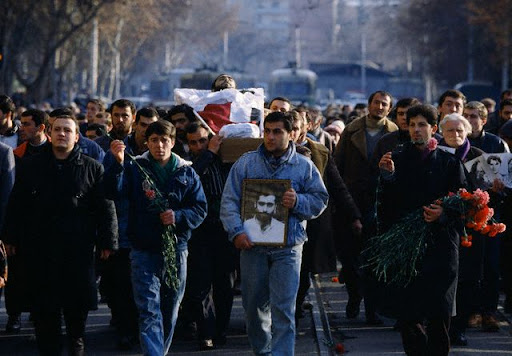
By January 3, President Zviad Gamsakhurdia was taking refuge in a bunker with his supporters. Outside, a rally in his support was held near the Didube metro station. “Zvi-a-di!” were heard. They demanded the return of power to the legitimate government. Suddenly, masked young men dressed in civilian clothes drove into the rally in cars and opened fire on them. Dozens of people were injured and 6 were killed, they were: Givi Rekhviashvili, Levan Taktakishvili, Gizo Khatiashvili, Tristan Tseradze, Guram Dolidze, Kakha Arsenidze. The bullets also hit random passers-by.
Just 7 months after being elected President of Georgia, on January 6, 1992, at dawn, Zviad Gamsakhurdia emerged from the bunker where he had been for several months, accompanied by two full buses and cars, and left Georgia with the government and some of his associates.
January 7th rally
The next day, his supporters gathered at the railway station square. Among them were members of the St. Ilia the Righteous Society, who had decided to peacefully protest the overthrow of Zviad Gamsakhurdia’s government in the streets of Tbilisi. They referred to it as the “national government” and wanted to show their intransigence to the de facto government, which they referred to as the “military junta.”
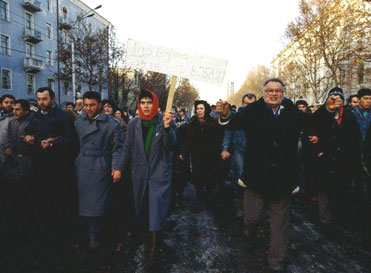
“Shooting began from the direction of Queen Tamar Avenue. The black-masked men fired into the air for a long time to intimidate the people. Despite the danger, thanks to the organization provided by the members of the St. Ilia the Righteous Society, the gathered crowd moved from the station towards Heroes’ Square. The people chanted: “Disobedience”, “Georgia”, “Down with the junta”, “Zviad”, “Merab” – recalls the protest participant Khatia Ghudushauri.
Since the streets leading to the Philharmonic and the University were blocked by armed individuals, the demonstration turned from Heroes’ Square to the television building and continued its march along Konstantine Gamsakhurdia Avenue (Pekini Street).
Khatia Ghudushauri writes that snipers were standing on the roofs of the buildings on the avenue, they were armed with machine guns They had set up and aimed low, for the march. “The dispersal of the march began with so-called Molotov cocktails (“smoke bombs”), which were thrown at the feet of the participants of the demonstration by armed putschists, machine guns were fired from the roofs of the buildings, the bullets of which fell on our feet. Despite the physical danger, the people encouraged each other with shouts and continued the march in the direction of the Delhi metro. On the way, we held a rally in front of the Abkhaz Hotel, and at that time we asked the refugees from Samachablo to join the demonstration,” recalls Khatia Ghudushauri.
The protesters were dispersed again near the Delisi metro station – they opened fire in their direction.
There is no information about the events of January 3-7 in the Georgian press of that time. At that time, representatives of the international media had already arrived in Tbilisi, and it was precisely through their lenses that these rallies were captured. Khatia Ghudushauri recalls that during the January 7 rally, “a blonde foreign female reporter who was filming the march was dragged by her hair and her video camera was broken, and the cameras of the photojournalists were taken from their cameras and their cameras were broken.” As a result of this shooting, one person died and several were injured.
“Christmas “After the brutal crackdown, people who came to the demonstration had their names and addresses written on a piece of paper in their pockets or embroidered on the belt of their trousers or dresses. No one knew who, when and where the putschists’ bullets would hit them… if only the shot dead could be identified in the morgue in time,” Khatia Ghudushauri writes.
Rallies after January 7
The people did not stop the raids, at that time a state of emergency was declared in Tbilisi and rallies and demonstrations were officially banned, however, the people did not obey those in power, did not recognize their orders – supporters of Zviad Gamsakhurdia constantly gathered at the Railway Station Square and demanded a change of regime. From time to time, the protesters were detained for several days.
Rallies were also held in Western Georgia. A strike committee was also created in Abkhazia, where they organized rallies. According to the newspaper “7 Days”, on January 9, at a rally held by the Georgian population in Sukhumi, Vladislav Ardzinba, the chairman of the parliament of the separatist Republic of Abkhazia, made a speech, stating that the Abkhazian government does not recognize the existing government of Georgia and considers it illegitimate. However, as the newspaper writes, according to other sources, a telephone conversation took place between Ardzinba and Tengiz Sigua (the acting Prime Minister of Georgia), in which Ardzinba expressed full confidence in the new government.
At one of the Sukhumi demonstrations, the ministers who were in Gamsakhurdia’s government and then remained in the same positions were declared “traitors to the nation”. The strikers demanded the resignation of the illegitimate government and the return of former President Zviad Gamsakhurdia. Otherwise, they threatened to declare disobedience to the interim government, and Western Georgia would separate from Eastern Georgia and declare itself a separate republic.
On January 30, supporters of the ex-president and the interim government clashed with stones and cold water cannons in front of the Georgian government building (7 Pavle Ingorokva Street).
On February 1, a large-scale demonstration was held. The people set off from the railway station square and headed towards Rustaveli Avenue. According to various sources, the number of demonstrators reached 200 thousand. That day, a member of the Military Council, Jaba Ioseliani, declared that “the provocateur will be shot on the spot…Democracy is not a lie, we are showing what democracy is.”
Shooting at the February 2 rally
The next day, demonstrators gathered at the railway station square and marched towards Rustaveli. According to eyewitnesses, there were so many participants in the rally that when the front lines approached the circus, the last were still at the railway station square. The clash began right at the circus.
The newspaper “7 Days” wrote that the protesters “were confronted by representatives of the Tbilisi Commandant’s Office. The water cannons were followed by firearms.”
“They poured water on the people. At that moment I heard shots. They were shooting in the air. It happened suddenly, but the people were not scared, they even clapped their hands, in general, the water and the shooting in the air caused general joy. In the meantime, the shooting intensified, but no one was scared… Then the bullets started to shoot out the windows of the buses… We all lay on the ground,” an eyewitness told the newspaper “Drons”.
Eka Kherkheulidze, a participant in the demonstration, later recalled: “The protesters were met by buses, “battlefields” and tanks near the circus. There were also people armed with machine guns standing nearby. Eyewitnesses say that when the shooting started, no one ran away at first, they thought they were shooting rubber bullets. Soon, the bloodied protesters fell like corpses – the bullets were real.”
After the people at the bridge were shot, the protesters turned back and headed towards the Marjanishvili metro station. The armed men met them there too.
According to official reports, 35 were wounded and 2 were killed, – the newspaper “7 Days” wrote at the time. This number is not specified, however, according to other reports, 23 people were killed and 183 were wounded.
Among them was 17-year-old Mamuka Terishvili, who led the demonstrators with a flag. His brother Gia Terishvili was arrested during the pro-European protests that began on November 28, 2024 and charged with “organizing a group action” and sentenced to 2 years by Judge Nino Galustashvili.
The wounded themselves say that hospitals were forbidden to admit them And doctors did not treat. Even the sick were told not to make any noise if they wanted to be carried away dead.
The events of January-February 1992 are almost not visible in the Georgian press, except for a few reports collected here. After February 2, fragmentary reports and information spread by the military commandant are published, where the first shot is blamed on the protesters.The next day, February 3, only a few hundred people gathered near the university. Shooting broke out here too. According to the newspaper “Droni”, “they were members of the organization “Orbi” and were sent from the commandant’s office to disperse the people gathered near the university. In short, nothing new happened in the university yard that day, February 3. They dispersed the rally. There was shooting. This is it and this is it.”