September 2nd Raid and Rallies Before the Civil War

1991

This AI-generated translation may not be completely accurate.
September 2nd Raid and Rallies Before the Civil War
On August 18, 1991, a military coup attempt began, which went down in history as the “August Putsch”. The word “putsch”, adopted from German, means an attempt to overthrow the government by a small armed group. On this day, the President of the Soviet Union (USSR), Mikhail Gorbachev, was dismissed from office by the so-called State Committee for the State of Emergency – GKChP, which included the Vice-President of the USSR, the Prime Minister, the Chairman of the Security Committee, the Minister of Internal Affairs and the heads of the military-industrial complex. They adopted a resolution declaring the government and governance structures, as well as paramilitary formations, the existence of which contradicted the Constitution of the Soviet Union, to be dissolved. The organizers of the putsch named Gennady Yanayev, the chairman of the State Committee for Emergency Situations and Vice President of the Soviet Union, as Mikhail Gorbachev’s replacement.
After mass protests against the coup in Moscow and other cities, the attempted seizure of power on August 21, 1991, ended in failure. The protests were led by the then President of the Russian Federation, Boris Yeltsin. Mikhail Gorbachev returned to Moscow.
These events also had a major impact on Georgia. On August 19, the President of the Republic of Georgia, Zviad Gamsakhurdia, who was in Kazbegi, urgently returned to Tbilisi and called on citizens to maintain peace, order, and discipline. According to historian Giorgi Arkania. On August 19, the Deputy Minister of Defense of the USSR, General Vladimir Shuravlyov, was already in Tbilisi. At the same time, “units of the Tbilisi garrison of the Transcaucasian Military District established control over the Tbilisi airport and railway station, and Soviet military bases on the territory of Georgia were in full combat readiness. Shuravlyov met with Gamsakhurdia and categorically demanded the abolition of the National Guard, otherwise the Soviet army would destroy the Georgian Guard.” On August 19, 1991, Zviad Gamsakhurdia signed a decree “On the Reorganization of the Internal Troops of the Ministry of Internal Affairs – the National Guard”, according to which the Guard became a subdivision of the special purpose militia, the position of commander was abolished, and the subdivision was subordinated to the Deputy Minister. In fact, the Guard was abolished, and its commander Tengiz Kitovani was dismissed from his post. The former commander and a large part of the National Guard did not obey the president and went first to the Rkoni Gorge, and then to the Tbilisi Sea.
In August 1991, the Georgian National Movement was split into two opposing camps. A significant part of the opposition parties did not participate in the first multi-party elections of October 28, 1990 and elected the Georgian National Congress. The parties participating in the Congress considered the reorganization of the National Guard a retreat by the government.
In the end, the GKChP was defeated on August 22. The putsch did not take place. All the putschists were arrested, although, as Radio Liberty writes, the events that took place on the “August Three” days still had a decisive impact on the fate of Georgia. It was from this time that a powerful armed component emerged in the political struggle in the form of the “Kitovani Guard”. In addition, the Prime Minister, Tengiz Sigua, who was dismissed from office on August 17, went into opposition.
Confrontation between the government and the opposition
On September 2, 1991, the opposition to Zviad Gamsakhurdia, the National Democratic Party led by Gia Chanturia, planned an information rally near the Cinema House. Before the rally began, special forces of the Ministry of Internal Affairs blocked traffic in the direction of Rustaveli Avenue and Elbakidze Descent.
The organizers of the rally stood on the stairs in front of the Cinema House. They held banners: “We demand the self-liquidation of the Supreme Council”, “Freedom to political prisoners”, “Freedom to the mass media”. About 400 people gathered.
When the protesters decided to set up a loudspeaker, a scuffle broke out between them and the special forces unit of the militia (then the police) called “OMON”. The confrontation escalated into a fight. The protesters greeted the appearance of the OMON with shouts of “Cha u shes ku!”
The OMON threw batons at the protesters. They repelled the first attack and temporarily pushed them back. The protesters “threw stones and rocks at the retreating protesters along with cursing and swearing.”
A couple of minutes later, the OMON attacked the protesters again. They also fired firearms. The people scattered, but no one went far. The OMON lined up on the stairs. The people again threw stones at them. Sticks. The riot police returned fire again. Eventually, the riot police left the square.
Three citizens were wounded by gunfire, two in the legs and one in the chest. Several people, including riot police officers, suffered minor and less serious injuries. The police officers, who had blocked Rustaveli Avenue and Elbakidze Descent, did not participate in the clash.
Despite the crackdown, the rally was held anyway. The speakers demanded the resignation of the Supreme Council, the government, and the President of Georgia, Zviad Gamsakhurdia. There were more radical demands. The participants of the rally – their number already reached several thousand – met such demands with applause.
At about half past eight in the evening, the protesters headed to the Sakteleradio department (that was the name of the state television, today’s Public Broadcaster). They demanded that information about the incident be broadcast on television, which was categorically refused.
State television covered the news in favor of the government, saying that the protesters themselves were violent, and that the information about the wounded was a lie. However, there were employees working at the television who were also dissatisfied with the authorities.
According to the TV station’s political commentator, Valeri Kvaratskhelia, a group of employees appealed to the TV station’s management, demanding that “there be no more informational and analytical vacuum on the screen and in radio broadcasts, so that people would not only hear the official government’s opinion or rumors about a particular event, but also the demands of the opposition.” They also demanded that journalists be no longer restricted. More than seventy people signed the appeal.
The rally was dispersed in the hope that the broadcaster would be guided by the “principles of a democratic press” in the future. However, the promise was not kept.
As Dodo Shonava, a journalist at the time, told Radio Liberty, Gamsakhurdia’s government disconnected the broadcast from the tower due to a critical story aired in Moambe, and some of the employees moved to the Supreme Council building, after which the television station broadcast from the Supreme Council, not from its own building.
Protesters dissatisfied with the coverage continued their demonstration in front of the television station and picketed the entrance. “If the television station were opened, if the government’s dictate over the mass media were finally lifted, all processes would then proceed peacefully,” Zurab Zhvania, who was the head of the Georgian Greens party at the time, addressed those gathered on the steps of the television station.
The television station split in two.
Some of the television station’s employees went on strike, joined the protesters, and sat on the steps of the television station.
The protests took on a permanent character.
Rallies, barricades, tents…
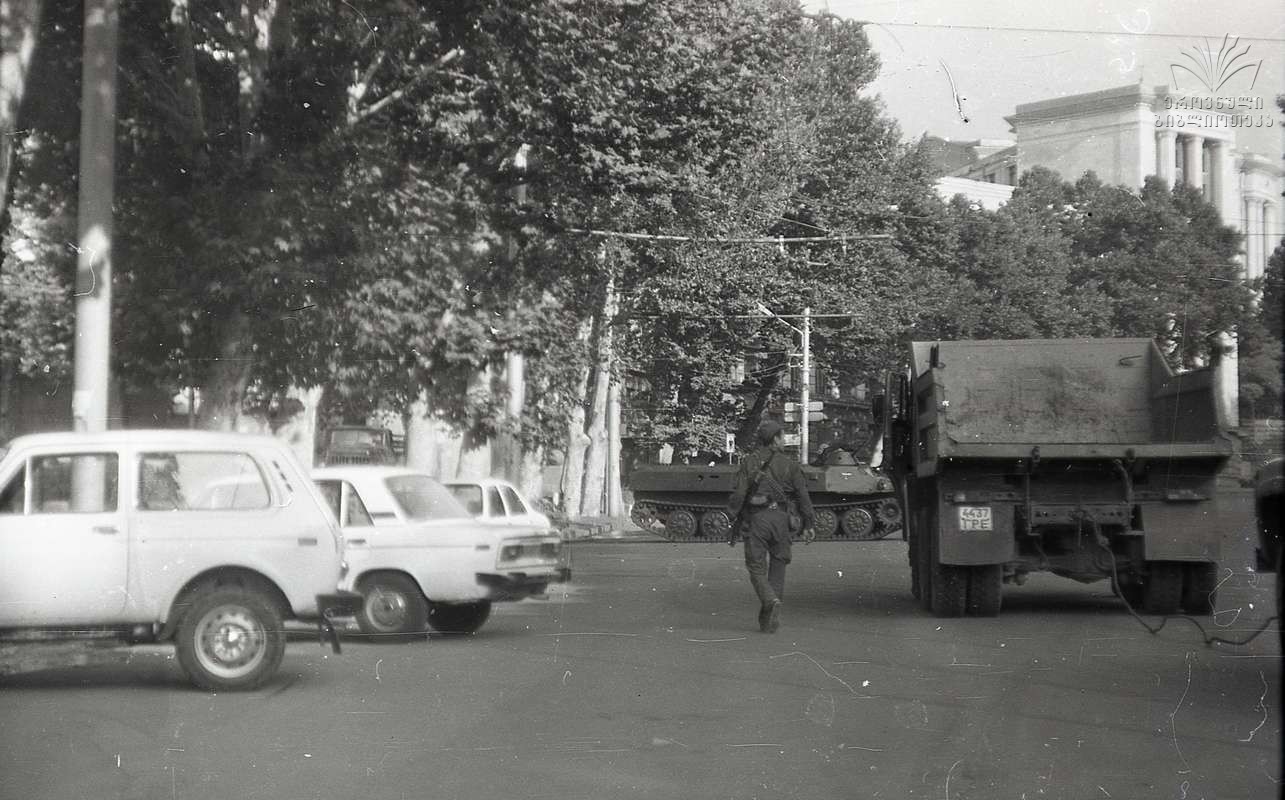
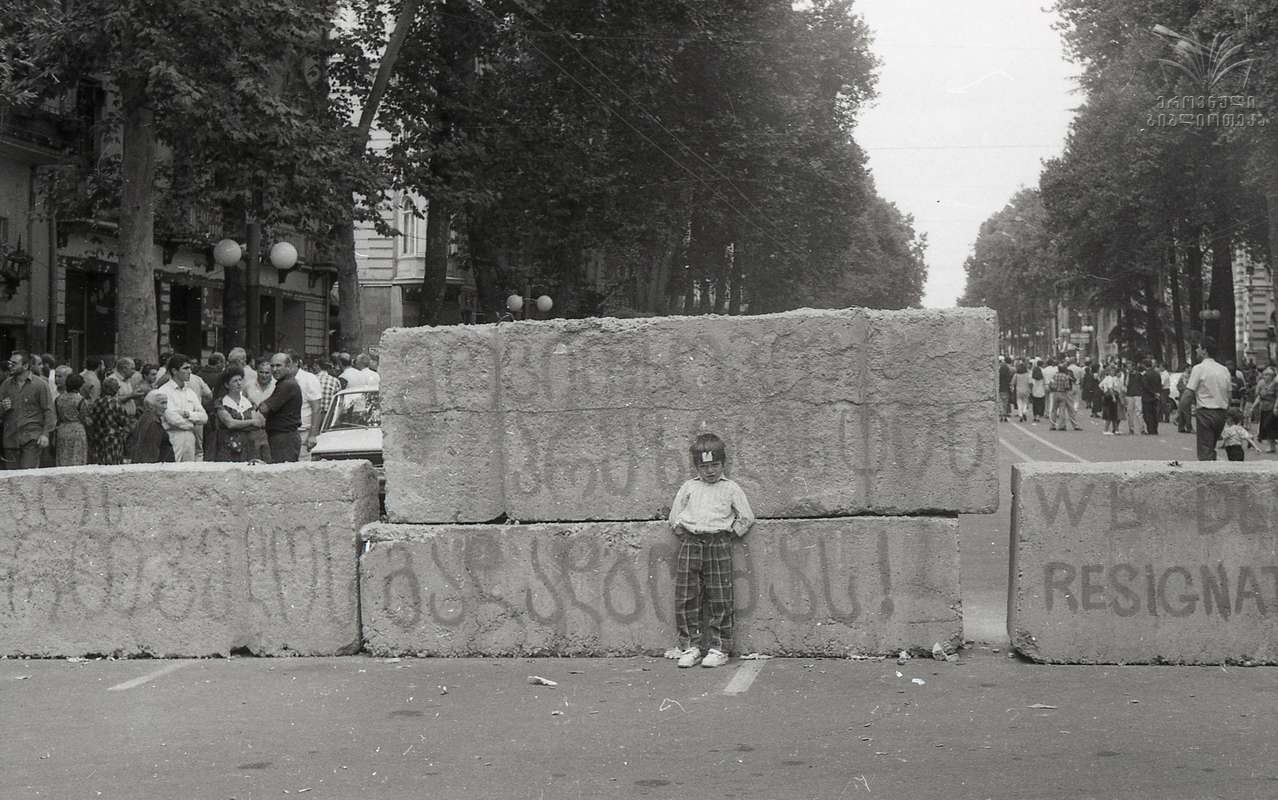
In parallel with the opposition, the government was also gathering its supporters. By September 9, Rustaveli Avenue was blocked in three places by minibuses. Citizens and militia units were brought from the regions in an organized manner to attend the rally. Powerful loudspeakers were working. At the rally, Minister of Internal Affairs Dilar Khabuliani “sworn publicly that he was not guilty of the events of September 2 (when special forces of the militia opened fire on protesters)”. According to Khabuliani, this was a provocation and added that after the investigation is completed, “all the guilty will be punished”. Zviad Gamsakhurdia emphasized that “political destabilization in Georgia is being caused by hostile forces controlled from Moscow. The protesters greeted the president’s speech with ovations… Shouts of “Zvi-a-di!” were often heard. “Zvi-a-di!…”
On the same day, a rally was held on Rustaveli Avenue, in front of the Theater Institute, at the initiative of the National Democratic Party of Georgia. Its participants condemned the government’s actions and demanded the resignation of President Gamsakhurdia, because he was leading Georgia “towards dictatorship and totalitarianism.”
According to the participants of this rally, the official government of Georgia was the inspirer of the September 2 tragedy, for which it should be held accountable before the people.
On September 9, the “Temporary Union of Student Youth of Georgia” was created at the initiative of student organizations of 5 higher educational institutions of the republic, as well as the Christian Democratic Association of Georgian Youth. According to them, the union aimed to fight against totalitarianism and authoritarianism in order to establish democracy in Georgia. For this purpose, it resorted to peaceful rallies.
On September 9, Zviad Gamsakhurdia accused Tengiz Kitovani of illegal actions, which were expressed in The Guards were assembled in the Shavnabada area to involve them in the anti-government putsch. The Guards were a military organization of the Ministry of Defense, established in 1990.
The President issued an order calling on the Guards officers to leave Shavnabada and return to the city barracks. However, Kitovani, under the pretext of freeing the media, went to the television station with the Guardsmen and occupied the building. He created an alternative to television at Shavnabada and broadcast from there.
After September 9, at the call of Zviad Gamsakhurdia, supporters of the government gathered near the Government House (now the Parliament Building), where the entrances were blocked by buses and barricades, while the opposition stood at the stairs of the television station and in other places in the city.
On September 10, the former “Imeli” (now the Biltmore Hotel) Another crowded rally was held near the building (Fligel). Representatives of the Georgian intelligentsia participated in it. Speeches were made by Otar Meghvinetukhutsesi, Jansug Charkviani, Lana Ghoghoberidze, Eldar Shengelaia and others.
A monarchist rally was also held in the square near the First School on Rustaveli.
On September 11, a sit-in strike began in the courtyard of the first building of Tbilisi State University at the initiative of the Georgian Green Party, which was joined by representatives of the Georgian intelligentsia. 80 people participated in the action. “When asked how long the strike would continue, the participant of the action, poet Jansugh Charkviani, recalled the dialogue between Zurab and his mother from “Surami Prison”: “Son, is Zurab Saddam?” – Oh, mother, I’m done” and added, “Until we’re done, until then…”
On September 14, film and theater figures held a rally in front of the Cinema House. Among the speakers were Robert Sturua, Eldar Shengelaia, Lana Ghoghoberidze, Ruslan Mikaberidze, Nodar Natadze and others. The rally was also held in front of the Television and Radio Department (State Television).
The “Georgian Women’s Rally” was held in front of the Government House on the same day in support of the government. At the same time, forty-one deputies left the session of the Supreme Council of Georgia in protest. Some of the women supporting the government watched the session from the outside. At the end of the rally, they performed a song based on Akaki Tsereteli’s famous poem with a slight modification: Zviad is Georgia, strings are all of us…
On September 16, two large-scale rallies were held almost simultaneously at Republic Square and near the Government House. Speaking at the rally in front of the Government House, Akaki Asatiani said that recognition of the Republic of Georgia by the countries of the world is not at all necessary, since abroad has already recognized our republic once (in 1918-21). According to him, now all that is needed is the restoration of diplomatic relations. President Zviad Gamsakhurdia called on the gathering to create a revolutionary committee.
Republic Square was filled with opposition protesters. “The number of those gathered clearly exceeded the number of agents and traitors named by Mr. President. Not to mention the “five hundred crazy people” (this is how Mr. President called the opposition representatives in a conversation with foreign correspondents), – writes the newspaper “Droni”. Representatives of the Temporary Union of Student Youth and the Ilia Chavchavadze Society, led by Giorgi Maisuradze and Valeri Vashakidze, who had come from the university yard, joined those gathered at Republic Square.
The rally at Republic Square was led by Eldar Shengelaia, a deputy of the Supreme Council of Georgia. Nodar Natadze, Irakli Tsereteli, Lana Ghoghoberidze, Paata Koghuashvili, Giorgi Maisuradze (on behalf of the students), Giorgi Chanturia and others spoke.
On September 16, the leader of the EDEPE, Gia Chanturia, who was flying to Moscow, was taken off a plane and arrested. This was followed by other arrests, including the arrest of popular TV journalist Valeri Kvaratskhelia.
Two days later, on September 18, a multi-thousand-strong rally of government supporters was held again near the Government Palace. Mukhran Machavariani, as the chairman of the board of the Writers’ Union of Georgia, noted that only a few disgruntled Soviet intellectuals are on the opposition side today. That the opposition does not want a constructive dialogue with the government and they stubbornly demand the resignation of the president.
As the press wrote, “In Tbilisi now, in some places there are barricades, in others tents and folding beds, in others only radical slogans.” Nevertheless, they danced and sang at the rally.
Although the opposition occupied the building of the TV and Radio Department, their voices were still not heard on the air, because the mast and, accordingly, the television were still controlled by the government.
“It is precisely because of the “information hunger” that part of the Georgian population uncritically, unambiguously perceives the calls broadcast by the Georgian government on radio and television “Everyone to protect the president and parliament!” “And will enthusiastically rush to the capital to support the president (including armed ones),” the press reported.
On September 19, doctor Gia Abesadze set himself on fire in front of the officers’ house on Rustaveli Avenue, protesting the confrontation between the people. “If the reconciliation of Georgians, the revival of Georgia requires a sacrifice, let me be that sacrifice, God forbid, the end,” he wrote in a letter left on the barricades. He died in hospital 48 hours later.
Clashes before the Tbilisi War
The opposition accused the president of a confrontation between the city and the countryside. Zviad Gamsakhurdia himself called the oppositionists “putschists.” The confrontation escalated on September 21, when during the day, the police expelled about forty hunger strikers from the territory in front of the government palace, who were demanding the release of the leader of the National Democratic Party, Giorgi Chanturia, from prison. Later, at about three in the morning, they began to take down the barricades of the National Independence and National Democratic Parties. Government representatives claim that this was a peaceful demonstration and that only civilians participated in it. However, about forty people were hospitalized after the clashes that occurred there. Both the government and the protesters accused each other of initially throwing stones and starting a fight.
After the expulsion of Chanturia and Tsereteli supporters from Rustaveli Avenue, government supporters sat on Rustaveli Avenue. The government barricades remained in the streets – buses and heavy trucks blocked the area around the government palace in three places. The rally of government supporters there did not stop. “The speaker, cheerful shouts, poems and songs replace the speaker. We have witnessed this too, a Georgian celebrates victory over another Georgian (even over the president’s opponent),” the newspaper “Akhalgazrda Iverieli” wrote in its September 24 issue.
Several attempts were made to reach some kind of agreement between government representatives and oppositionists, but to no avail. The students also split up. Some joined the pro-government rallies, while others remained at the university. “The university is a peace zone,” they wrote to the gathered. They said they would do everything to reconcile the opposing sides.
On September 23, a part of the National Guard, which was subordinate to the opposition leader Tengiz Kitovani, arrived in Tbilisi. The president called on the armed opposition to lay down their arms and promised them inviolability.
On September 24, a state of emergency was declared in Tbilisi by decision of the National Security Committee. The work of the Supreme Council was suspended. Colonel Jemal Kutateladze was appointed the military commandant of the city, and general mobilization was declared. Gamsakhurdia stated that destructive forces had become active in Tbilisi, committing numerous illegalities and aiming to overthrow the government. According to the president, if the members of parliament affiliated with them did not separate, he would dissolve the parliament and introduce presidential rule.
On September 25, a clash between the Guard and riot police (militia) took place near the office of the electricity distribution company “Telasi” located on Vani Street in Didube. There are two versions as to why they opened fire – according to MIA representative Valeri Chkheidze, “drunk” Guardsmen attacked the “Telasi” office and broke inside. About twenty opposition “attackers” led by Badri Makharadze opened fire, resulting in the deaths of two MIA representatives and two members of the Guards. Two militiamen (police officers) and one Guardsman were seriously injured. A different version was disseminated by the Guard’s press center. According to their information, the commander of the Ozurgeti battalion of the Guard, Zurab Apkhazava, was taking his family to the hospital in a Guard vehicle due to a stomach ulcer when they noticed a Zugdidi battalion OMON vehicle near the Telasi office, which he informed his comrades about. Five Guardsmen rushed to help. Meanwhile, the OMON, which had captured Apkhazava and his wife, opened fire. The Guardsmen also opened fire. Meanwhile, both Guardsmen and militiamen arrived to help. According to their information, only one Guardsman died and one was wounded.
“Rallies are raging in front of the Government Palace. Near the TV and Radio Department building, in Merab Kostava’s yard, near the Philharmonic. In short, a democratization process is underway, which no one knows how it will end,” the Droni newspaper reported on September 27.
On the night of September 29, the area surrounding the television station and the entire Saburtalo area were shaken by the sound of an explosion. This was followed by shooting that did not stop until the morning. According to Zviad Gamsakhurdia, the “putschists” were responsible for the explosion. According to him, rockets were fired from the circus building at the Ministry of Food Industry and Agriculture (the building on the Kostava slope). The opposition representative, Tengiz Kitovani, said that that night they managed to go on the air of Channel Two, during which two Stringer-type rockets were fired, and the opposition then opened fire in return.
In his book “Georgia: A Political History Since Independence”, Stephen Jones describes the period from September 2 to November 1991 as follows:
“Tbilisi was physically divided. The opposition was fortified in the Philharmonic, Tbilisi State University, the Institute of Marxism-Leninism, and the television studios. Mkhedrioni had set up his headquarters in the Chess Palace. Gamsakhurdia’s forces controlled the Government Palace and other ministry buildings on Rustaveli Avenue. In the surrounding districts of Vake and Vera, the “Red Intelligentsia” and the “Golden Youth” dominated, which Gamsakhurdia could not stand. Rallies were held, checkpoints were set up, and picketing around bonfires took place at night, accompanied by gunfire. The relatively unprestigious districts populated by workers: Gldani, Nadzaladevi and Didube supported Gamsakhurdia.”
The escalation of the military conflict took a dramatic turn in December, when both sides obtained weapons from the Soviet armed forces.
The beginning of the civil war
The events that took place from September 2 were described as a putsch, and the leaders of these events were called putschists. Clashes between government units and armed formations supporting the opposition became permanent, which sometimes resulted in casualties. In all cases, both sides accused each other of opening fire. This is how Tbilisi came to December 20 – on the day when Zviad Gamsakhurdia’s supporters were near the Government House (today’s Parliament building), the opposition gathered its supporters on Republic Square, and Tengiz Sigua, who had taken refuge in Tbilisi from the sea and had come for this rally, addressed them. “I do not call on you to go to the Government House, where a rally of supporters of the president is taking place, but if someone wants to, that is their will,” he told the protesters. They also headed towards Rustaveli Avenue, which was blocked by dump trucks.
The newspaper “Droni” describes the events of that night in detail. According to this article, the opposition brought a sound-amplified vehicle and began its rally near Kashveti. The voices of protesters from both sides could be heard from both sides of the barricades. The opposition brought a heavy-duty vehicle “Krazi” and began to drag the barricades in order to unite both sides. In the evening, Roman Gventsadze, the First Deputy Minister of Internal Affairs, approached the opposition and demanded an end to the active confrontation, in return for which he promised to mediate with the authorities. That evening, the crowd dispersed.
Gventsadze’s promise did not bear fruit, and the next day, December 21, the crowd gathered again. Both rallies began again. The opposition continued to tear down the barricades, which was followed by the shouts of the leader of the pro-government rally that this action would lead to “unforeseen consequences and bloodshed.” The opposition, however, kept repeating that the barricades would be dismantled and the people would unite. In the meantime, the last barricade was also demolished, mixing the people with each other. “They argued a little, talked a lot, and since it was getting dark and cold, they dispersed.” Tengiz Sigua remained on Rustaveli. Bonfires were lit here and there.
As the correspondent of “Droni” Soso Simonishvili describes, they talked until 5 am, and then he went to sleep in his “Zhiguli” parked nearby. Soon he was awakened by terrible shooting, the groans of the wounded could be heard. “They were shooting from the artist’s house and from the palace,” meaning the current parliament building and the building of the Museum of Fine Arts opposite it, on the facade of which an eagle is now depicted. “I don’t know how long this frantic shooting lasted, half an hour or more. The shooting stopped. It seems that the “defenders” of the government also ordered a ceasefire so that the corpses and wounded could be removed from the area,” writes “Droni.”
By midday, the guard camped on the Tbilisi seashore arrived. “They set up a cannon near the artist’s house, they parked large vehicles near the Tbilisi Hotel (today’s Tbilisi Marriott) – the front line passed here. The Guard headquarters was located in the hotel itself. They fired training shells at the Government Palace. The entire Rustaveli was shelled…”
On December 22, 1991, the civil war began, which would last until November 6, 1993.