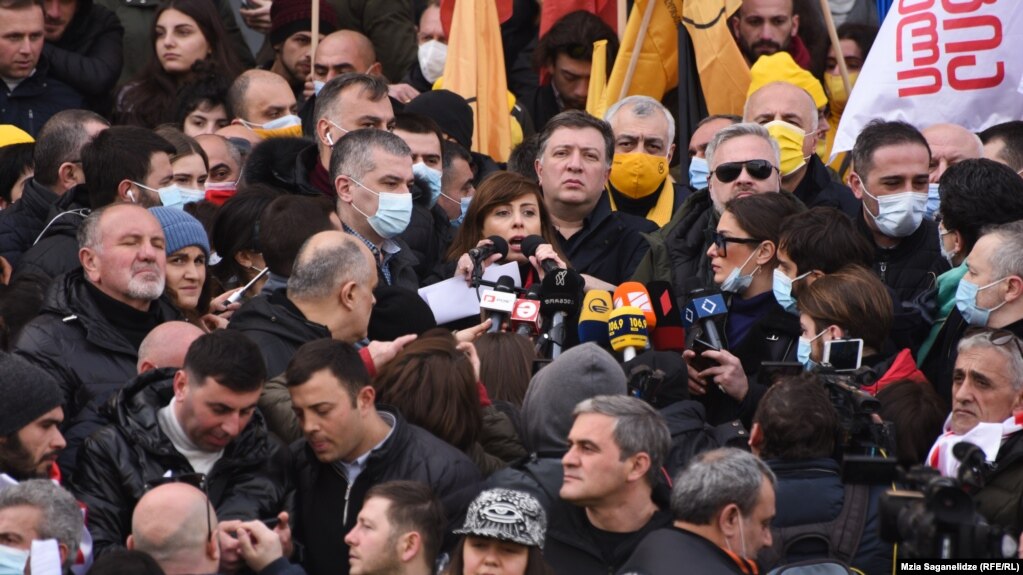
Protest Demanding the Release of Nika Melia

2021

This AI-generated translation may not be completely accurate.
Protest Demanding the Release of Nika Melia
The chairman of the largest opposition party, Nika (Nikanor) Melia, was charged by the Prosecutor’s Office on June 25, 2019, for “organizing and participating in group violence” during the anti-occupation protest near the parliament on June 20–21, 2019 (“Gavrilov’s Night”). According to the prosecution, he attempted to storm the parliament building. On June 27, the Tbilisi City Court imposed a bail of 30,000 GEL and electronic monitoring as a preventive measure.
He wore the ankle monitor until November 1, 2020, when, at a protest on Rustaveli Avenue against the parliamentary elections, he publicly removed it and threw it into the crowd. Because of this, the Prosecutor’s Office requested a change of preventive measure, to increase bail to 100,000 GEL. The court partially granted the request and imposed 40,000 GEL, giving him 50 days to pay. However, Nika Melia did not pay the amount within the deadline nor within the additional week granted by the Prosecutor’s Office. The Prosecutor’s Office again requested a change of preventive measure (from bail to imprisonment), and on February 17, 2021, the court granted the request.
- Since Nika Melia was an acting member of parliament, parliamentary approval was required for his arrest. On February 16, 2021, parliament granted the request of the Prosecutor General with 88 votes in favor and 2 against, stripping Melia of parliamentary immunity.
The discussion began in court at 16:00. Activists brought barbed wire to the parliament building, hung pictures of the Russian MP Sergei Gavrilov, Georgia’s Prime Minister Giorgi Gakharia, and members of “Georgian Dream” on it, and protested the removal of Melia’s immunity.
Meanwhile, firewood and barrels were taken to the central office of the United National Movement. Opposition politicians and their supporters gathered there. Police appeared on February 18 in the morning to arrest Nika Melia. They were not allowed into the building. Later, the Ministry of Internal Affairs postponed Melia’s arrest because Prime Minister Giorgi Gakharia resigned, saying that he could not reach an agreement with the ruling team regarding Melia’s arrest.
The ruling party nominated Irakli Garibashvili as the new Prime Minister, a position he had held years earlier. Speaking about Melia, Garibashvili said the law must be enforced. His appointment caused public dissatisfaction. On February 19, protesters attempted to set up tents in front of parliament, and police detained 20 people.
Nika Melia, other politicians, and supporters gathered at the party office on February 22, when parliament expressed confidence in the new government led by Irakli Garibashvili. Police arrived outside the party office the next morning, February 23, at 07:30. Kakheti Highway, where the office is located, was blocked, and police took full control of the area.
To enter the building, police used special means; they used a crane to reach the roof, cut the door, and entered. 17 people needed medical assistance. Activists and journalists were removed from the building. Despite resistance from supporters, Nika Melia was arrested around 10:00. 21 people were detained that day, including United National Movement leader Giorgi Baramidze. Melia’s arrest triggered sharp reactions from the international community, while Irakli Garibashvili thanked the police.
The political crisis that emerged after the 2020 parliamentary elections intensified further after Nika Melia’s arrest.
Party members set up tents at parliament (a protest was also held in Batumi), and the next rally was announced for February 26. Plans were voiced to blockade various state institutions. Protests were held at Tbilisi City Court (in parallel with Melia’s hearings) and at Rustavi Prison. Young activists carried orange flags and scarves with the inscription FOX (Melia).
To help resolve the political crisis, EU mediator Christian Danielsson arrived in Georgia. In April, the President of the European Council, Charles Michel, visited Georgia, and on April 19, an agreement was signed with his mediation. One of the terms of the agreement was the adoption of an amnesty law, according to which individuals involved in the violence of June 19–20, 2019, including Nika Melia, would no longer face prosecution. One of the last protests in support of Nika Melia was held at Rustavi Prison on April 21.
Before the amnesty law was passed, on May 8, the 40,000 GEL bail was provided by the European Endowment for Democracy and paid through the Georgian Young Lawyers’ Association. The court changed Melia’s preventive measure, and he was released from prison on May 10, 2021.