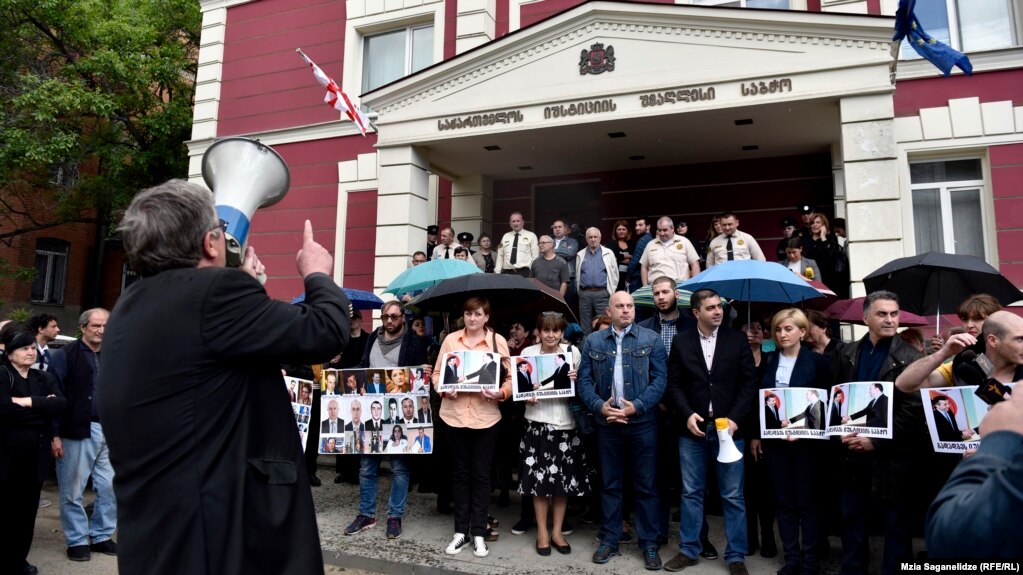
Protest over the appointment of Levan Murusidze as a judge for life

2017

This AI-generated translation may not be completely accurate.
Protest over the appointment of Levan Murusidze as a judge for life
On May 8, 2017, a small group of lawyers, NGO representatives, and opposition party members gathered outside the High Council of Justice of Georgia to protest the planned lifetime appointment of Levan Murusidze — the Council’s secretary and a former Supreme Court judge. Murusidze’s name was associated with several high-profile cases, including the Sandro Girgvliani murder and the torture of Sulkhan Molashvili, for which the European Court of Human Rights later found multiple violations of the European Convention on Human Rights.
Protesters argued that Murusidze’s appointment symbolized the continuation of a politicized and abusive judicial system. “Keeping Levan Murusidze in the judiciary today means political verdicts, political decisions, and the full subordination of the judiciary to the government,” said Zaza Khatiashvili, Chairman of the Georgian Bar Association, in an interview with Radio Liberty.
The High Council of Justice stated that recent amendments to the Law on Common Courts prevented the probationary appointment of a candidate who had previously served as a Supreme Court judge. Therefore, the Council claimed it was legally obligated to halt Murusidze’s evaluation and automatically grant him a lifetime appointment — an interpretation disputed by leading civil society organizations.
The protest ended after two hours when it was announced that the discussion of lifetime appointments for Levan Murusidze and Maia Sulkhanishvili had been postponed indefinitely, as the rapporteur, Council member Shota Getsadze, was scheduled to take a French language exam that day as part of his candidacy for the European Court of Human Rights.
Ultimately, Levan Murusidze was appointed to the position after some time, and his allies — often referred to by critics as the “judicial clan” — further consolidated their influence within the court system.