Pro-European Protests in Georgia

2024

This AI-generated translation may not be completely accurate.
Pro-European Protests in Georgia
Following the October 26, 2024 parliamentary elections, the Central Election Commission declared a majority victory for the ruling party, Georgian Dream. This outcome was immediately rejected by a significant portion of the public, who condemned the results as rigged elections.
Throughout November, mass protests against the “stolen elections” swept through the nation.
In the central districts of Tbilisi, a new symbol of resistance emerged: the “Black Spot” graffiti. Representing the ink that leaked through ballot papers, this image became a viral symbol of vote secrecy violations and election manipulation.
Tensions escalated on November 19 during a rally on Melikishvili Avenue. Law enforcement detained 21-year-old Mate Devidze, who faced criminal charges. Devidze became one of the first of dozens of demonstrators arrested and prosecuted during the crackdown in November and December.
A major rally was organized for November 25, coinciding with the first scheduled parliamentary session. The protest aimed to block MPs from entering the building, though turnout was lower than anticipated.
Despite the unrest, Georgian Dream convened what critics called a “single-party parliament.” Although official results awarded the opposition 60 seats, no opposition members attended the inaugural session. The boycott included major coalitions:
- Coalition for Change (Ahali, Droa, Girchi – More Freedom)
- Unity – National Movement
- Strong Georgia (Lelo, Freedom Square, For the People, Citizens)
- Gakharia for Georgia
Citing election fraud, these parties declared the 11th convocation of parliament illegitimate. While the protests failed to stop the session, public demonstrations began to lose momentum in the following days.
On November 28, the Georgian Dream-led parliament passed a vote of confidence, approving the Cabinet of Ministers headed by Prime Minister Irakli Kobakhidze.
That same evening at 18:15, Prime Minister Kobakhidze delivered an announcement at a party briefing. He declared that the government would remove EU accession negotiations from the agenda until the end of 2028 and refuse all European Union budgetary grants during this period.
28 November 2024 — Beginning of the Mass Protests in Georgia
Within hours of the Georgian Dream party announcing its decision on 28 November 2024, citizens began gathering on Gorgasali Street in Tbilisi, near the party office. Many interpreted Irakli Kobakhidze’s statement as a rejection of Georgia’s Western path — despite Article 78 of the Georgian Constitution, which obliges state institutions to take “all measures” toward EU accession.
Chants of “Slaves,” “Russians,” “Go away” echoed in front of the Georgian Dream office as the crowd grew rapidly. Facebook posts encouraged more people to join the spontaneous protest.
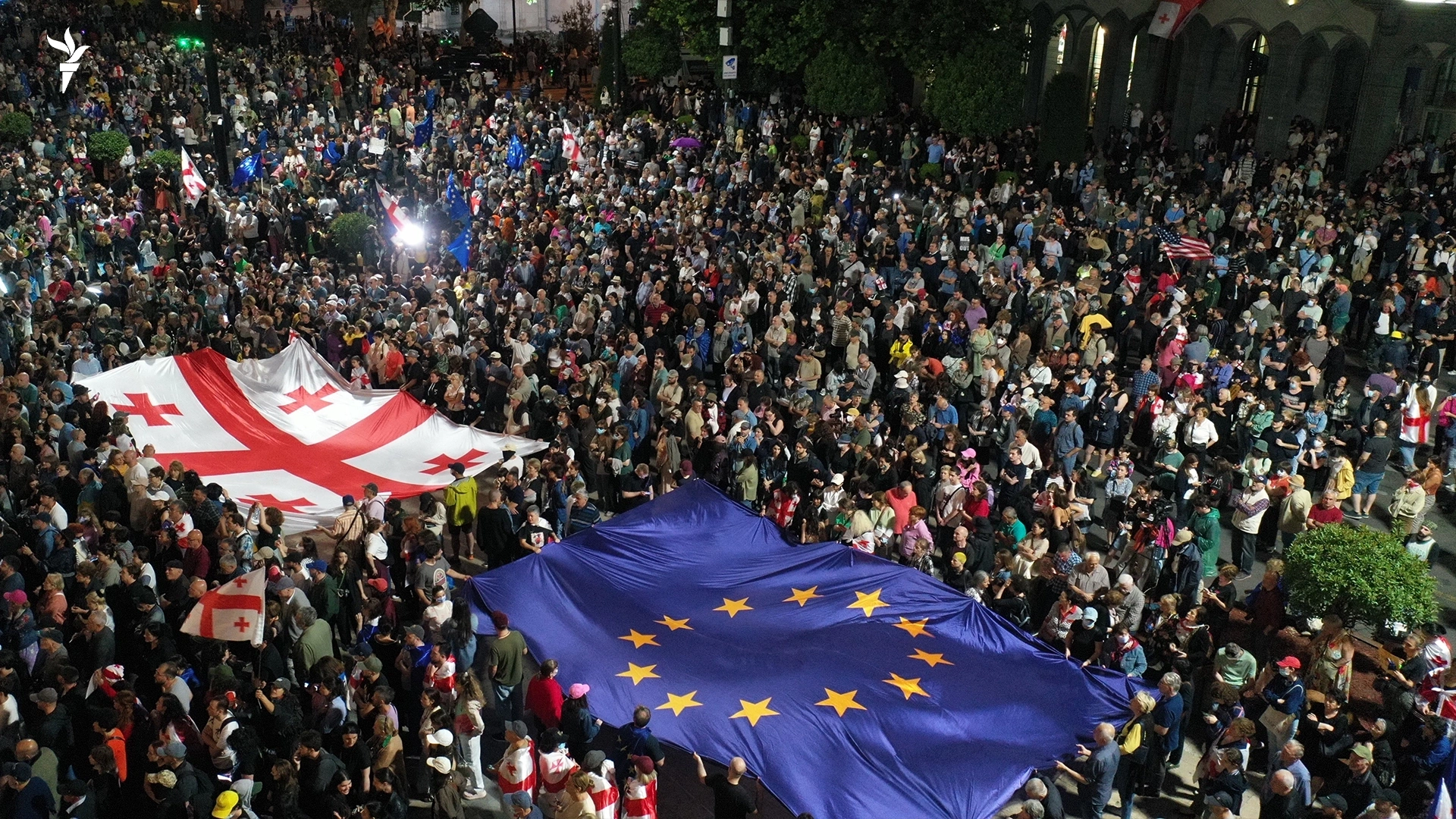
Thousands soon marched toward Parliament and blocked Rustaveli Avenue. Protesters gathered around the metal barricades under the building’s arches, relentlessly pounding them with fists and stones. That same evening, spontaneous solidarity rallies erupted in Gori, Zugdidi, Batumi, Kutaisi, Telavi, and Poti, with demonstrators carrying EU and Georgian flags.
Protesters demanded the arrival of President Salome Zurabishvili, viewing her as an ally. She joined the gathering, declaring: “A resistance begins, one that will not end until we get new elections.” She proceeded to confront the special forces at Freedom Square, asking: “Do you serve Russia or Georgia? To whom did you swear your oath?”
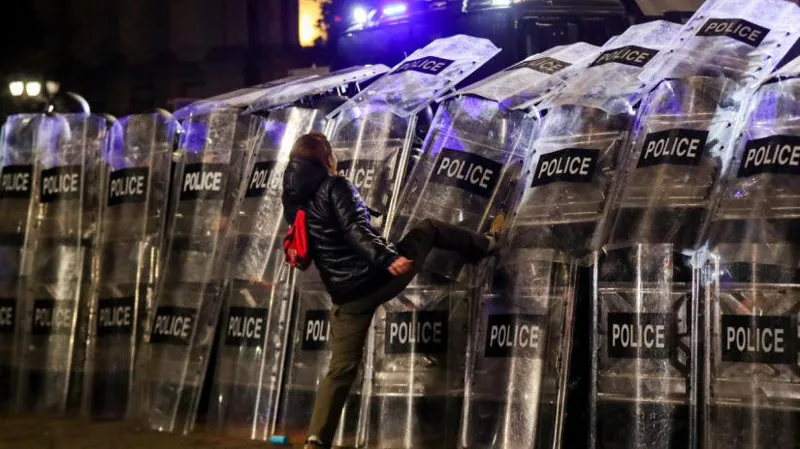
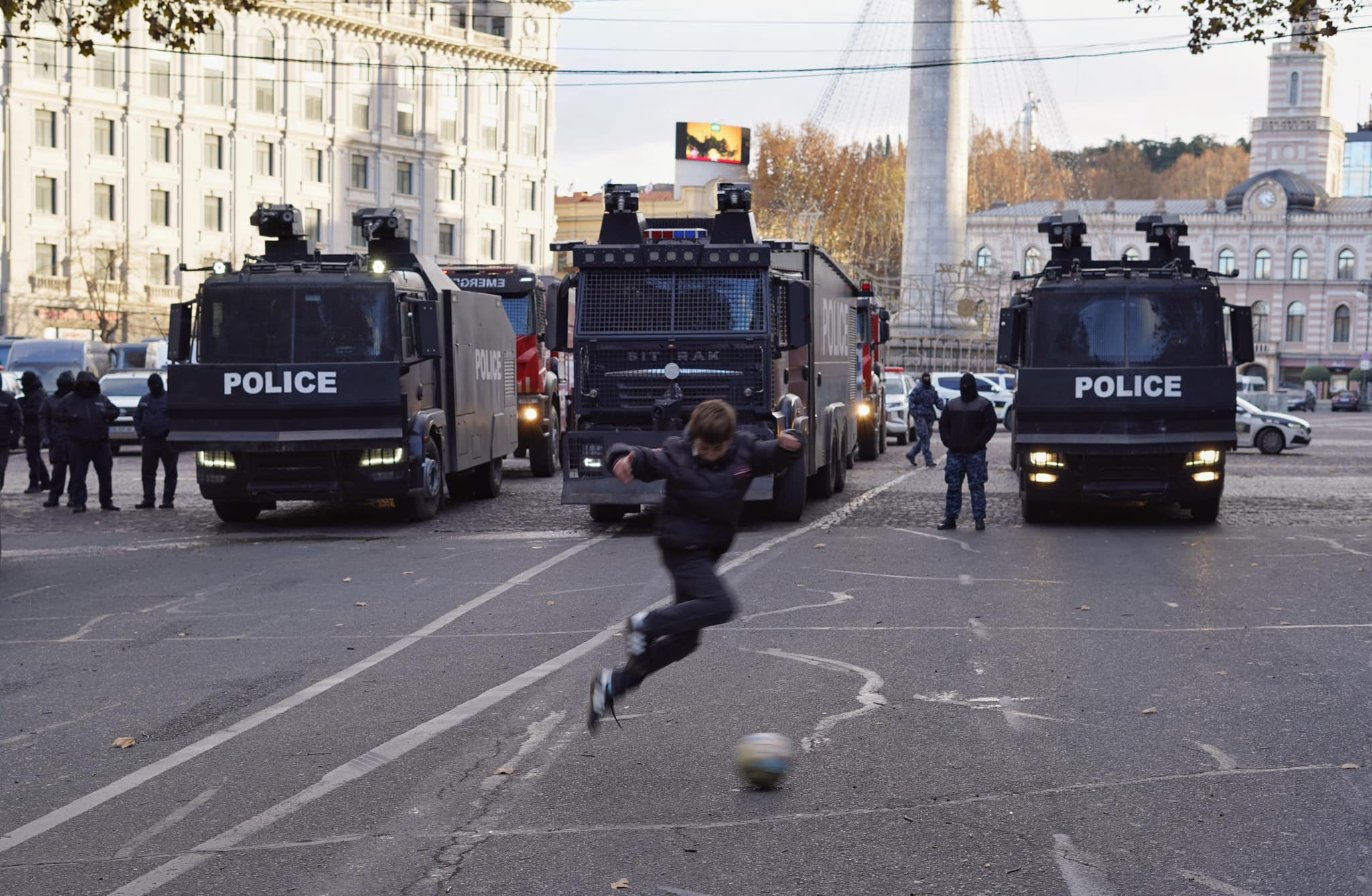
Clashes soon broke out. Protesters dismantled the metal barricades. The Ministry of Internal Affairs claimed the protest had exceeded legal limits and confirmed the use of “special means.” Police deployed water cannons on Rustaveli Avenue and Chichinadze Street. In response, protesters built barricades from trash bins and various objects.
NGOs reacted immediately: GYLA labeled the actions of special forces a dispersal, while My Voice called it inhuman treatment.
That night, Interior Ministry officers violently assaulted numerous people, seriously injuring Publika journalist Aleksandre Keshelashvili (who was also detained) and Formula journalist Guram Rogava. Several other media representatives were harmed as well.
By the morning of 29 November, 43 people had been detained. The Deputy Minister of Internal Affairs, Aleksandre Darakhvelidze, stated that protesters had thrown stones, heavy objects, paint, and eggs at police officers and had “actively used pyrotechnics.”
Escalation of Violence and Mass Demonstrations
On the evening of 29 November, crowds returned to Rustaveli Avenue. For the following months, not a single day passed without a protest; the avenue was blocked almost every evening.
Demonstrations expanded to regions and to Georgian consulates abroad. Tens of thousands demanded new elections and condemned both the suspension of EU negotiations and election fraud.
The government again deployed special forces and water-cannon trucks on the night of 29 November. The Interior Ministry claimed that some demonstrators confronted police, hurled insults, and threw unidentified objects. Protesters rebuilt barricades and set fire to trash bins and other flammable materials, prompting the police to use special means once more. By dawn, officers had dispersed the crowds on Rustaveli Avenue, detaining 107 people. Special forces were also deployed in Batumi, where eight additional protesters were arrested.
The violent dispersal of protesters continued over the following days. Each evening, thousands who regrouped on Rustaveli Avenue were met with tear gas, pepper spray, and water cannons. Many injured demonstrators were taken to clinics, and numerous others were detained. Participants described how special forces violently seized protesters, encircling them and dragging them toward vehicles, where the beatings and abuse continued inside the so-called detention vans. In several instances, officers surrounded crowds while deploying tear gas or pepper spray, creating dangerous crushes. Despite this, groups scattered through nearby streets repeatedly reorganized, and Rustaveli Avenue filled with demonstrators again. Front-line protesters responded by throwing pyrotechnics and various objects, while an increasing number of cities saw citizens take to the streets to voice their anger..
One year later, a BBC investigation revealed that the water used in the cannons contained banned chemical substances. Dozens of protesters developed health issues months after the dispersal.
On 4 December, police raided the opposition party Droa’s office and seized pyrotechnics. Beginning 5 December, police started searching citizens at the entrances of Rustaveli and Freedom Square metro stations.
The protests on Rustaveli had no stage, no speeches. The rhythm of the movement was shaped by laser projections on the Parliament façade — announcing updates, chants, jokes, slogans, and calls to action. This became a core communication method until lasers were eventually banned.
During and after the dispersals, laser messages became as integral to the protests as the constant clanging of stones against the metal barricades at Parliament’s entrance. Later, authorities banned the use of lasers, and the metal fence was replaced with one designed to produce no sound.
In December, men dressed in black appeared at various protest sites, assaulting protesters and journalists. On 7 December, masked attackers beat TV Pirveli journalists live on air near Parliament. Although their identities were quickly confirmed by the TV channel, no one was punished.
The Interior Ministry routinely reported only injured police officers and ignored cases of beaten protesters. Only lawyers spoke about these detainees, reporting that the overcrowded detention facilities were filled mostly with people who had been beaten. Media outlets critical of the government published footage showing Interior Ministry officers brutally assaulting protesters. After their release from administrative detention, visible marks of physical abuse were evident on many individuals. Detainees described being beaten both inside the so-called “detention vans” and beforehand, offering detailed accounts of inhuman treatment.
According to a report published on 6 December 2024 by Transparency International Georgia, around 400 people were detained during the protests that began on 28 November—more than 350 under administrative charges—and over 300 became victims of torture and inhuman treatment.
On 30 January 2025, the Georgian Dream-elected President Mikheil Kavelashvili awarded high-ranking Interior Ministry officials with the Order of Honor — the same officials widely accused of orchestrating brutal violence.
Not a single officer responsible for brutality was punished.
In June 2025, the government abolished the Special Investigation Service, the only body responsible for investigating crimes committed by Interior Ministry employees.
Prisoners of Conscience
During the November–December 2024 protests in Georgia, dozens of people were detained. Some received administrative detention and were released shortly after, while others faced criminal charges. Many were arrested not at protest sites, but at their homes, workplaces, or even removed from vehicles.
The Prosecutor’s Office pressed charges including assault on police officers, group violence, Molotov cocktail attacks, and property damage. Five protesters were arrested for drug possession or trafficking. In total, 47 people were held in pre-trial detention. Two more protesters, Mate Devizde and Anatoli Gigauri, were added to this number for demonstrations against the 2024 election results.
On 12 January 2025, Mzia Amaglobeli, founder and director of Batumelebi newspaper, was arrested twice: the first arrest was for placing a protest stencil on a police barricade. The second happened shortly after, when in the chaos of the demonstration — as police were arresting protesters — Amaglobeli slapped the head of Batumi police, Irakli Dgebuadze. The Prosecutor’s Office classified this as an assault on a police officer, and the court ordered her pre-trial detention. Amaglobeli stated that after her arrest, Dgebuadze spat in her face and treated her in a degrading manner, but no agency responded to this complaint. She remained in pre-trial detention.
In total, 50 protesters were imprisoned — mostly young people, including students, doctors, artists, and professionals from various fields. These detainees became known as “prisoners of conscience”. Alongside the demand for new elections, protesters called for: “Freedom for the prisoners of conscience!”
Some detainees staged extreme forms of protest. Mzia Amaglobeli went on a 38-day hunger strike. In solidarity, other prisoners joined, though health issues forced them to stop. Temur Katamadze, a non-Georgian citizen, who was charged with violating residence rules, went on hunger strike for 48 days.
Mass Protests, Marches, and Street Performances
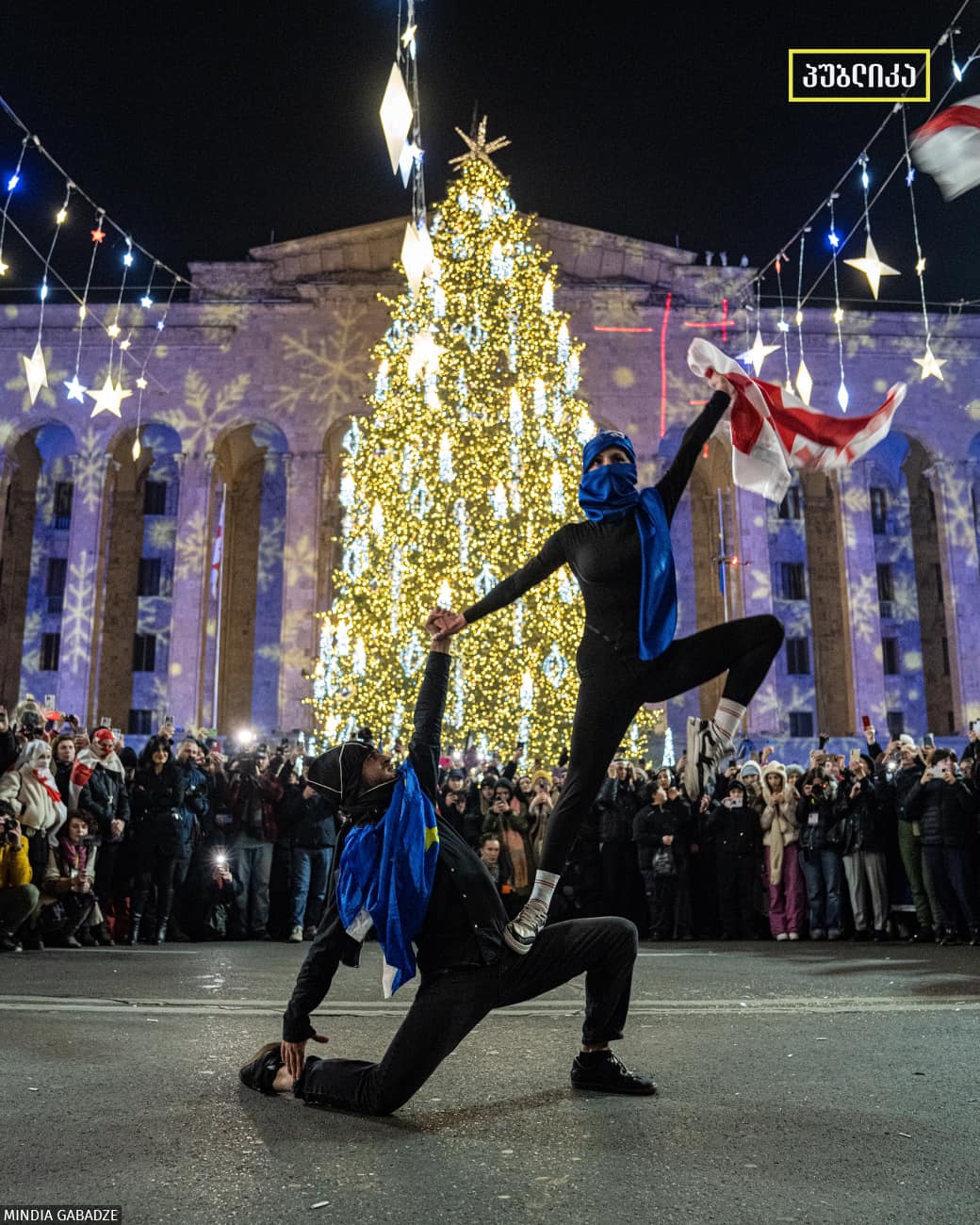
Despite arrests, street protests in Tbilisi continued. Every day, tens of thousands gathered on Rustaveli Avenue. On 8 December, city authorities attempted to erect a Christmas tree in front of Parliament, but protesters covered the structure with photos of people beaten by police, preventing the ceremonial tree-lighting.
From December 2024, a new form of protest emerged: organized marches. Diverse groups — including religious communities, public servants, emigrants, club culture enthusiasts, veterinarians, football fans, and more — marched toward Rustaveli Avenue. Region-specific slogans and banners highlighted local identity and grievances, energizing nationwide protest participation.
On 13 December, central streets were blocked for nearly an hour by professional group marches. Protesters urged citizens to join the movement.
The traditional Georgian Khorumi dance became a symbol of the pro-European protests. On 21 December, the “Khorumi Toward Europe” street performance saw protesters move from the Philharmonic Hall to the area near Parliament, using coordinated dance movements to symbolize unity and European integration.
Protesters attempted general strikes, which turned into warning strikes lasting a few hours in private companies. Workers displayed signs reading “On Strike” and stood outside workplaces, though operations resumed the next day. Public institutions could not sustain strikes; employees who criticized the suspension of Georgia’s EU accession faced dismissals.
On 28 December, protesters formed a “Chain of Unity”, stretching hand-in-hand across several kilometers in Tbilisi, from Metekhi Bridge, and replicated in regional cities and worldwide. The event was joined by former President Salome Zurabishvili and opposition politicians.
Protesters had long planned to gather on Rustaveli Avenue on 31 December 2024, turning the New Year celebration into a collective act of solidarity. Starting at 8 p.m., they set up a nearly 900-meter-long feast table along Rustaveli, filled with sweets, fruits, and homemade dishes. Together, they welcomed the New Year — and later celebrated Christmas as well. In contrast, Tbilisi City Hall pre-recorded its New Year concert at the Palace of Ceremonies, the former presidential residence, which was broadcasted on pro-government TV channels.
The “Public Broadcaster March” (Saz Maus March)
Even after the wave of mass marches ended, a new protest tradition emerged — the “Georgian Public Broadcaster March” (“Saz Maus March”), a nightly procession organized outside the Public Broadcaster building on Kostava Street. Marchers would then proceed to Rustaveli Avenue, where other protesters greeted them with lights and joined in their chants, creating a powerful symbol of civic unity.
From the very start of the protests on 30 November 2024, crowds had gathered at the Public Broadcaster to criticize what they saw as biased coverage favoring the government. Protesters demanded airtime for voices excluded by the broadcaster’s editorial policies and called for the resignation of director Tinatin Berzenishvili and board chair Vasil Maglaperidze. Although the leadership did not resign, protesters were allowed to participate in an evening talk show for several days.
The broadcaster’s editorial policies were also criticized internally. A group of employees calling themselves the “GPB Guardians” claimed that the Public Broadcaster failed to serve the public. Many of them were subsequently fired or offered altered employment conditions; those who refused resigned.
The GPB March became a central voice of the protest movement. Its chants — which evolved over time — were widely adopted by other protest groups and echoed across Georgia for months:
- “No justice? No peace!”
- “Police everywhere, justice nowhere!”
- “Broadcast the people’s voice — the people demand justice!”
- “Unjust courts, fear the power of the people!”
- “Georgia, rise up, resist!”
- “For truth — until the end!”
- “Fear the power of the people — a storm is coming!”
- “You cannot stop the river of people flowing from the heart of the country!”
- “Fire to the oligarchy!”
- “Victory is with the people, strength is in unity!”
Each night, the march concluded on Rustaveli Avenue with protesters chanting the names of the prisoners of conscience:
“Freedom for the regime’s captives!”
From time to time, the GPB March expressed solidarity with other oppressed groups or parallel protest movements, such as striking miners in Chiatura.
In March 2025, the Public Broadcaster relocated to a new building on Jikia Street, far from Rustaveli, leaving the Kostava building empty. Despite this, the nightly march continued. On 8 October 2025, organizers announced a change in the protest format, transitioning to public meetings and community outreach in open spaces. Some participants joined the For Social Democracy movement, which aimed to promote social justice and strengthen the ongoing protest wave. Attempts to register the movement as a political party were repeatedly rejected due to bureaucratic issues.
Protest Music
The protest had its own soundtrack – a melody that evolved into an anthem and a cry of rage. By early December, as special forces violently dispersed rallies daily, footage emerged of young people clad in black, their faces disguised, chanting at police on the streets near Parliament. They used a melody typically reserved for cheering on sports teams – a variation of Darion G’s “Carnaval de Paris,“ an anthem of the 1998 World Cup.
On December 4, Georgian electronic artist Kordz released AntiGeorgianDreamAnthem, a track sampling this chant. The lyrics, opening with “Ole Ola” and descending into expletives against the “Georgian Dream” party, were instantly memorized by protesters. They sang it at marches, on makeshift stages, and in bars. In retaliation, government-affiliated thugs (known as Titushky) were deployed to ambush and beat anyone singing “Ole Ola.” Victims included Vaniko Tarkhnishvili, lead singer of the band Gamouvali Mdgomareoba, and Tornado Gabunia. Kordz himself was attacked on the street after playing the track at a club in Zurich.
“Ole Ola” was also visible on the t-shirt of “Prisoner of Conscience” Nikoloz Javakhishvili at one of his court hearings. It was spelled out using the NATO phonetic alphabet: Oscar Lima Echo, Oscar Lima Alpha.
Other music defined those days as well: Tamada’s Brdzolas Me Ver Gadamachvev (You Can’t Break Me from Fighting), Qaji Todia’s SHEGECI, Melqo’s Gamoikhede (Look Out), and Lexo Ratiani’s Samshoblo Khalkhs! (The Homeland to the People!). When the rhythmic banging of fists, feet, and stones began on the iron barriers erected in front of Parliament, protesters also revived Quemmekh’s 2020 song Titebi.
Some musicians, though rarely, performed directly on Rustaveli Avenue. Vakho Babunashvili, one of the “Musicians of the Rain” who had sung at the 2003 Rose Revolution, returned to sing the same protest song. The band Umushevroba (Unemployment) also played a set in the middle of the road.
Advertising agencies became unexpected allies. Playmakers, commissioned by the pharmacy chain PSP, produced a commercial for Independence Day on May 26. The concept, “Birds don’t forget how to fly,” was developed in prison by director and “Prisoner of Conscience” Giorgi Okmelashvili, who had been arrested during the spring 2024 rallies. The video was filmed using scripts sent from his cell, narrated by fellow prisoner Andro Chichinadze (whose voice was also recorded from prison), and starred actors who openly supported the movement.
Another agency, Supermarket Agency, produced a video about “Prisoner of Conscience” Mzia Amaglobeli and a newspaper chronicling the history of Batumalebi, the media outlet she founded. While much of the business sector avoided taking a stance, the protest art created by these two agencies gained international recognition, winning numerous prestigious industry awards.
Bans and Fines
Georgian Dream responded to new protest tactics by issuing bans and increasing fines. Laws were often fast-tracked without public justification.
New regulations simplified the dismissal of public servants, leading to a wave of firings. By early December 2024, pyrotechnics, lasers, and face coverings at rallies were banned. Simultaneously, the government procured CCTV cameras equipped with facial and emotion recognition technology.
Enforcement began immediately. Mariam Sichinava, a protester in Zugdidi who demonstratively covered her face and set off fireworks, was fined multiple times. The public responded on January 18, the 52nd day of pro-European rallies, with a march from the Philharmonia. Demonstrators defiantly wore creative masks, marching to Rustaveli Avenue with their faces hidden. Photos of the masked marchers instantly went viral.
On January 31, 2025, just days before a major rally at Tbilisi Mall, the government criminalized the blocking of “roads of international importance.” This included the Aghmashenebeli Alley, the location of the planned February 2 rally.
On the day of the rally, police swarmed the area. Although demonstrators arrived in groups, law enforcement acted aggressively to keep the road open. While the road was blocked intermittently, a full blockade failed. Police administratively detained 31 people; eight were later charged under criminal law. During the arrests, police beat several individuals, five of whom required hospitalization at the Ingorokva Clinic. Journalists and citizens faced threats and verbal abuse. Eventually, the crowd marched on foot from Tbilisi Mall to Rustaveli Avenue.
A new wave of fines hit in February—this time for “artificially blocking the road,” using street camera footage as evidence. People were fined even if they arrived at a road that was already blocked. On February 21, Nona Kurdovanidze, chair of the Georgian Young Lawyers’ Association (GYLA), reported receiving 150 calls in a single day regarding these fines. Most citizens appealed them in an effort to overload the court system.
Many fines were temporarily paused, yet people continued to rally and block Rustaveli Avenue. Journalists covering the events were also fined; while some fines were revoked, others remain under review. Notably, Judge Zviad Tsekvava upheld a 5,000 GEL fine against Publika journalist Mariam Kavshbaia for covering a rally where she was accused of blocking the road.
On April 23, the Ministry of Internal Affairs simplified detention rules and began issuing fines via SMS. This caused the wave of fines to subside until October, when many citizens discovered they had been fined only after leaving the country and trying to return.
The authorities alternated their tactics: sometimes fining for face coverings, other times for road blocking. When road-blocking fines spiked, protesters wore carnival masks, medical masks, and sunglasses to evade facial recognition. This continued until penalties for face coverings were tightened, and police began detaining people simply for wearing medical masks.
Solidarity
In the fall and winter of 2024, demonstrators organized self-help networks similar to those in the spring. They flushed the eyes of those hit by tear gas with saline, neutralized gas canisters, and distributed hot food and drinks during cold nights. Restaurant chefs brought hot soup to the rallies, and the “Museum” cafe opposite Parliament became a sanctuary for protesters to warm up. During police crackdowns, residents of Rustaveli Avenue opened their doors to shelter demonstrators from arrest and gas.
When protesters were arrested on criminal charges, the public fundraised for their legal fees and family support. Volunteers covered bank loans and delivered supplies to prisons. Some citizens even took personal responsibility for prisoners who had no family, including Russian and Ukrainian nationals detained on drug charges. The media reported dozens of such cases.
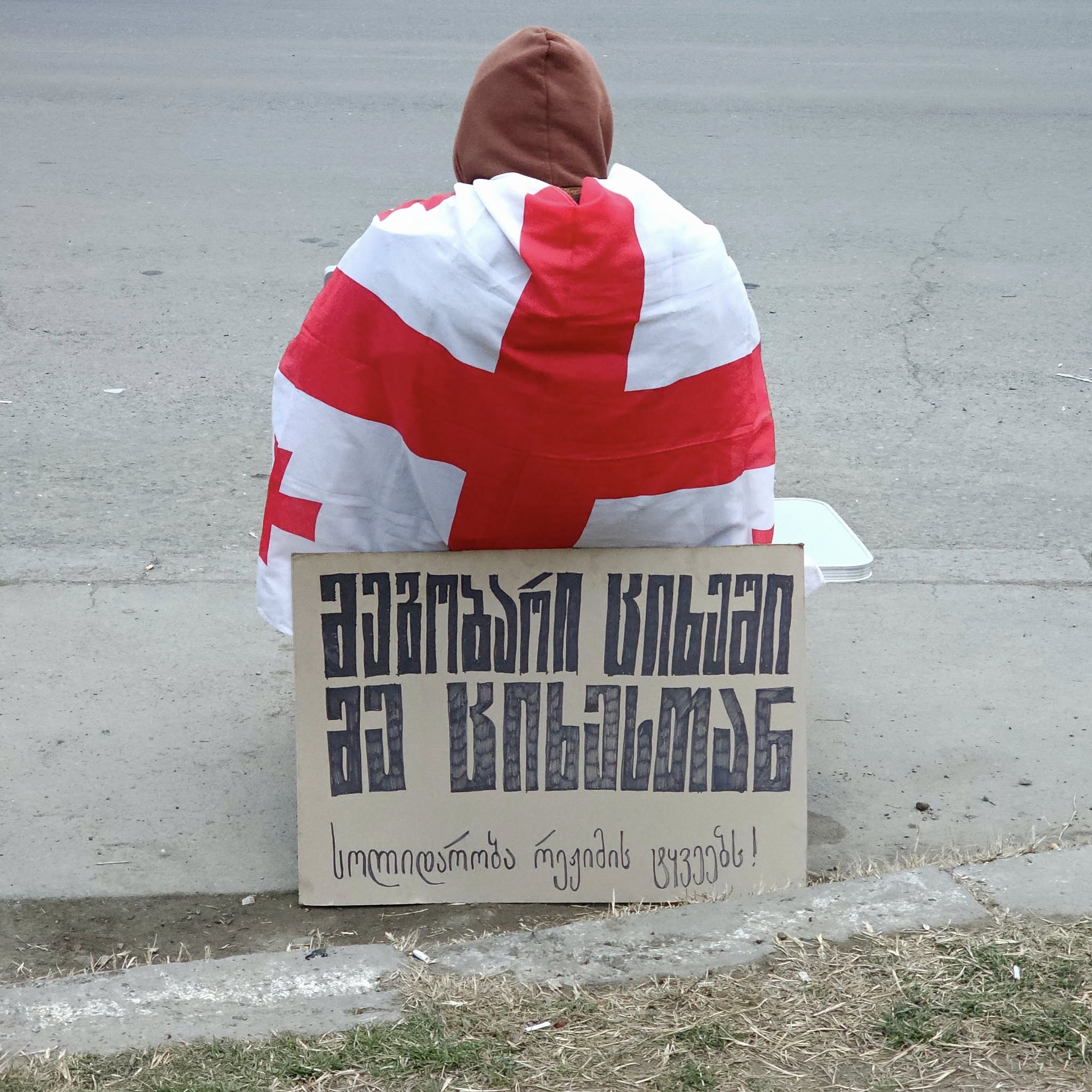
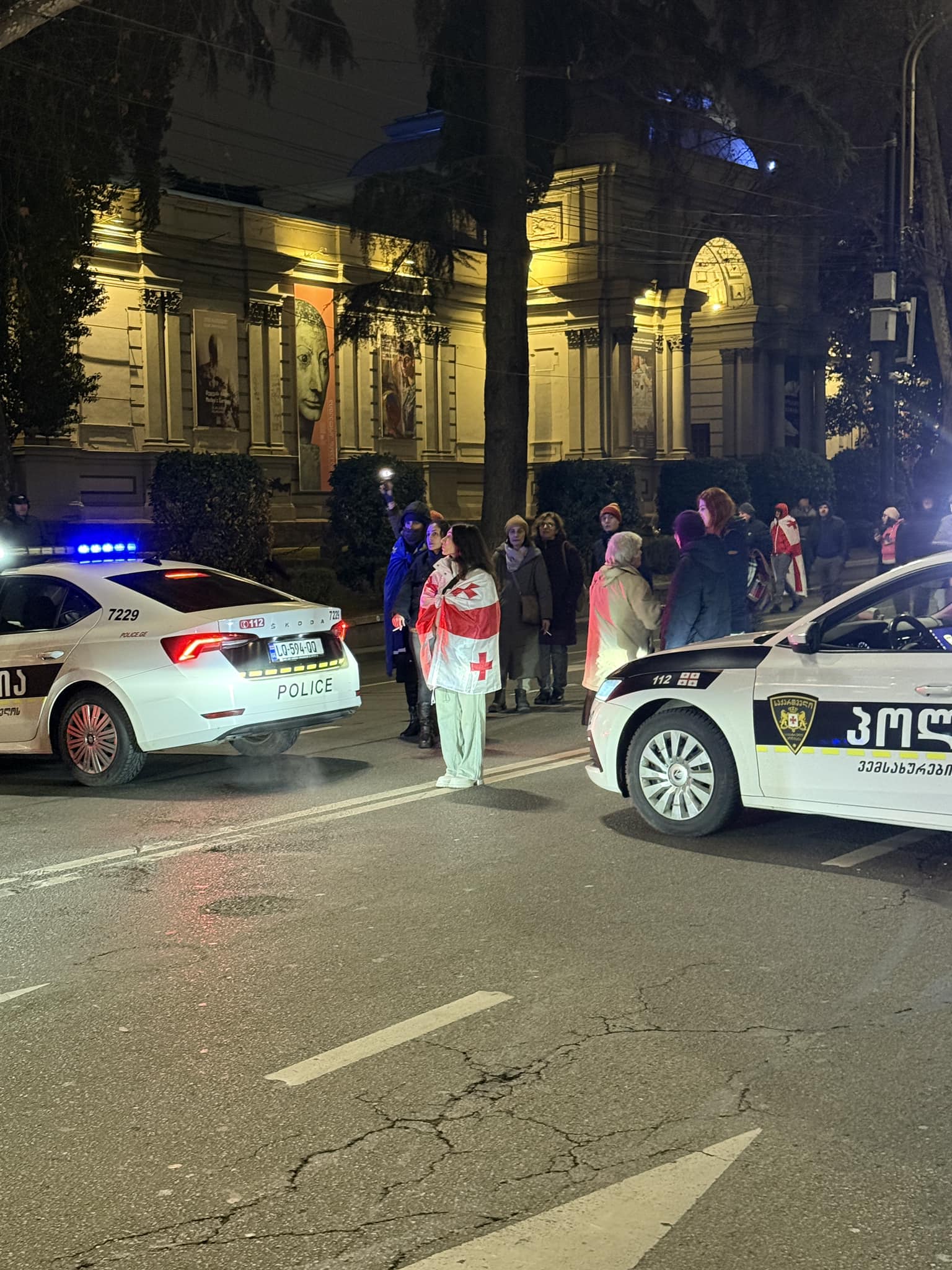
There were also solitary acts of protest. Humorist Onise Okriashvili held one-man rallies in public spaces, standing silently with a banner. Graphic designer Dato Simonia camped outside Gldani prison for 10 days—the exact duration of his friend’s administrative sentence. His banner read: “Friend in prison, me by the prison.” Eto Bichikashvili stood daily on Rustaveli Avenue, wrapped in a flag, positioned between two police cars that signaled the road closure.
Civil society mobilized rapidly during arrests, tracking detainees to specific isolation centers and securing pro bono lawyers.
Actors were particularly active on the front lines. When Andro Chichinadze, an actor at the Vaso Abashidze “New Theatre,” was arrested, performances were halted in solidarity across multiple theaters. The “New Theatre” troupe toured the regions, performing their protest manifesto to spread awareness.
When the troupe and director Dato Doiashvili refused to replace their imprisoned colleague, effectively keeping old productions off stage, Minister of Culture Tika Rukhadze fired Doiashvili on April 16, citing the suspension of the creative process. The troupe rejected the decision and stood by their director. No performances were held at the theater for a year. Eventually, the actors and Doiashvili moved to the “Royal District Theatre,” where they premiered Shakespeare’s A Midsummer Night’s Dream in October 2025.
Sports and Politics
Unlike the arts community, athletes offered no support to the protests. In fact, Olympic champions Lasha Talakhadze (31) and Geno Petriashvili (30) abruptly retired to enter Parliament on the “Georgian Dream” party list in 2024. National football team players also appeared in the party’s election advertisements.
The silence of the footballers was the deepest disappointment. While they condemned the violence, they refused to openly support the protest goals. This stung particularly because, after qualifying for the European Championship on March 26, 2024, the team and fans had chanted, “Where are we going? To Europe!” During the April protests against the “Russian Law,” this chant became a political slogan, and the public viewed the players as natural allies.
Despite economic hardships, thousands of Georgians had traveled to Germany to support the team during the Euros. Among them was 21-year-old Giorgi Gorgadze, on his first trip abroad. He posted a photo from the stadium with the caption: “I keep all your wins in my heart, and when you lose, I still love you.” Gorgadze was later arrested at the rallies. In his final court speech, he wished the national team success.
No footballer expressed solidarity with him.
Later, players admitted the “spark” from the Euros had faded. Following a series of losses and goalkeeper Giorgi Mamardashvili’s criticism of the fans, public frustration boiled over.
An exception was basketball player Giorgi Tsintsadze. Having retired in February 2024, he was a frequent presence at rallies. On July 26, 2025, when the government awarded the Order of Honor to the basketball team, Tsintsadze refused the award and donated his 10,000 GEL bonus to the “Prisoners of Conscience” fund.
In contrast, basketball player Giorgi Shermadini ended his career on November 27, 2025, by publicly thanking Prime Minister Irakli Kobakhidze, drawing jeers and whistles from the crowd.
Society continues to debate whether sports and politics can be separated – a narrative often pushed by “Georgian Dream” and internet trolls to deflect criticism of silent athletes. Yet, in the 11th Parliament alone, 5 out of 89 “Georgian Dream” MPs were former athletes, and former footballer Kakha Kaladze has held high office since the party’s inception.
Seizure of Funds
Prisoners were financially supported by “Nanuka’s Fund,” established by journalist Nanuka Zhorzholiani. Ordinary citizens, other grassroots initiatives, and emigrants also contributed, helping protesters pay administrative fines. Donations flowed through both individuals and organizations.
In February 2025, following an appeal from the movement “United Neutral Georgia” (Nana Kakabadze, Vato Shakarashvili, Gela Nikolaishvili), the Prosecutor’s Office opened an investigation under articles related to sabotage, attempted sabotage, and aiding hostile activities.
On April 29, based on these charges and with court approval, investigators searched the apartments of NGO leaders and charitable fund organizers who had been assisting pro-European protesters. Among those targeted were Nanuka Zhorzholiani; her daughter and activist Mariam Geguchadze; the head of the Human Rights Center, Aleko Tskitishvili; and activist Mariam Bajelidze, who was pregnant and alone with her young child at the time.
On March 17, at the Prosecutor’s Office’s request, Tbilisi City Court froze the bank accounts of organizations covering protesters’ fines and needs: Nanuka’s Fund, Shame Movement (Sirtskhvilia), Prosperity, Fund for Each Other 24, and Tbilisi Human Rights House. In August, accounts of seven additional NGOs were frozen under the same accusations: the Civil Society Foundation, ISFED, IDFI, GDI, Democracy Defenders, Sapari, and the Social Justice Center.
The media labeled the investigation the “Masks Case.” According to the Prosecutor’s Office, the alleged crime of these organizations was that their “targeted finances were used to purchase equipment such as gas masks, protective goggles, face coverings, pepper spray, and other items actively used during violent clashes with police.”
Despite the freeze, people continued to raise money for fines through the personal accounts of friends and relatives. A bank account was even opened in the United Kingdom to support demonstrators. Crowds gathered daily on Rustaveli Avenue, blocking traffic; numbers surged again on symbolic dates, and large-scale rallies resumed.
“Political Justice”
From March 2025, months-long court hearings began for the Prisoners of Conscience detained on criminal charges during the rallies. Most of the 50 cases were assigned to three judges: Nino Galustashvili, Jvebe Nachkebia, and Tamar Mchedlishvili.
Courtrooms were too small to hold everyone who wanted to attend. Relatives and ordinary citizens filled halls, corridors, and even courtyards, offering support to the accused. For many, the lack of evidence presented by the prosecution was evident. Police witnesses often gave contradictory statements, were unable to specify damages, or could not even identify the defendants by face.
Media outlets covered the hearings exhaustively. Developments, quotes, and verdicts dominated daily news. The public came to know not only the accused and their families but also the judges, prosecutors, and the police witnesses providing questionable testimony. Defendants quoted literature, debated prosecutors, and commented on political events; their words spread widely on social media.
Lawyers and defendants developed unusually close relationships. “I was defending people in whose place I could have been…” lawyers later reflected in Indigo magazine’s series “Lawyers of Conscience.”
A June 2025 survey showed that 70% of Georgians supported releasing the detainees, including 40% of Georgian Dream voters.
On June 25, before the verdicts were announced, Georgian Dream banned photo, video, and audio recording in court buildings and courtyards. In response, journalists began attending hearings with illustrators, who produced courtroom sketches while reporters described the proceedings in greater detail. Prisoners frequently provided new information by sending letters or calling into TV programs from prison.
Only three defendants were acquitted – Giorgi Akhobadze, Tedo Abramov, and Nika Katsia — all charged with drug possession. However, three foreign citizens accused of the same crime were sentenced to prison: Anastasia Zinovkina and Artem Gribul to eight years, and Anton Chechin to two years.
All other defendants received prison sentences of 2 to 5 years. Relatives and civil society groups considered the rulings politically motivated. International statements increasingly called for the release of political prisoners.
Conditions for some Prisoners of Conscience deteriorated. Three (Giorgi Akhobadze, Onise Tskhadadze, and Guram Mirtskhulava) lost a parent while imprisoned.
Anastasia Zinovkina and Nino Datashvili reported severe back pain, mistreatment, and harsh conditions in the women’s colony. Datashvili — a teacher detained for allegedly attacking a bailiff — became so ill that she could no longer care for herself. Her pre-trial detention was replaced with a 5,000 GEL bail payable within 30 days, but supporters raised the entire amount in just eight minutes after a Facebook post.
The Court of Appeals upheld a two-year sentence for Mzia Amaglobeli, who had nearly lost her sight in prison. She stood through hours-long hearings because she could not sit in the defendant’s dock. At her first trial she held the book How to Stand Up to a Dictator by Nobel laureate Maria Ressa — its cover soon appeared on posters at protest rallies.
Mzia became one of the faces of the Georgian protest. She received multiple international awards, including the EU’s highest human rights honor, the Sakharov Prize, and the Forum 2000 Award for Courage and Responsibility.
In solidarity with Mzia Amaglobeli and Nino Datashvili, poet Zviad Ratiani symbolically slapped a policeman on Rustaveli Avenue — and was sentenced to two years in prison.
Mothers of Prisoners
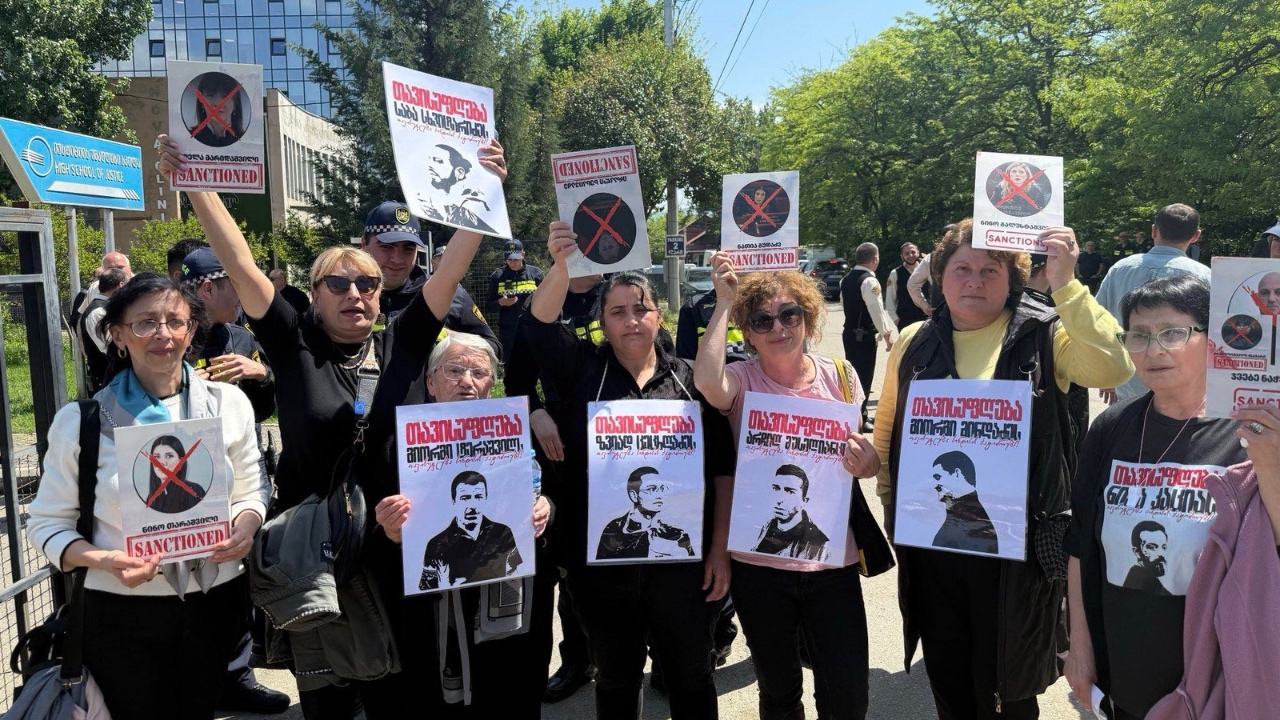
Alongside the trials, the public came to know the prisoners’ families, especially their mothers, who frequently spoke to the media and later united. On March 3, Mother’s Day, they organized the “Mothers’ March” titled “Let Go, It’s My Child.” Family members held banners demanding “Freedom for Prisoners of Conscience.”
On April 2, they announced a new movement: “For the Freedom of Prisoners of Conscience.” They not only appeared together at rallies but also compiled a newspaper from prisoners’ letters, traveled to regions, and spoke to people in markets and public squares about the unjust sentences their children were serving.
International Sanctions
Following the violent dispersal of rallies, the international response quickly intensified.
On December 19, the United Kingdom sanctioned officials in the Ministry of Internal Affairs responsible for attacks on journalists and peaceful demonstrators: Minister Vakhtang Gomelauri, Deputy Aleksandre Darakhvelidze, Tbilisi Police Director Sulkhan Tamazashvili, Special Tasks Department Head Zviad “Khareba” Kharazishvili, and his deputy Mileri Lagazauri.
The same day, the United States placed Vakhtang Gomelauri and Mirza Kerzevadze (Khareba’s deputy) on the Global Magnitsky List.
The next day, Irakli Kobakhidze appointed Gomelauri Vice Prime Minister.
On December 27, the US sanctioned Bidzina Ivanishvili, the founder and honorary chair of Georgian Dream. All property in the US belonging to him or under the control of US citizens was blocked.
Sanctions continued in the following months from Lithuania, Latvia, Estonia, the Czech Republic, and others, targeting high-ranking officials, MPs, and judges, and banning them from entering those countries.
On May 6, 2025, the US House of Representatives passed the MEGOBARI Act with bipartisan support (349–42), enabling sanctions against senior Georgian Dream officials. The bill awaits Senate approval.
As sanctions increased, anti-Western rhetoric from Georgian Dream intensified. Officials accused the “Global War Party” — and later the “Deep State” — of trying to drag Georgia into conflict. In a January 8, 2025 letter, Georgian Dream’s political council claimed that the “Deep State” was the “main instrument of informal influence of the Global War Party.” Neither term was clearly defined.
Western governments responded with statements supporting the Georgian protest movement and calling for the release of political prisoners.
“I do not refer to this government as a government, but rather as a regime that does not follow the will of the Georgian people,” said Estonian Foreign Minister Margus Tsahkna at a US Helsinki Commission hearing.
Repressive Laws
Alongside the protest rallies, Georgian Dream introduced a series of new legislative measures, significantly tightening penalties. Most were adopted through a fast-track procedure. The public referred to them collectively as “repressive legislation,” believing that each initiative aimed primarily at suppressing the protest movement. According to a study by the Georgian Young Lawyers’ Association, between 28 November 2024 and 7 May 2025, Georgian Dream initiated and expedited 27 draft laws. “The majority of acts adopted in this manner are aimed at restricting fundamental rights,” the report noted.
Penalties increased for violations related to assemblies and demonstrations, while grounds for administrative detention and the duration of administrative imprisonment were expanded. In defamation cases, the burden of proof shifted from plaintiff to defendant. Insulting public officials was criminalized; based on this clause, activists and TV hosts were fined for calling Georgian Dream MP Mariam Lashkhi a “slave” on Facebook. The regulatory framework for broadcasters also changed: TV stations were prohibited from receiving foreign grants, and issues previously governed by self-regulation were placed under state oversight. Using this mechanism, Georgian Dream filed complaints with the National Communications Commission against critical TV stations. The agency determined the outlets had committed administrative violations for using terms such as “regime,” though it did not impose fines.
On 1 April 2025, the so-called FARA – the “Foreign Agents Registration Act,” presented as an analogue to the U.S. law – was adopted. It required both individuals and organizations receiving foreign funding to register as “agents.” At the same time, civil society organizations were effectively barred from receiving grants, as every project now required government approval – a requirement that eliminated funding for civic and media groups investigating alleged government wrongdoing.
Together with the already-active “foreign influence transparency law” – widely known as the “Russian law” – these two acts severely restricted civil society. They effectively removed its primary means of survival: NGOs and independent online media had long relied on international grants. With no advertising market sufficient to support media outlets and no tradition of reader subscriptions or memberships, no viable alternative remained.
As a result, not only the organizations whose accounts were frozen in the “mask case” were forced to shut down, but many others also ceased operations. Some managed to continue temporarily using remaining funds from earlier projects; others provided legal or other assistance voluntarily. Lawyers from these organizations continued to represent protesters detained under administrative procedures free of charge.
Civil society groups challenged the restrictive laws in the Constitutional Court.
The Anti-Corruption Bureau, the body tasked with enforcing FARA and the new grant regulations, quickly launched monitoring procedures. It requested extensive information – including personal data – from around one hundred NGOs and four media outlets. The organizations refused, arguing that the demands were unlawful. The Bureau then took the matter to court, which ruled against them. Appeals were unsuccessful. Ultimately, the organizations were compelled to provide the requested data: some submitted full information, some only partially, and some refused entirely. The case did not advance further.
Shortly afterward, Georgian Dream announced that the Anti-Corruption Bureau would be dissolved and its functions transferred to the State Audit Office.
Politicians in Prison and October 4
Beginning in May 2025, leaders of parties that had participated in the 2024 elections were arrested — with the sole exception of former Georgian Dream official Giorgi Gakharia. The official reason for the arrests was their failure to appear before a temporary investigative commission established by the ruling party and chaired by Tea Tsulukiani. The commission’s mandate was to examine the activities of the former United National Movement government 13 years earlier.
Summonses were issued not only to former officials but also to politicians such as Zurab Japaridze, leader of Girchi — More Freedom, who had entered politics after the UNM left power. The party leaders refused to participate, saying they did not recognize the legitimacy of parliament and were boycotting it. They were fined with bail, refused to pay, and were arrested. Another party leader, Elene Khoshtaria of Droa, was detained for damaging an election poster; she too refused to pay bail and was imprisoned.
Local elections scheduled for 4 October 2025 approached as protests continued. Most opposition parties boycotted the elections; only Lelo and Gakharia’s For Georgia decided to participate. Yet Lelo’s leaders, Mamuka Khazaradze and Badri Japaridze, were in prison. On 5 September – one month before the vote – President Mikheil Kavelashvili pardoned them, citing the importance of their participation; both were released the same day. Georgian Dream and its mayoral candidates went on to win in every municipality.
But 4 October was notable not only for the elections. A protest rally was announced by UNM leader Levan Khabeishvili, joined by Strategy Aghmashenebeli and opera singer Paata Burchuladze. They argued that the ongoing gatherings on Rustaveli Avenue had become routine and required escalation. They declared 4 October as the day of a “peaceful revolution,” though they never explained how such a transition could occur within a single day. Other opposition parties rejected the call and did not join.
Weeks earlier, on 11 September, Khabeishvili had been arrested after leaving the Formula TV studio. Prosecutors claimed he had publicly offered a bribe – allegedly promising USD 200,000 to law enforcement officials if they refused to perform their duties. He was placed in pre-trial detention.
On 4 October, as Georgian Dream celebrated its virtually uncontested electoral victory at a restaurant in Mtatsminda Park, thousands gathered on Rustaveli Avenue. Many voters had boycotted the elections; turnout was 13 times lower than in 2021.
As the Rustaveli crowd grew, organizers instructed protesters to march toward the President’s Palace on Atoneli Street. Soon, several dozen people reached the residence and shook the metal fence – which unexpectedly collapsed. Riot police emerged from inside the compound and deployed tear gas. Most protesters on Rustaveli never joined the march. Suspicions immediately arose that the fence had been pre-cut.
For many, it remained unclear why protesters had been directed toward the palace or how a “peaceful revolution” was supposed to unfold.
The organizers were arrested that same night, followed by the detention of 45 demonstrators over the next days. All received pre-trial detention. Charges ranged from group violence to blocking a strategic facility. One exception was 71-year-old doctor Giorgi Chakhunashvili, whose arrest sparked widespread outrage; he was released on bail.
New Laws Again and the Marches
After 4 October, the Ministry of Internal Affairs announced that any gathering in the following days would be treated as a continuation of “October 4.” People still assembled, forming small groups in front of parliament and blocking Rustaveli Avenue for several hours.
Meanwhile, Georgian Dream began arresting former high-ranking officials on corruption charges, including former Defence Minister Juansher Burchuladze. Former Prime Minister Irakli Garibashvili was charged as well; searches of his and other officials’ homes resulted in the seizure of USD 7 million and valuables. Garibashvili was ordered to post 1 million GEL bail.
By this time, many of the law-enforcement commanders responsible for dispersing the November–December 2024 protests had already been dismissed — despite having been awarded state honors. They included Interior Minister Vakhtang Gomelauri; Zviad Kharazishvili (known as Khareba), head of the Special Tasks Department; and State Security Service chief Grigol Liluashvili. Tornike Rizhvadze, former head of the Adjara government, attempted suicide.
Laws targeting demonstrators were further tightened: covering one’s face and artificially blocking roads became punishable by imprisonment rather than fines. Repeated violations became grounds for criminal prosecution.
Still, protesters continued blocking Rustaveli. Arrests escalated. Police detained anyone stepping onto the roadway. People took turns crossing the street to halt traffic for a few minutes. Journalists, writers, translators, publishers, lawyers, displaced individuals – people of all ages – were detained and sentenced to several days in jail.
The face-covering ban was strictly enforced. Police stationed near Liberty Square metro stopped people and confiscated masks as “evidence.” Some protesters intentionally wore medical masks in defiance.
Once police lined both sides of Rustaveli, protesters could no longer step onto the road — yet the avenue remained closed, now by police themselves. From mid-November 2025, demonstrations shifted into the city’s side streets. Marches wound through narrow roads, which became blocked naturally by the crowds. Often led by Nino Zhvania and her colleagues playing percussion instruments, the marches moved through different districts as police followed closely, at times blocking underpasses or sidewalks.
Starting 22 November, police began detaining people directly from sidewalks — abruptly grabbing participants and dragging them into vans. One example was Vano Skhirtladze, detained simply for sounding a toy near a police officer. The next day, protesters returned with the same toy, making noise deliberately. Activists sought to demonstrate they were not afraid: after someone was detained, they played recordings of that person’s voice near police lines or placed cardboard cutouts with the detainee’s image in front of officers.
The media also became a primary target. Beyond legal restrictions, journalists faced continuous attacks from law enforcement personnel or unidentified groups. According to a Reporters Without Borders assessment, “from October 2024 to October 2025 […] 600 attacks on media were recorded — including physical assaults, unlawful fines, detentions, threats, suspension of accreditation, and more. The growing number of violations indicates an unprecedented expansion of political control and rapid escalation of repression, confirming the Georgian government’s distancing from European democratic standards.”
Propaganda and Narratives
To undermine the ongoing Georgian protests, the ruling party, Georgian Dream, employed sophisticated propaganda and media manipulation. Protesters were labeled and demonized to discredit their demands and reduce public support.
As early as December 2024, when tens of thousands of Georgians took to the streets, Prime Minister Irakli Kobakhidze claimed that only 5,000 people had participated. He insisted that Georgia’s European integration process was unaffected – a claim widely contradicted by European partners, who criticized Georgian Dream’s government from international platforms.
Throughout 2025, Georgian Dream sought to marginalize the mass protests on Rustaveli Avenue, calling participants “radicals,” “stateless,” or “troublemakers,” and accusing them of being controlled from abroad. Independent media outlets covering the protests and NGOs providing legal support were labeled as foreign agents. The ruling party propagated the narrative that protest participation was negligible, despite the fact that on 4 October 2025 – ten months into the demonstrations – Rustaveli Avenue was again filled with thousands of people.
Television channels such as Imedi, Rustavi 2, and PostV, along with their social media pages, actively spread these narratives. Trolls and automated accounts (bots) played a significant role in amplifying the messaging. According to ISFED research, at least 25 online news agencies were financially linked to Georgian Dream, spreading the party’s narratives and influencing public perception of the protests.
Ahead of the 4 October 2025 elections, Georgian Dream introduced a new term to demonize protest participants: “Akatsuki.” Borrowed from anime, the term had no real connection to the protests in Tbilisi but was widely used by party members and supporters to stigmatize demonstrators.
Later, another label, “moneyed” or “paid,” was added to imply that protesters were financially supported by foreign entities like the “Deep State” or a “global war party.” This narrative aimed to delegitimize the protests and undermine the credibility of civic activism in Georgia.
The use of propaganda and strategic labeling by Georgian Dream illustrates how political narratives, media manipulation, and misinformation were employed to control public perception during one of the largest civic protest movements in Georgia’s recent history.