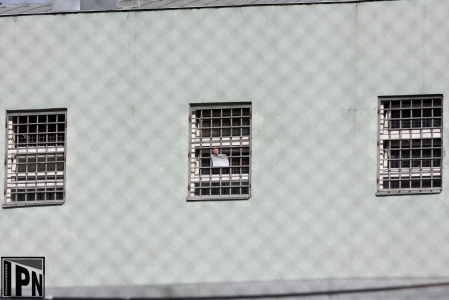
Prisoners’ hunger strike demanding the resignation of the prison administration

2012

This AI-generated translation may not be completely accurate.
Prisoners’ hunger strike demanding the resignation of the prison administration
In the autumn of 2012, systemic violence and torture in prisons were exposed, which was followed by a change of power on October 1, 2012. At that time the parliament and the president represented rival political forces — Georgian Dream held a majority in parliament and formed the government, while the leader of the United National Movement, Mikheil Saakashvili, remained president. The ruling party also retained majorities in many local governments. This period is referred to as “cohabitation.”
The rise of Georgian Dream to power was preceded by the release of so-called prison footage, which confirmed public suspicions about the harsh conditions inside penitentiaries. An investigation was launched and several prison staff members were detained.
Afterwards, hunger strikes began in prisons demanding the dismissal of the administration.
For example, on November 5 it was reported that a prisoner, Davit Minasov, slit his throat and refused to have the wound stitched until the director of Ksani Prison No. 15, Nukri Khukhuashvili, and two administration employees, Giorgi Khukhiashvili and Mamuka Shalamberidze, were removed from their posts.
According to Minasov’s statements to an Interpressnews correspondent who is a member of a public monitoring group, Shalamberidze had for years been involved in organizing the torture of multiple inmates. Minasov said that Mamuka Shalamberidze had filmed the torture inflicted on him.
“They held me by my legs, put a bucket of water under my head so that my head would be submerged, then connected me to an electric current and beat me brutally. Shalamberidze filmed all of this,” Minasov said. He added that the torture caused him serious health problems and that his repeated requests over the years to be taken to a hospital had been ignored.
On November 5 relatives of prisoners gathered outside Ksani prison. Throughout the day reports varied on how many prisoners had begun hunger strikes or had sewn their mouths shut; by midday one prisoner phoned and said that about 30 inmates had sewn their mouths.
That same evening prisoners at Ortachala Prison No. 1 declared a hunger strike, although the Penitentiary Department later said they soon decided to end the protest. By contrast, on November 6 the number of hunger strikers increased at Ksani Prison, notably in Facility No. 19 for tuberculosis patients. Prisoners at Ksani facilities No. 15 and No. 19 were on hunger strike.
Sozar Subari, the new penitentiary minister appointed by Georgian Dream, said he would not tolerate disorder either inside or outside prisons. He emphasized that if specific violations were detected at any facility, those responsible would be severely punished, but he also warned that the ministry could not instantly accede to every demand for dismissals made by particular groups of prisoners:
“Of course some staff from the old administration remain in the system, but if we were to fire 5,000 employees at once the system would collapse. Right now we are studying the situation and identifying those whose presence poses a danger to prisoners, but this takes time and cannot be done in a day or two. If someone simply wants a director who will obey their every whim, we will not allow that,” Subari said on November 5.
In response to the protests, Nukri Khukhuashvili initially said he would resign, but later changed his mind, arguing:
“If I step down now, society may conclude that I indeed committed some crime. If I resign, then people will demand someone else’s resignation, and so on… If they find even one trivial wrongdoing on my part, they should not expect me to resign — they should rather bring criminal charges against me,” he said.