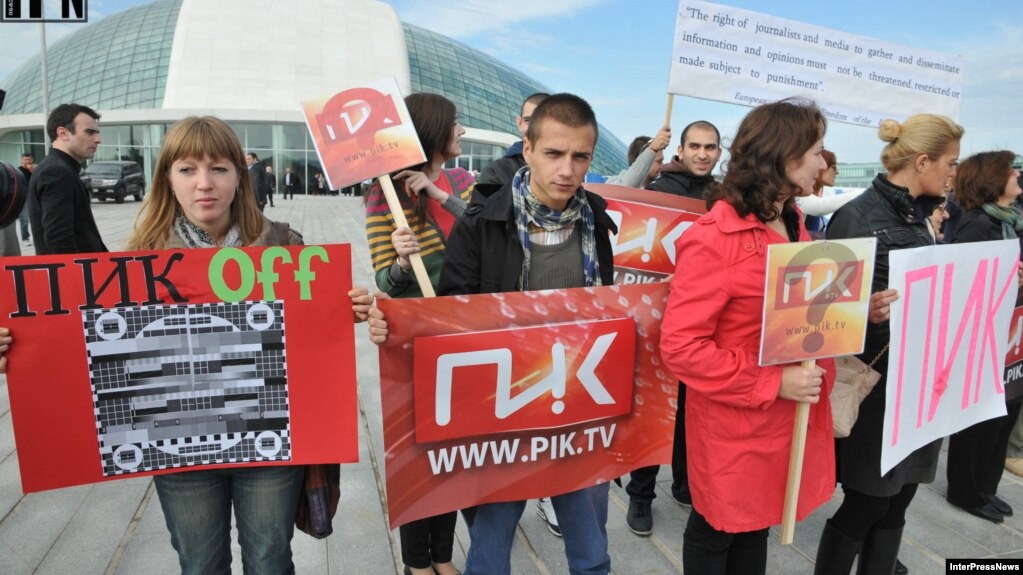
Protest by employees of TV company “Pik”

2012

This AI-generated translation may not be completely accurate.
Protest by employees of TV company “Pik”
The Russian-language First Caucasian Information Channel (PIK) was a Russian-language broadcaster whose primary target audience was considered to be the population of Russia and the North Caucasus. “Pik” was aired through the Georgian Public Broadcaster’s third channel starting in 2010.
Unlike the first and second channels, “Pik” was handed over to a private company for management. At the time, digital broadcasting did not exist, and broadcast frequencies were limited. The Georgian Public Broadcaster owned these frequencies, which is why the Russian-language channel was launched via its unused third channel.
From 2010, “Pik” was managed by K1 Ltd., founded by Russian opposition radio Echo of Moscow’s Tbilisi correspondent, Ekaterine Kotrikadze, and British journalist Robert Parsons, and was funded by the government’s reserve fund. In January 2012, however, management of the channel was transferred to Alania Ltd., which was to receive 14 million GEL from the state budget for that year.
Alania Ltd. had previously been considered a political instrument of the United National Movement. The company began broadcasting from Tbilisi in 2005, targeting the population of South Ossetia with its Russian-language news programs. Until 2008, the station operated without a license, and according to IREX’s 2009 report, its ownership and funding were shrouded in secrecy.
In early 2012, this same Alania was granted management rights over the public broadcaster’s third channel.
Following the October 1, 2012 parliamentary elections, power shifted from the United National Movement to the Georgian Dream coalition. Soon after, PIK employees began experiencing salary delays. On October 12, the channel’s satellite broadcasting was halted, and rumors spread that PIK might soon be shut down.
Facing uncertainty, the channel’s journalists expressed their protest silently during the main news broadcasts on October 15, 2012. Throughout the program, anchors posed questions such as “Will the channel be shut down?”, “Why aren’t employees being paid?”, “Why are obligations toward PIK not being fulfilled?”, and “Where did the money go that was supposed to cover the year’s expenses?” In response, reporters appeared on screen standing silently, symbolizing their unanswered questions and the administration’s silence.
Although employees managed to restore satellite broadcasting on their own, on October 20 the Georgian Public Broadcaster’s General Director Giorgi Chanturia labeled the move “unauthorized” and “self-willed,” also condemning the journalists’ on-air protest as unacceptable. He terminated the broadcaster’s contract with PIK’s managing company and suspended all news programs.
On October 20, PIK employees sent a written appeal to the Georgian Public Broadcaster’s Board of Trustees, urging them to dismiss Chanturia for what they called “openly declared censorship.”
On October 25, PIK employees held simultaneous protests — one in Kutaisi, outside the Parliament where the new government was being approved, and another in Tbilisi, outside the Georgian Public Broadcaster during a Board of Trustees meeting.
“The First Channel and its leadership remain in a state of expectation, waiting to see what the new government will say about Pik. They are waiting for political approval,” said Giuli Chachanashvili, PIK’s news producer, during the protest.
Finally, on November 2, at a meeting of the Georgian Public Broadcaster’s Board of Trustees, it was announced that the 2013 budget did not include sufficient funds to sustain the project, and therefore PIK would cease broadcasting from the following year.