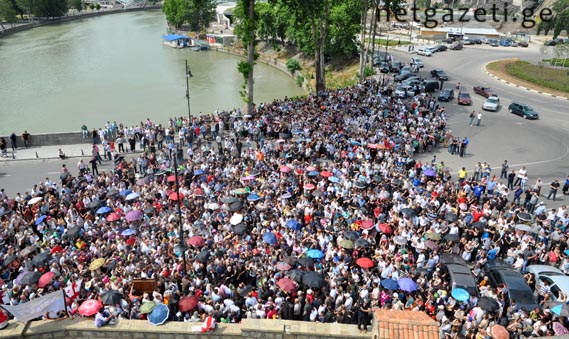
Orthodox protest march

2011

This AI-generated translation may not be completely accurate.
Orthodox protest march
On July 9, 2011, around five hundred people gathered near the Kashveti Church in Tbilisi to protest a law passed by Parliament on July 5, which granted religious organizations in Georgia the right to register as legal entities under public law.
Before the law’s adoption, on July 4, the Patriarch of Georgia had appealed to Parliament to hold a broad public dialogue and suspend the process. However, on July 5, Parliament approved the bill, and although the Patriarch later called on President Mikheil Saakashvili to veto it, it was later revealed that he had already signed it into law the same day.
In response, on July 10, Orthodox Christians held a protest march demanding the annulment of the law. Demonstrators gathered at the Holy Trinity Cathedral (Sameba) and then moved toward Metekhi.
Participants also collected signatures for a petition addressed to the Georgian authorities, protesting not only the new law but also the introduction of biometric passports, electronic ID cards, and plastic documents, which they claimed contained non-Christian symbols. They demanded alternative, religiously acceptable versions of these documents.
From Metekhi Bridge, the crowd marched toward Parliament and blocked Rustaveli Avenue.
On July 11, 2011, the Holy Synod discussed the issue and urged the government to consult with the Patriarchate in the future before considering legislation related to religion, emphasizing the topic’s sensitivity. Bishop Seraphime later stated that the government had reassured the Patriarchate that the new law would not grant other religious groups the same privileges as the Georgian Orthodox Church and that the state would not transfer property to other religious organizations.