“No to Machakhela HPP”

2019

This AI-generated translation may not be completely accurate.
“No to Machakhela HPP”
The memorandum of understanding between Georgia’s Ministry of Energy and Machakhela HPP Ltd. was signed on July 24, 2014, regarding the construction of two hydroelectric power stations—Machakhela HPP 1 and Machakhela HPP 2—on the Machakhela River in Khelvachauri Municipality. Under the agreement, the company was obliged to prepare the initial project and an environmental impact assessment (EIA) report. Machakhela HPP Ltd. was wholly owned by Silk Road Energy.
Residents of the Machakhela Valley said they first heard about the planned hydropower plants in 2010, which immediately triggered local protests. Malkhaz Kokoladze, a resident of the village of Kvemo Kokotleti, recalled that although the government changed afterward, the idea of building the plants remained.
According to local resident Roin Malaqmadsze, community protests led to some project modifications—but despite these changes, many remained firmly opposed to any hydropower construction in the valley:
“The decision and planning were made without consulting the local population. It was taken against their interests. People had many questions back then—and still do.”
In January 2019, geologists appeared in the valley, sparking a new wave of protests. Locals were not told what the experts were studying, but eventually learned that a seven-kilometer tunnel was planned in the area.
Over the years, Machakhela had developed into an ecotourism destination. Ten of its villages were granted high-mountain settlement status, and 9,000 hectares of land became part of the Machakhela National Park. With the support of the UN Development Programme (UNDP), a draft law was prepared to designate the valley as a protected landscape. Locals benefited from tourism and envisioned developing an “eco-village,” fearing that the construction of a hydropower plant would jeopardize this future.
Silk Road Energy claimed the environmental impact would be minimal and that residents had been misinformed. Company director Vakhtang Ghonghadze stated that instead of two hydropower plants originally agreed with the government, only one would be built—with a capacity of up to 30 MW. The project would not include a dam or water reservoir, only a 15-meter-high intake structure diverting water through a tunnel at least 250 meters below ground.
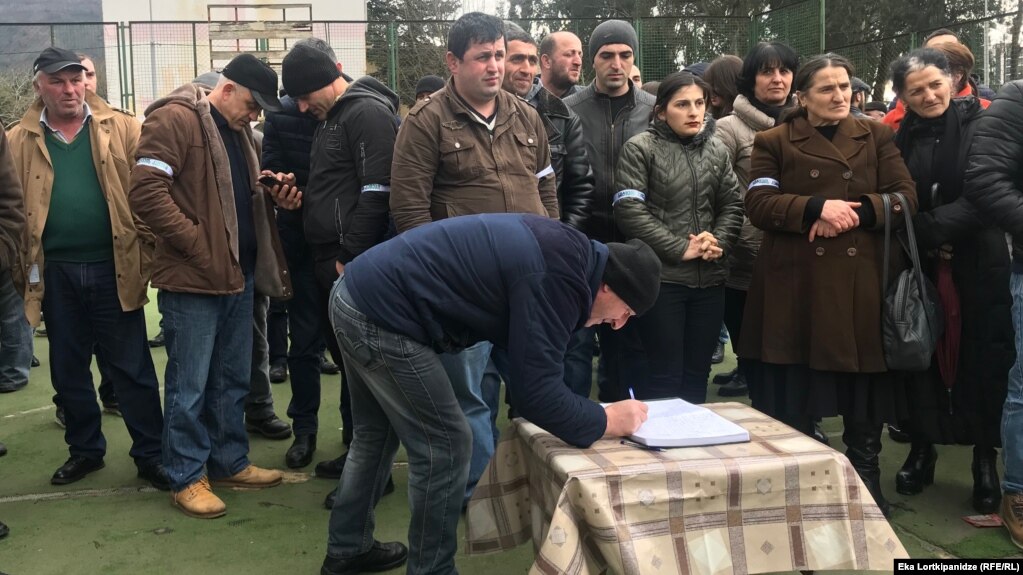
Concerned about ecological risks, residents formed a grassroots movement called No to HPPs and began wearing armbands labeled “Men of Their Word.” Villagers from six communities took an oath not to sell their land to the construction company. They gathered in the village of Zeda Chkhutuneti and confirmed their pledge with signatures.
Their campaign spread beyond the valley. On February 17, residents of Gonio organized a solidarity protest under the slogan “No to Machakhela HPP” and joined the Men of Their Word movement, also vowing not to sell their land.
At the time, the company had halted environmental studies because locals had blocked access to the area.
On February 20, during another protest near the Machakhela Gun Monument, residents painted the asphalt red and wrote STOP—a symbolic message that they would not allow the hydropower plant’s construction.
On April 5, the Men of Their Word held another rally in Batumi and sent an open letter to Prime Minister Mamuka Bakhtadze, collecting over 8,000 signatures in support—including those from diaspora communities abroad.
Finally, on April 8, the Chairman of the Government of Adjara, Tornike Rijvadze, announced that it was possible the hydropower plant would not be built in the Machakhela Valley, adding that the government and the investor would work on an alternative solution and that the interests of local residents must be taken into account.