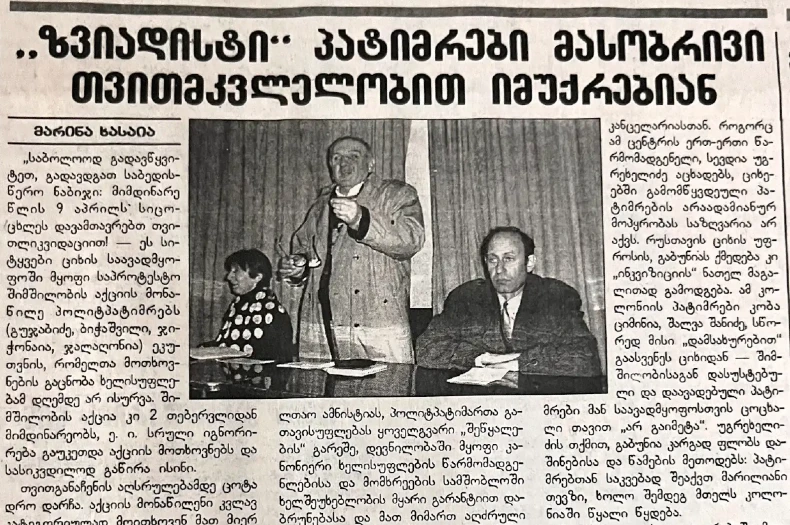
Hunger strike in Prison Hospital

2000

This AI-generated translation may not be completely accurate.
Hunger strike in Prison Hospital
On February 2, 2000, a hunger strike began at the Ortachala prison hospital, initiated by Bidzina Gujabidze, Dato Bichiashvili, Kakha Jichonaia, and Murtaz Jalaghania, who were considered political prisoners and supporters of Zviad Gamsakhurdia. They were later joined by former National Guard leader Loti Kobalia, although Kobalia soon withdrew due to health issues.
The strikers demanded a general amnesty and the release of all political prisoners without pardon procedures, safe return and immunity guarantees for members of the ousted legal government (referring to Gamsakhurdia’s administration) and their supporters, and the termination of ongoing criminal cases against them. They also requested meetings with international organizations, unrestricted access for the media inside the prison, and permission for open communication with detainees.
According to Droni newspaper, the parliamentary faction “XXI Century” had already initiated the creation of a special commission to investigate the events of 1991–92, and President Eduard Shevardnadze had approved this step. This led faction chairman Vakhtang Bochorishvili and MP Elene Tevdoradze to view the hunger strike as being incited by outside influence. Still, the protest continued inside the prison hospital.
On February 5, inmates at the women’s colony also began a hunger strike. Most of them claimed wrongful imprisonment and demanded that the Supreme Court review their cases and the presidential pardon commission release them. Many had been convicted on serious charges, particularly drug trafficking. The hunger strikers insisted on meetings with Rusudan Beridze, Deputy Secretary of the National Security Council, and Deputy Prosecutor General Nugzar Gabrichidze. Both officials met with the women, but the protest continued.
Frustrated by government inaction, the prisoners announced that they would end their lives in a mass suicide on April 9, coinciding with the upcoming presidential election. Their protest gained solidarity: around 40 outside supporters began fasting, and several political groups, including the Chkondideli, Didgori, and National-Conservatives, organized rallies outside parliament demanding political amnesty.
Government envoys, including MPs Elizbar Javelidze and Vakhtang Bochorishvili, urged the strikers to suspend their protest, but they refused. Elene Tevdoradze argued that “political amnesty” did not exist in legal terms, while President Shevardnadze signaled openness to pardons. However, the prisoners rejected pardon as a solution, insisting on political recognition of their demands.
On April 6, journalists staged a protest outside the prison hospital after being denied access to interview the hunger strikers. They sent a formal appeal to the Minister of Justice and the head of the penitentiary department, but with no response, they continued demonstrating the next day. NGOs soon joined in solidarity.
On April 8, before noon, Patriarch Ilia II visited the prisoners, urging them to end their hunger strike. Later that day, parliamentary leaders, including Speaker Zurab Zhvania, Tevdoradze, Rusudan Beridze, Bochorishvili, Jemal Gogitidze, and Jemal Gakharia, entered the prison hospital with journalists. They reached an agreement: the prisoners would suspend their hunger strike, and parliament would review their cases at its next session.
This event was hailed as an act of “national reconciliation.” Family members were finally allowed to visit the strikers the same evening.
Weeks later, parliament passed a resolution on addressing the consequences of the 1991–92 events and achieving national consensus. The resolution condemned attempts to resolve political disputes through violence or the overthrow of legitimate authority and instructed the prosecutor’s office to review related criminal cases by June 23, 2000.