Home to Europe

2022

This AI-generated translation may not be completely accurate.
Home to Europe
On June 17, 2022, the European Union recommended granting Ukraine and Moldova EU candidate status, conditional on the fulfillment of certain requirements. In Georgia’s case, the EU outlined 12 priority reforms that needed to be implemented before candidacy could be considered. The final decision was expected to be announced at a summit in Brussels at the end of June.
A few days earlier, the civic movement Shame (Sirtskhvilia) announced a large pro-European rally, “Home to Europe,”to be held on June 20. The movement had emerged following the anti-government protests of June 20–21, 2019 — known as “Gavrilov’s Night” — against the ruling Georgian Dream party.
On June 14, President Salome Zurabishvili urged organizers to postpone the June 20 rally and instead invited citizens to gather at Europe Square on June 16. EU Ambassador Carl Hartzell and French Ambassador Diego Colas attended the June 16 gathering.
On June 13, Prime Minister Irakli Garibashvili called the planned June 20 rally a “provocation”:
“The main thing is that after all their failures — after they couldn’t drag the country into war and couldn’t achieve anything — they now want to hold a rally on June 20, supposedly to demand EU integration and candidate status…”
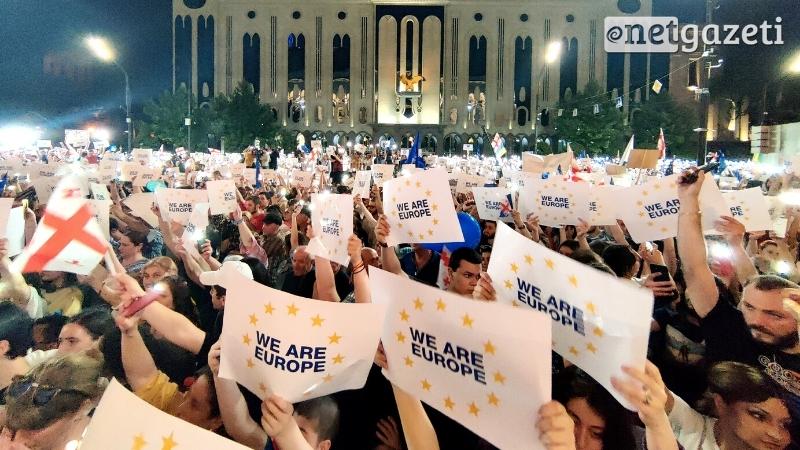
On June 20, marking the third anniversary of “Gavrilov’s Night,” thousands marched through Tbilisi from Rustaveli Avenue to Europe Square under the slogan “Home to Europe.” A stage was set up in front of Parliament early in the day, and due to the massive turnout, Freedom Square Metro station only allowed passengers to exit. Among the speakers were Eka Gigauri (head of Transparency International Georgia) and Giorgi Kadagidze (former president of the National Bank).
Parallel rallies were held in Batumi, Kutaisi, and Zugdidi. Demonstrators waved EU, Georgian, and Ukrainian flags. The Shame movement read aloud its official manifesto.
It was announced that another rally would take place on June 24, when the EU’s final decision was expected. During that demonstration, attended by several thousand people, protesters demanded the resignation of Prime Minister Irakli Garibashvili.
On June 23–24, three opposition TV channels — Mtavari Arkhi, Formula, and TV Pirveli — aired a 41-minute video produced by Shame promoting the “Home to Europe” rally. The clip depicted different generations of a Georgian family expressing frustration over Georgian Dream leaders’ statements about the war in Ukraine and the European Parliament’s resolution. The ruling party filed a complaint with the Communications Commission, which ruled that the video constituted political advertising and fined the broadcasters.
On June 28, several MPs left Georgian Dream, later announcing that their goal was to “equip the public with the truth,” which soon proved to mean spreading anti-Western narratives.
Another major “Home to Europe” rally took place on July 3. Ahead of it, civil society and opposition representatives toured regional towns (Ozurgeti, Khoni, Gori, Telavi, Marneuli) to meet with citizens. At Tbilisi State University, students distributing informational leaflets were verbally attacked by pro-government groups.
The July 3 rally once again drew thousands. At the end of the march, protesters moved toward the Government Administration and the Georgian Dream party headquarters, where hundreds of police officers blocked access. It was decided that a group of citizens would stay overnight near the Government Administration.
That night, the rally dispersed. Some participants expressed frustration online, and on July 8, the Shame movement released a statement apologizing for the lack of clear communication about their plans and goals.