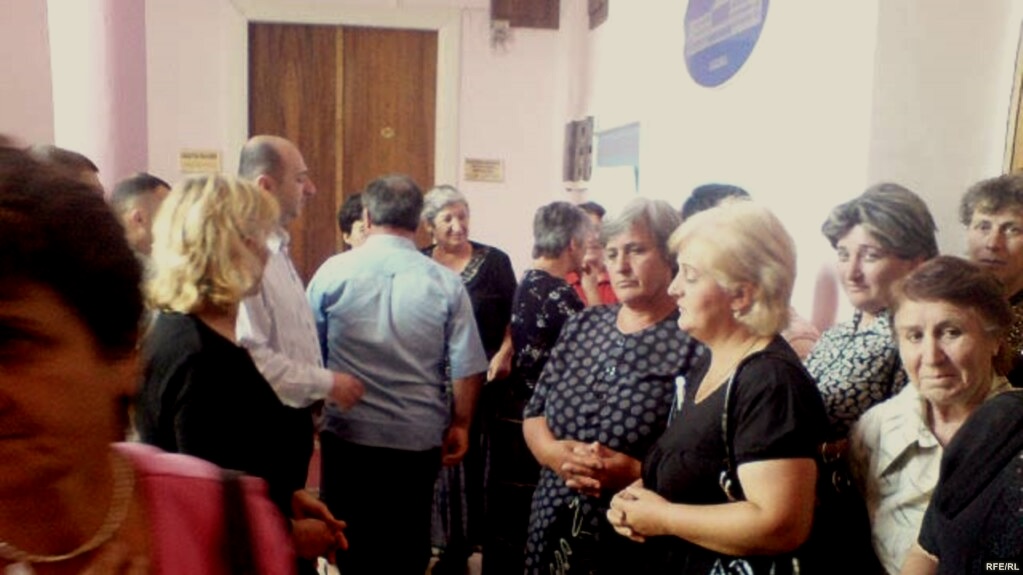
Demonstration of residents of Flavi and Flavisman

2009

This AI-generated translation may not be completely accurate.
Demonstration of residents of Flavi and Flavisman
On August 13, 2009, about fifty residents of the villages of Flavi and Flavismani held a protest inside the Gori administration building. The villagers demanded protection and security guarantees from the government and expressed dissatisfaction with the decision that granted electricity bill discounts only to 24 villages bordering the occupied territories. Although Flavi and Flavismani also border the Tskhinvali region, they were not included in the list of villages eligible for this benefit.
Due to near-daily shootings from the occupied territory, parents avoided letting their children play outside—especially after a recent explosion on the road to Flavi injured a teenage boy. A middle-aged woman told Radio Free Europe/Radio Liberty that Russian soldiers had already fenced off part of her garden with barbed wire. She added that Russian troops once offered her a sack of flour in exchange for a bucket of fruit. “I’d still rather eat the bran our people gave us for six months, that almost killed us. But how long can we live like this?” the woman told Radio Free Europe.
Residents of Flavi and Flavismani also said that even Georgian police officers hesitated to enter their villages, which lie within the so-called “buffer zone.”
The protesters in Gori demanded a meeting with the governor of the Shida Kartli region, but Vladimir Vardzelashvili was not in his office. Instead, they met with Kakhka Toliashvili, head of the Gori Municipality Administration. He explained that Flavi and Flavismani had not been included on the state aid list because they had suffered less damage during the August War. According to Toliashvili, no houses in those villages had been burned or destroyed, and fortunately, no residents had been killed.