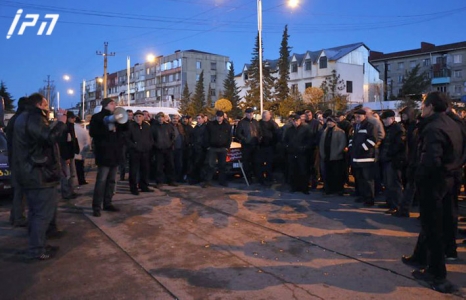
Demonstration of Batumi bus drivers

2014

This AI-generated translation may not be completely accurate.
Demonstration of Batumi bus drivers
On February 12, 2014, public bus drivers in Batumi went on strike demanding higher hourly wages. The strike disrupted public transportation across the city.
The drivers, employed by the municipal company Batumi Autotransport Ltd., called for the dismissal of the company’s director, Giorgi Loria, and an increase in hourly pay from 4 GEL to 4.5 GEL — which would raise their monthly salaries to around 800 GEL.
The drivers accused Loria of pressuring them to leave their labor union. By the third day of the strike, participants reported that the administration had coerced one driver to return to work.
“We realized that sending out a bus was a provocation. Some of the strikers lay down in front of the exit. We spoke to the driver and convinced him not to become the administration’s tool. He listened and drove the bus back to the depot,” said Ilia Verdzadze, head of the Adjara Trade Union Federation.
On the fourth day of the protest, two drivers began a hunger strike. By the fifth day, tents were set up at the depot entrance.
On February 18, the Batumi City Council formed a commission to review the drivers’ demands. Two days later, on February 20, Giorgi Loria submitted his resignation, requesting that the council consider him for another suitable position due to his experience.
On February 28, his resignation was formally accepted. However, he was temporarily kept in his post until a replacement could be selected through an open competition. After the formation of an inter-factional working group in the City Council to negotiate with the strikers, the bus drivers ended their strike.