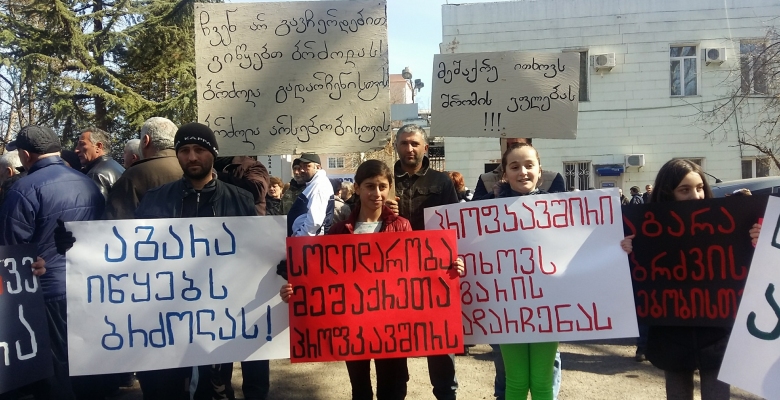
Protest of the Agara factory workers

2018

This AI-generated translation may not be completely accurate.
Protest of the Agara factory workers
The Agara sugar factory suspended operations in 2017 because it could no longer compete with the lower prices of imported sugar. The entire settlement, which depended economically on the factory’s work, faced a severe crisis, and around 500 people lost their jobs.
On March 2, 2018, the factory workers in Agara held a protest demanding that production resume. Their banners read: “Restart Agara,” “Agara Needs Help,” and “Sugar Workers Demand the Right to Work.”
On April 9, representatives of trade unions joined the protest and called on the Georgian Prime Minister to get involved. They reminded the government that before the elections, the ruling party had promised new jobs, but instead, even existing workplaces were disappearing.
Sectoral unions—including representatives from the energy, railway, and metro workers’ unions—also joined in solidarity. They appealed to Georgian citizens to support local industry by buying domestic products, arguing that doing so would strengthen the national economy and improve the conditions of Agara’s workers.
Despite 40 days of continuous protest, there were no visible results.
“The company blames everything on the low price and over-importation of foreign sugar, denies responsibility, and points to the government. Meanwhile, the government has failed to take meaningful steps to solve the problem. What we see are only ineffective discussions aimed at calming the protest, involving groups that have no decision-making power.
The people of Agara are now in unbearable crisis, both economically and socially. Every worker has a family to feed, and most are burdened with bank loans. Hunger has become widespread in Agara. We call on the government to act responsibly and adopt a real solution,” stated the workers in a declaration released on April 18. They then decided to march from Agara to Tbilisi.
After walking more than 100 kilometers, the protesters arrived in Tbilisi on April 19, carrying a banner that read “Restart Agara.” They spent the night in tents at the Dighomi forest park and the next day went to the Government Chancellery, demanding a meeting with the Prime Minister to discuss the issue.
The Agara workers ended their protests after April 25, when it was announced that an agreement had been reached between the factory’s management, trade unions, and the Business Ombudsman. According to a joint statement from the company and the Business Ombudsman’s office, negotiations between the Georgian government and the owners of the Agara Sugar Company resulted in a support package that would allow the factory to resume operations on June 1. Workers were promised reemployment.
Trade union representatives said that the agreed plan would remain in effect until December 31, after which the factory’s owner was to present a long-term project ensuring stable operations. The Agara sugar factory did indeed reopen in June 2018 and continued production until the end of the year, after which it operated intermittently.