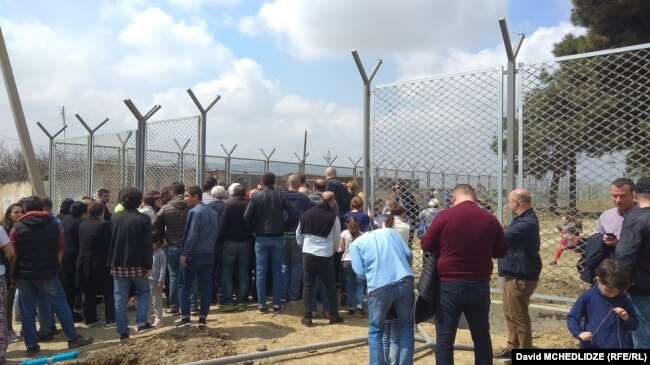
Demonstration against the construction of prisons in Rustavi

2019

This AI-generated translation may not be completely accurate.
Demonstration against the construction of prisons in Rustavi
The construction of two new penitentiary facilities was planned in the Chkondidi district of Rustavi, prompting strong opposition from local residents. A petition was launched stating that the government had decided to build the prisons without consulting the Rustavi municipal authorities or studying the opinions of local citizens.
At a protest rally on April 9, Rustavi Mayor Irakli Tabagua confirmed that the city administration had not been informed about the project.
One of the petition’s initiators, David Metreveli, director of the Rustavi International Scouting Center, said that the plan contradicted Rustavi’s general land-use plan, which defined the city’s development zones and future prospects. According to him, the proposed area for construction — the Chkondidi settlement — was both historically important and economically promising for Rustavi:
“Several studies show that this area is two degrees cooler than the rest of the city. It’s ideal for developing a small model town… everything would be good here — except a prison.”
Protests became continuous. On April 14, demonstrators held a march under the slogan “They’re building prisons in our yards.” Residents argued that the facilities were planned too close to residential areas:
“Rustavi is already a city of prisons, but the others are located outside the city — this one would be right next to our homes,” said one protester.
Carrying banners reading “No to prison construction,” protesters marched from the Chkondidi neighborhood into the city center, chanting, “Join us to stop Rustavi from becoming a city of prisons.” They blocked the main road several times and gave the Minister of Justice 24 hours to reverse the decision.
On April 16, part of the protesters set up tents and announced a 24-hour vigil. That same day, opposition leader Grigol Vashadze of the United National Movement visited the site, promising residents that the opposition would prevent the construction, and if it did proceed, a future government would convert the facility into a technology center.
On May 2, local clergy from the Rustavi Diocese joined the protests.
In early 2020, the issue reached the Georgian Parliament. On September 19, 2019, the Speaker of Parliament told Info Rustavi that authorities might consider relocating the project to another area, though construction was never officially suspended. By May 15, 2020, Info Rustavi reported that the penitentiary project was in its final design stage and undergoing expert review. However, as of May 6, 2022, construction had still not begun.