Protest against taxi licensing

2019

This AI-generated translation may not be completely accurate.
Protest against taxi licensing
In 2019, the Tbilisi City Hall decided to introduce new regulations for taxi drivers. Under the new rules, licenses were divided into two categories: Type A licenses allowed drivers to pick up passengers from the street, while Type B licenses only permitted work through ride-hailing apps. Only drivers with white-colored vehicles could obtain a Type A license — a restriction set by the municipality.
The regulations affected around 28,000 taxi drivers. Many opposed the color restriction — some refused to repaint their cars used for work, while others could not afford the cost.
Drivers held their first protest on March 27, 2019, gathering at Station Square and marching to Rustaveli Avenue, where they blocked the road. They began to clear the area only after police started towing vehicles. The protest then moved to the Parliament building, where participants demanded that City Hall revoke the regulation, arguing that it created a monopoly in the taxi business.
Another protest took place on April 11, when drivers marched from Aghmashenebeli Highway to the home of ruling party founder Bidzina Ivanishvili, where they were met by police. The protests were supported by the leader of the Labour Party, Shalva Natelashvili.
Drivers demanded a postponement of the new regulations until December 31, 2021, giving City Hall a deadline of June 1, 2019, to respond. The municipality partially conceded, allowing drivers to cover their vehicles with white film instead of repainting them, which would not damage the cars.
The regulations officially took effect on October 1, 2019, and fines of 200 GEL were imposed on drivers who lacked the proper license or violated the licensing rules.
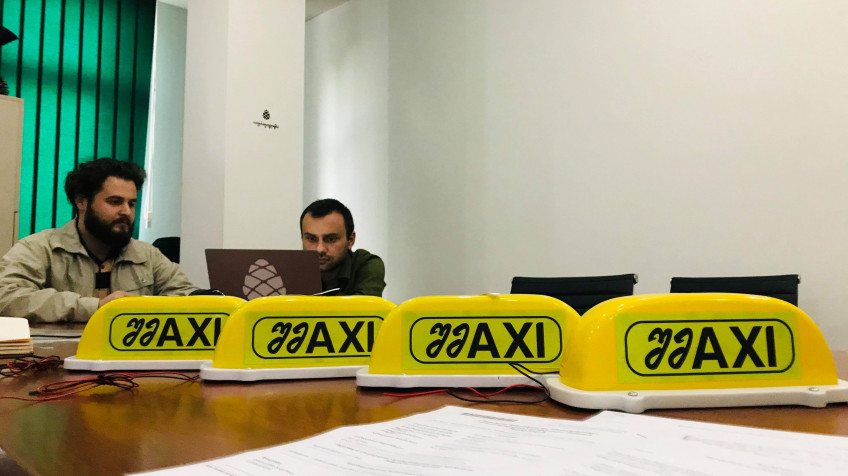
Zurab Japaridze, leader of the political party Girchi, sought to bypass the law by registering a company called Shmaxiwith the Public Registry and distributing its logos to drivers who refused to comply with the city’s demands. Police began fining these drivers as well.
Girchi members and Shmaxi drivers held their final protests against the regulations on October 29 and December 23, but these actions did not lead to any policy change.