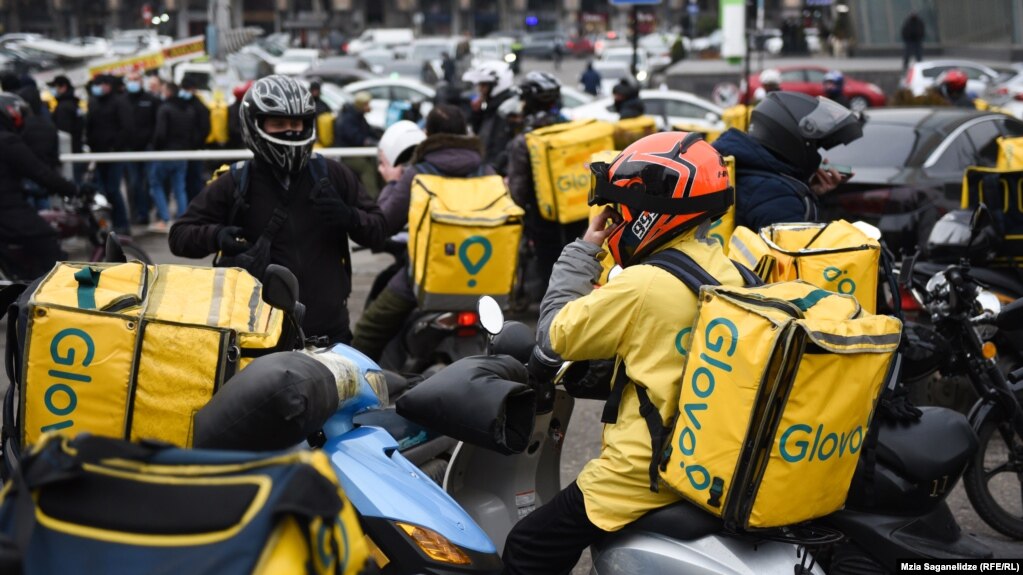
Delivery Drivers’ Protest

2021

This AI-generated translation may not be completely accurate.
Delivery Drivers’ Protest
In Tbilisi, where the largest number of couriers are employed, workers permanently protested their working conditions. Several companies offered food delivery and parcel delivery services from restaurants and dining establishments. Among them were: the Spanish company “Glovo,” the Estonian “Bolt Food,” the Finnish “Wolt,” and the Russian company “Yandex.” In most cases, couriers did not have employment contracts and were considered contractors.
Couriers mostly complained that they were not receiving fair compensation for their labor and demanded improvements in working conditions. Protests took place at different times.
Glovo protests
On January 29, 2021, couriers gathered in front of the Glovo office and protested working conditions. With whistling and chants of “Come out!” they demanded a meeting with company representatives. Couriers said the company was “putting its hand into their pockets” because the app used for deliveries did not count kilometers accurately and reduced their pay. Glovo management responded with a statement saying: “We expect specific demands from the partner couriers participating in the protest so that we can discuss all details with them and find a constructive solution.”
On May 16, 2021, Glovo couriers gathered again to protest — this time against changes to the bonus system, reduced working hours, and a change in how distance traveled was calculated. According to them, the change would significantly reduce their earnings. On the same day, the company restricted app access for about 50 couriers. The company claimed the decision was due to “misuse of the app,” not participation in the protest, as couriers suspected.
Two days later, the couriers stopped the protest, because some of them accepted the new terms. “We didn’t agree with the updated bonus system, but in the end, some agreed and returned to work. For those who continued the strike, protesting no longer made sense, because they could easily be replaced. So now everyone is starting to work again,” one Glovo courier told “Publika.”
Under the updated bonus system, instead of weekly bonuses, couriers would receive hourly bonuses. The company claimed that “under the new system, it would become faster and easier to earn additional compensation.”
From October 2021, Glovo-sponsored media articles appeared, stating that the company was “setting a new standard of social rights,” starting the project in Georgia and Morocco. The project included fair compensation, insurance, and improved safety for couriers.
Bolt Food protests
On March 17, 2021, Bolt Food couriers also began protesting. They stopped working and marched from Kostava Street to the company’s headquarters on Beliashvili Street. The protest followed a reduction in pay: couriers had been receiving 7 GEL per delivery, which was reduced to 4 GEL.
On March 23, Bolt Food couriers held another protest in front of the Sports Palace and drafted these demands:
- The bonus system should be revised — the required number of daily orders to receive the daily bonus must not exceed the number of orders that can realistically be completed. The earned bonus should appear immediately in the account.
- Couriers should be compensated not only for the distance from the restaurant to the customer, but also for traveling to the restaurant.
- Even if a courier does not receive any orders while online for one hour, that time should still be compensated.
- It should be defined when and under what circumstances a courier can receive a low rating, and couriers should be warned before being disconnected from the system.
- The app should add a “tip” feature so customers can pay extra for the courier’s effort.
On March 24, the company responded, stating that the guaranteed minimum payment per order was 50% higher than what competitors offered. In the same statement, management warned couriers that “any organized attempt that may disrupt Bolt Food’s or partner restaurants’ business operations will result in strict reaction from the company.”
They followed through – some couriers had their app access restricted, which couriers saw as punishment for protesting. Later, in June 2021, the Public Defender assessed the company’s actions as discriminatory and called on the company to uphold the principle of equality.
Wolt protests
A new wave of courier protests began in 2023, when on February 5, “Bolt” partner drivers also gathered to protest. They demanded the return of pre-2023 tariffs, a reduction of commission fees, the opening of a Georgian office, and a 24-hour call center. Bolt drivers also demanded compensation for long-distance deliveries and the addition of a waiting-time button. Wolt couriers expressed solidarity. After their own protest, they marched from the Bicycle Monument to University Street to join the taxi drivers’ protest.
On February 15, around 200 Wolt couriers went on strike. Because of this, the app stopped functioning for several hours. They demanded increased fees as well as the dismissal of regional manager Natalia Khizanishvili, claiming she threatened couriers with termination for participating in protests. During a couriers’ conference on March 29, they decided to continue protest actions until app access was restored and demands met.
On March 30, the company issued a statement claiming that striking couriers were threatening and insulting active couriers. Couriers denied the allegation.
On March 31, they gathered again, demanding improved working conditions. They complained that instead of restoring app access for protesting couriers, the company was hiring new ones — a claim the company denied, stating that recruitment takes place periodically. Like Bolt, Wolt was also found discriminatory by the Public Defender, after the company blocked the app for two couriers for publicly discussing work problems and participating in protests. In addition, the Ombudsman found discriminatory a mass SMS sent to 142 couriers urging them not to participate in protests.
Wolt Georgia told Radio Free Europe/Radio Liberty that the company did not intend to restore app access for these couriers, did not agree with the Public Defender’s assessment, and believed that its partnership with couriers was not an employment relationship.