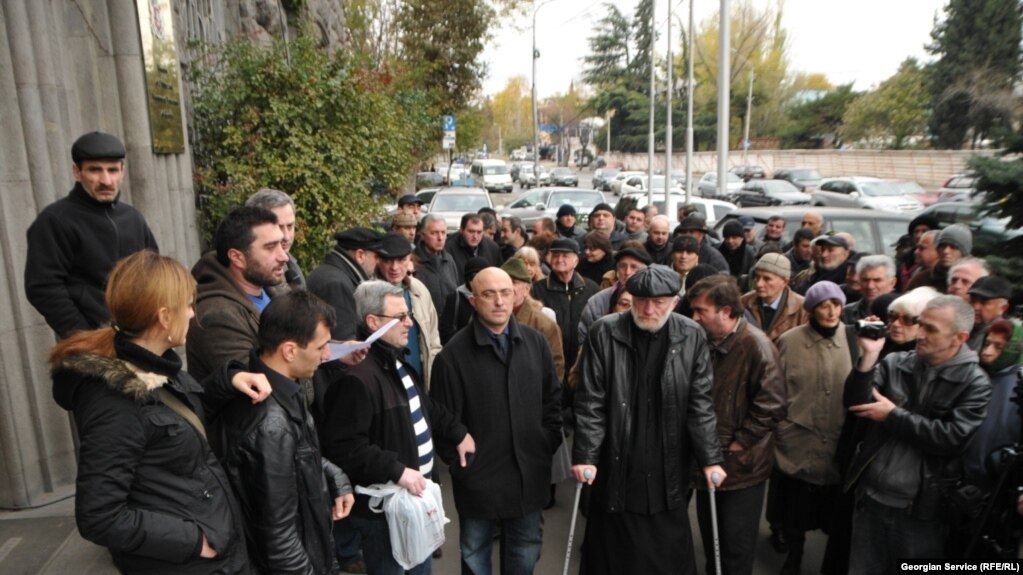
Protest to protect the Mestia museum exhibits

2011

This AI-generated translation may not be completely accurate.
Protest to protect the Mestia museum exhibits
In 2011, the reconstruction of the Svaneti Historical and Ethnographic Museum began, leading to the removal of its exhibits and their transfer into special containers placed in the museum’s courtyard. Some members of the public argued that the Ministry of Culture and the National Museum were delaying the safe relocation of the treasures, thereby endangering 9th–10th century Georgian manuscripts and other unique archaeological artifacts.
On November 21, several dozen people gathered at 1 p.m. in front of the Ministry of Culture and Monument Protection to protest and demand the protection of the Mestia treasure. Representatives of NGOs and opposition parties called on the ministry’s leadership to accept the Patriarchate’s special commission proposal and immediately move the exhibits to the Church of St. Nicholas in Mestia.
Deputy Minister of Culture and Monument Protection Davit Tskhadadze met with the protesters. According to Tea Tsulukiani, a representative of the “Free Democrats,” the two sides agreed on a four-point plan. Under this plan, a new building was to be prepared in Mestia to house the national treasure. “The deputy minister agreed that our representatives, the Patriarchate, experts, and members of the commission will travel there to assess the quality of the new facility,” Tsulukiani said.
The second point of the agreement required an inventory of the exhibits before temporary placement to ensure that none of the items were missing. The third and fourth points included public discussions of the new museum project and regular updates for the public.
Ultimately, the Ministry decided to place the exhibits not in the church but in the local music and art school building. The government tasked the local administration with adapting and securing the site—installing climate control, alarm systems, and window bars.
The Ministry of Culture maintained that the concerns were exaggerated, asserting that the storage containers were equipped with a fully functional climate control system. According to Minister Nikoloz Rurua, the museum’s exhibits were in no danger.