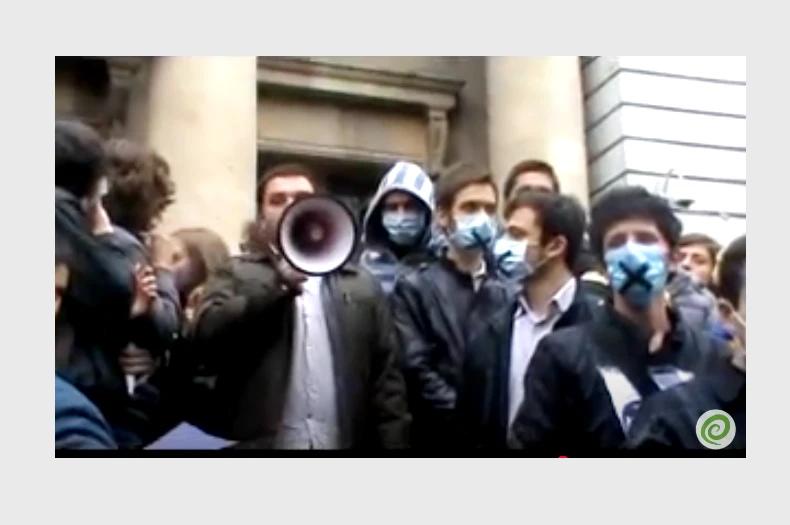
Students Against Violence

2011

This AI-generated translation may not be completely accurate.
Students Against Violence
On April 18, 2011, students and their supporters gathered outside the second building of Ivane Javakhishvili Tbilisi State University (TSU) to protest against violence toward students. The demonstration was organized by the student initiative group “Translate” (Targmne), and students from other universities and their friends also joined in solidarity. According to one of the organizers, Lasha Kavtaradze, the protest was triggered by an incident that occurred three days earlier, on April 15, at TSU’s fifth building.
On that day, the “Translate” group held a presentation to discuss problems related to academic literature at the university. The students pointed out that most course materials were in English, while existing Georgian translations were often of poor quality. They demanded the translation of high-quality academic texts into Georgian. During the discussion, students also criticized the university’s student self-government for spending money on “foreign trips and entertainment” instead of improving educational resources. Members of the student government reacted aggressively and physically assaulted several students.
At the April 18 protest, students declared a vote of no confidence in the TSU Student Union and demanded the expulsion of those involved in the assault, as well as the publication of the organization’s full financial report.
Although the protest did not lead to immediate results, it became a turning point in Georgia’s student activism. The movement laid the foundation for the creation of Laboratory 1918, an independent student organization that emerged later that year.
In their first manifesto, published in 2011, members of Laboratory 1918 wrote:
“Laboratory 1918 will be an educational space within the university, based on the principles of student and faculty self-organization. Together with professionals, we will work toward building a free educational environment, turning the university into the vanguard of civil society. Such a university is what a society deserves—one that refuses self-deception and submission to force, and instead aspires to development and freedom.”