Protest due to the Competition for School Directorship

2023

This AI-generated translation may not be completely accurate.
Protest due to the Competition for School Directorship
Teachers, students, and some parents from three schools in the Chkhorotsku municipality protested what they described as unfair principal election processes, which they believed aimed to install government-favored candidates ahead of the 2024 elections.
Due to the protests, educational activities were disrupted on October 6, 2023, at Kirtskhi Public School No. 1, Chkhorotsku Public School No. 2, and Akhuti Public School No. 1.
Protesters claimed that some former principals were “blocked” for political reasons and that, with the support of local authorities, only one preferred candidate remained in most schools, while others were told they had not been selected.
Dimon Arahamiya, acting principal of Kirtskhi Public School No. 1, said he had been elected twice—in 2007 and 2014—and, because a third term at the same school was not legally allowed, he attempted to apply for a different school position but was denied. He believed the rejection was retaliation for not following government directives during the previous elections.
On October 6, students gathered in the schoolyard with banners reading “No to injustice” and “We love our principal.” Similar protests took place at other schools, where students refused to attend classes and demanded the education minister’s intervention.
The following day, during the “Chkhorotskuba 2023” celebration, students from all three schools joined the event carrying protest signs. Dimon Arahamiya, who had been awarded honorary citizenship of Chkhorotsku, renounced the title publicly during his speech — his microphone was turned off mid-statement.
Principal selection involved two stages: testing and an interview. Candidates who passed both could apply to specific schools, after which the Ministry of Education presented eligible candidates to school boards for selection. In some schools, only one candidate was presented; others were not allowed to participate at all.
With the support of the International Society for Fair Elections and Democracy (ISFED), 26 candidates appealed to the court on October 17, challenging the interview results.
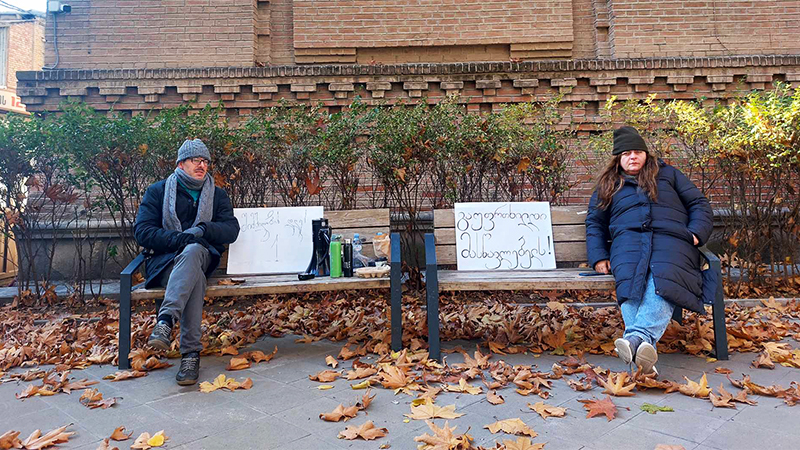
One of them, Georgian language and literature teacher Maia Ekaladze, began a hunger strike outside the Ministry of Education on December 4, protesting the process with a sign reading “Protect teachers.” She and fellow teachers David Peradze and Giorgi Chauchidze later met with Education Minister Giorgi Amilakhvari and his deputies, but described it as an “empty meeting” and continued their protest in tents outside the ministry.
On December 11, Peradze and Ekaladze submitted a written request to meet with the prime minister.
on December 12, the three teachers held a march from the First Classical Gymnasium to the presidential palace under the slogan “Teachers, don’t be afraid—fight for your students.”
The protests yielded no results. On February 24, 2024, the government published a new decree on school principal selection procedures that retained the controversial interview stage. Civil society groups’ proposal—to let certified candidates automatically apply to any school and be evaluated only by school boards—was not adopted.