“Georgia will never become a land of Qizilbash.”
“They are corrupting and defiling the country of saints,”
“Everyone should know their place,”
“A guest cannot take a Georgian’s place, and this country will never belong to a guest.”
Content is being updated — some hyperlinks may be missing
This website traces Georgia’s journey since 1991 through the protests that shaped its spirit of resistance.
GE
March of the Georgians – a Xenophobic Demonstration

2017
This AI-generated translation may not be completely accurate.
March of the Georgians – a Xenophobic Demonstration
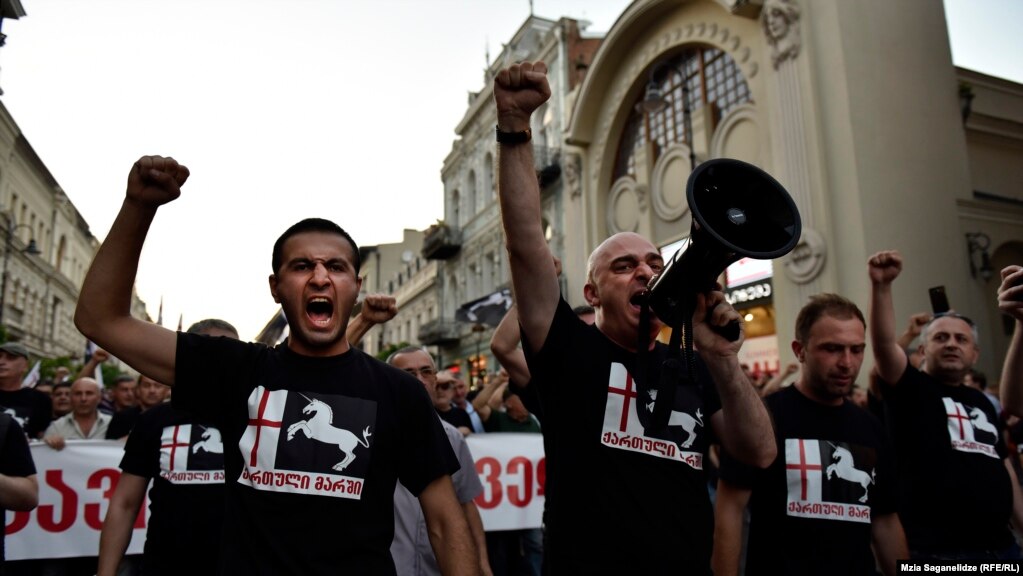
On July 14, 2017, the “March of the Georgians” took place in Tbilisi, organized by the “Erovnulebi” (Nationals) movement. Approximately 2,000 participants joined the procession on Agmashenebeli Avenue, demanding the deportation of illegal immigrants, the tightening of immigration laws, restrictions on residence permits for foreigners, and a ban on foreign funding for non-governmental organizations. They were joined by Emzar Kvitsiani, a representative of the parliamentary opposition party, the Alliance of Patriots.
Agmashenebeli Avenue was specifically chosen for the march due to its high concentration of cafes and bars featuring diverse international cuisines, including Iranian, Turkish, Indian, Lebanese, and Egyptian. As many of those employed there were also foreign nationals, the march was directed specifically against them. Participants led the procession with a large icon of King David the Builder.
Xenophobic chants were heard throughout the event: “Georgia will never belong to the Qizilbash,” “They are corrupting and defiling the land of saints,” “Everyone should know their place,” and “A guest cannot take the place of a Georgian, and this country will never belong to a guest.”
The rally concluded within an hour. Prior to the march, member organizations of the civil platform “No to Phobia” issued a statement urging the government to implement appropriate measures to prevent violence rooted in racial and xenophobic prejudice.
Counter-demonstration
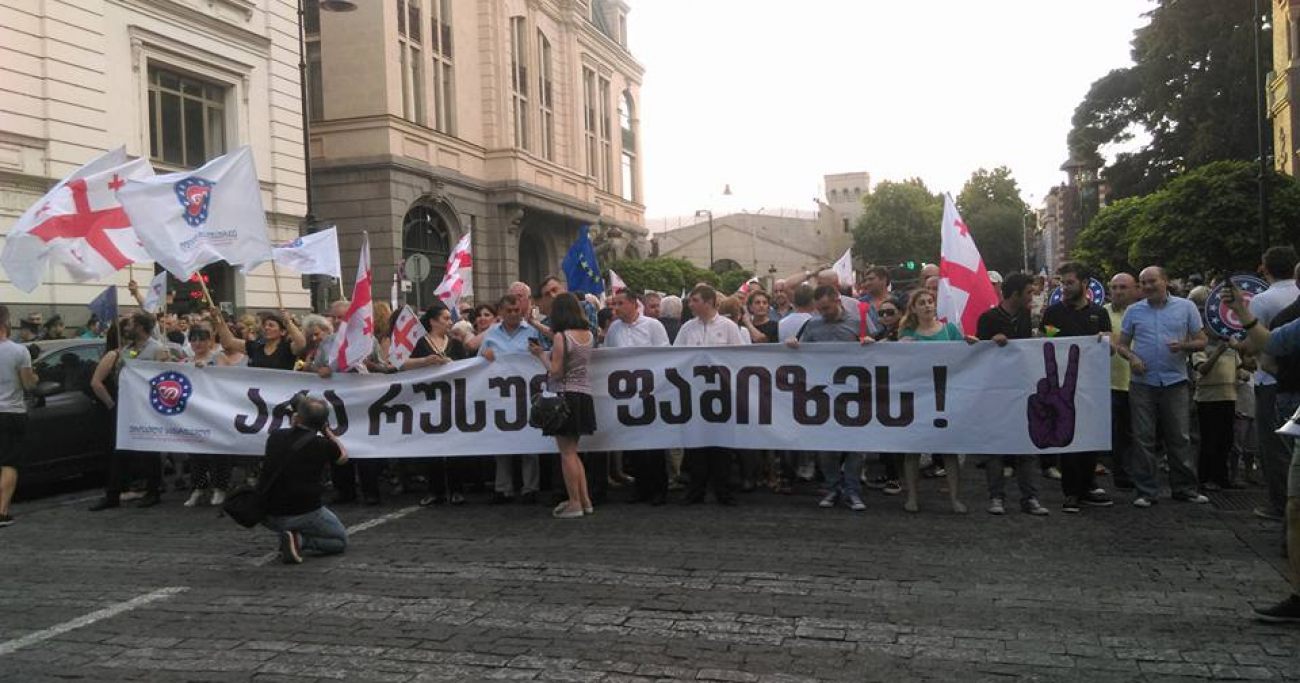
In response to this march and to protest the xenophobic demonstration, the “European Georgia” party held a rally on July 23, also on Agmashenebeli Avenue, titled “No to Russian Fascism in Georgia.” Party leader David Bakradze stated: “What we are witnessing—the aggression, the violence, the trampling of true Georgian traditions, the intolerance of dissent, and xenophobia—is a manifestation of Russian propaganda and is precisely what closes the door to Georgia’s European future.”
The “No to Russian Fascism” rally was also joined by the leaders of the Republican Party and the Free Democrats, as well as several civil society groups.
In an attempt to disrupt the European Georgia rally, the “March of the Georgians” announced a parallel counter-demonstration on Agmashenebeli Avenue.
Activists from the “March of the Georgians” also met with the Catholicos-Patriarch of Georgia, Ilia II, after which they were urged to cancel the planned rallies. Tbilisi City Hall similarly called on them to postpone the event or hold it at a different location. Despite these appeals, approximately 50 “March of the Georgians” activists gathered on Pasteur Street, adjacent to Agmashenebeli Avenue.
A large number of police officers were mobilized in the area, forming a cordon to prevent the counter-demonstrants from entering Agmashenebeli Avenue. However, several minor incidents occurred. Upon approaching the counter-demonstrants, European Georgia activists were pelted with eggs, empty bottles, and other objects.