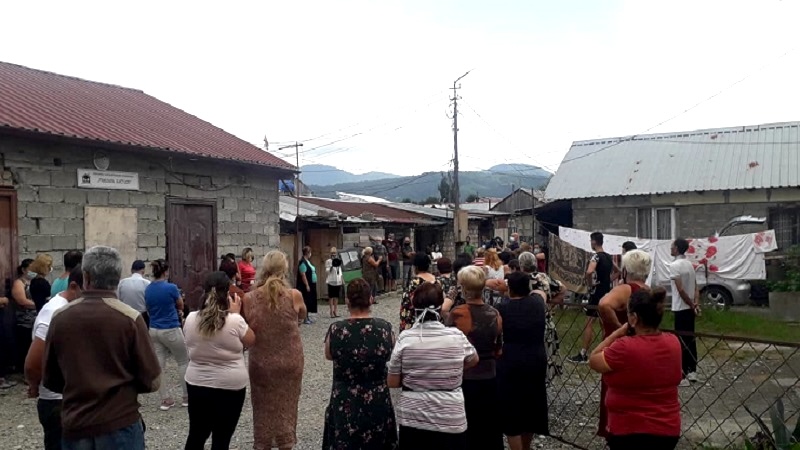
Demonstration in the “Dream City”

2019

This AI-generated translation may not be completely accurate.
Demonstration in the “Dream City”
After the 2012 parliamentary elections, wooden and cardboard structures began to appear near Batumi, close to Fridon Khalvashi Avenue, on the grounds of the former Russian military base. Families who had lost their homes due to natural disasters and had nowhere else to go settled there. The area came to be known as the “Cardboard City” and later as the “Dream Town,” because its residents believed that after the 2012 elections and the rise to power of the Georgian Dream party, their lives would improve and they would finally be able to live in decent conditions. Over the years, makeshift shelters were replaced with sturdier buildings, and the population grew steadily.
On February 9, 2019, the government began registering families living in Dream Town in preparation for a housing construction project. By May, 1,551 families had been officially registered.
On September 29, 2019, residents of Dream Town held a protest demanding progress on the delayed housing project. The next day, the Chairman of the Adjara Government, Tornike Rizhvadze, announced that project planning was complete and that a construction tender would soon be announced. According to the 2020 Adjara regional budget, 582 families were to receive apartments in 2021, and another 968 in 2023. Meanwhile, residents demanded immediate solutions to pressing living conditions.
“The roads are in terrible condition, water leaks into the houses, electrical wiring is in disrepair and hasn’t been replaced. Twelve shacks have already burned down—probably twenty more will too. We’ve been asking for streetlights for seven years because ambulances can’t reach us in the dark,” said local resident Marina Beridze.
On September 22, 2020, residents held another protest demanding clear criteria for determining who would receive apartments. They said that Tornike Rizhvadze had promised to clarify the selection process a month earlier, but by late September, there were still no answers. The same demands were repeated during another protest on October 18 outside the Adjara Government building.
On November 20, 2020, it was announced that the project’s completion deadline had been postponed. Initially budgeted at 48.75 million GEL for 2019–2022, the project was extended to 2020–2023 with an increased budget of 73 million GEL, and then again to 2021–2024 with a revised budget of 70 million GEL.
In February 2021, part of a building under construction collapsed. The Adjara Ministry of Finance and Economy told Batumelebi that the contractor was responsible for maintaining construction quality and compliance with safety standards.
By March 21, 2021, residents still had no clarity about apartment allocation criteria. They gathered near the settlement, blocking Fridon Khalvashi Avenue in protest until police reopened the road. That same day, the Adjara Health Ministry claimed that the criteria were being developed with resident participation.
The next day, residents marched to the Adjara Health and Economy Ministries in Batumi, demanding transparency. Despite repeated promises, the government failed to clarify the criteria, and by the end of 2021, the buildings remained unfinished. Photos from December 28 showed visibly warped walls. The construction company, DAGI, insisted that the flaws posed no structural danger, citing forensic assessments to support its claim.
On April 17, 2022, residents organized another protest demanding on-site registration of households, public release of the apartment allocation criteria, and safety inspection results for completed buildings.
Shortly before local by-elections that year, 338 individuals were registered at a single address—near Fridon Khalvashi Avenue 188. On April 2, 2015 voters were registered at one polling station, exceeding the legal limit of 1,500.
On May 7, residents protested again in front of the Adjara Government building, demanding written contracts with all eligible families and independent inspection of the new buildings. “The government says they’ll satisfy 580 families in this phase, and there’ll be another later. We demand that contracts be signed with all categories of families and that proper inspection be conducted,” said activist Marina Beridze.
On May 30, 2022, Tornike Rizhvadze announced that a commission had finalized the apartment allocation criteria, but residents remained dissatisfied, as they still didn’t know how the order of recipients would be determined. Although the criteria were officially approved on June 26, no timeline for apartment distribution was provided.
By the end of 2022 and throughout 2023, residents were still waiting. On October 22, 2023, they attempted to block Fridon Khalvashi Avenue multiple times, but police prevented it. This time, they demanded that individual contracts be signed for apartment ownership.
By the end of 2023, no lists had been published, and residents were still in the dark about who would receive apartments first.
After 12 years of waiting, on June 5, 2024—just months before the October parliamentary elections—the Adjara government held a ceremonial apartment handover event attended by the Prime Minister. Only one family was symbolically given a key, representing the first of 582 promised apartments. Even that day, the list of beneficiaries was not made public. After this stage, 1,025 families were still awaiting housing.
On September 6, 2024, shortly before the elections, Batumelebi reported that ruling party coordinators had transported residents by minibus to the Public Registry to finalize ownership documents. “We left all our papers with the coordinators—they told us we had to,” residents told the outlet, which suggested that the Georgian Dream party was using the Dream Town residents for political leverage.
On February 8, 2025, the newly appointed Prime Minister, Irakli Kobakhidze, visited Adjara and announced the start of the second phase of apartment transfers. A “symbolic capsule ceremony” was held at the construction site, costing 209,000 GEL from the regional budget.
A week later, on February 15, two children fell into an open pit and died near the same site. The construction area had no safety fencing, though footage from the Prime Minister’s visit showed barriers in place for the ceremony. Locals said the fencing was removed the very next day.
Two days after the tragedy, only the pit where the children had died was fenced off.