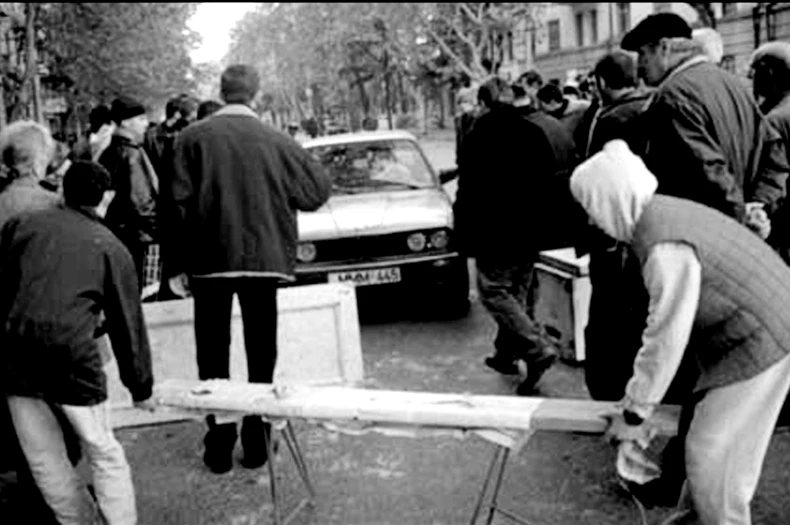
Demonstration due to lack of Electricity in Vake

2000

This AI-generated translation may not be completely accurate.
Demonstration due to lack of Electricity in Vake
On November 14, 2000, a major protest broke out in Tbilisi’s Vake district over the severe energy crisis and constant blackouts. It began when about twenty residents blocked Chavchavadze Avenue, and soon hundreds of people from nearby apartment buildings and students joined them. The protest quickly grew into a large demonstration, with locals lighting bonfires in the middle of the street and demanding uninterrupted electricity supply.
Residents carried slogans such as “There is darkness in the coffin, there is also no light in the room” and “Give us the opportunity to build.” Their message was clear: they wanted 24-hour electricity. Tbilisi mayor Vano Zodelava met with the crowd, promising solutions, but protesters distrusted the government’s repeated assurances.
By November 17, the protests had spread across the city. Major roads, including Rustaveli Avenue, Chavchavadze, Vazha-Pshavela, Tsereteli, and Melikishvili streets, were blocked, with thick smoke from burning wood filling the air. Some demonstrators attempted to halt traffic, and tensions between drivers and protesters nearly turned into physical clashes. The blackout crisis also triggered solidarity actions in other districts like Saburtalo, Gldani, and Nadzaladevi.
President Eduard Shevardnadze ordered police not to use force against the population. Energy Minister Davit Mirtskhulava blamed the blackout on drought, which left hydroelectric reservoirs only 68 percent full, and on corruption within the sector. He promised that repairs at Tbilsresi (the Tbilisi State Regional Power Plant) and the launch of Shaori Hydroelectric Station would ease the situation, although 24-hour electricity was still considered unrealistic.
Newspapers at the time highlighted that this was one of the largest social protests of Shevardnadze’s presidency, particularly significant because it erupted among the very groups that once supported his rise to power.