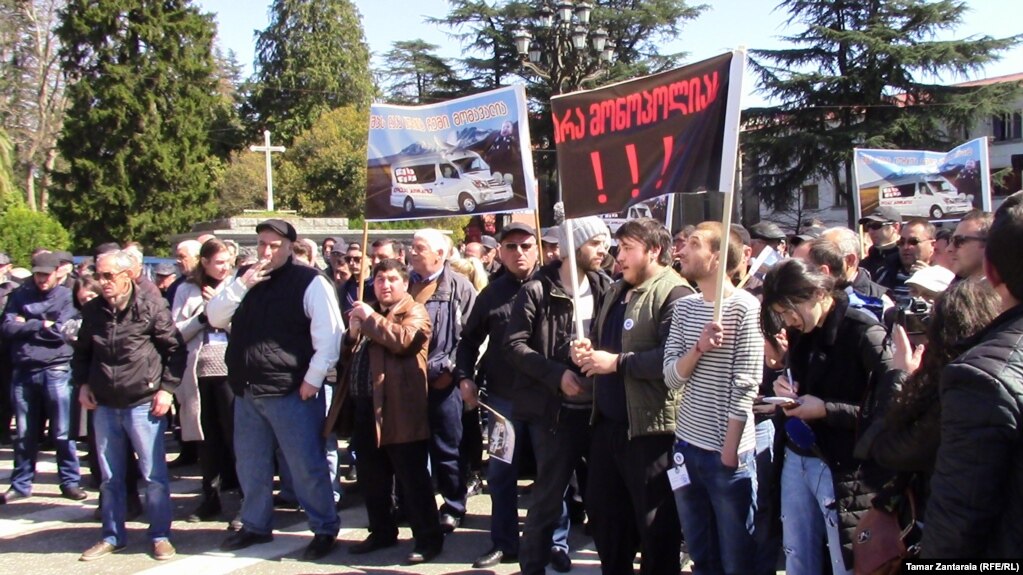
Protest Against the Entry of “Metro” Buses in Zugdidi

2016

This AI-generated translation may not be completely accurate.
Protest Against the Entry of “Metro” Buses in Zugdidi
On January 16, 2016, minibus drivers operating on the Zugdidi–Tbilisi route held a protest against the Turkish company Metro+, which had announced plans to begin running buses on the same route. The drivers feared that the arrival of the new competitor would cost them their jobs.
During the demonstration, the station dispatcher urged the strikers to stop the protest and return to work, leading to verbal and physical altercations between the two sides.
On January 30, the drivers escalated their protest by blocking the main Senaki–Leselidze highway for half an hour. After police intervention, traffic was restored. The drivers warned that if their demands were not met, they would cross into Russian-occupied Abkhazia via the Enguri Bridge and request Russian citizenship.
That same day, under police protection, Metro+ managed to operate its first bus trip from Zugdidi to Tbilisi.
The protest continued on February 1, when minibus drivers pelted Metro buses with eggs. The confrontation led to clashes with the police, who detained ten protesters.
Protesters accused the Turkish company of invading their market: “The Turks have entered our business and are taking over what we’ve built for 30 years,” they said. Some co-owners of the bus station also expressed anger, claiming that the lease agreement with Metro+ had been signed without informing most of them—only three of the 21 shareholders were aware. However, Metro+ representatives denied any wrongdoing, stating that they were operating fully within the law.
On February 3, the drivers ended their strike after the Zugdidi bus station management unilaterally terminated its contract with Metro+, which had been signed on January 20.
Despite this temporary victory, protests against Metro Georgia continued throughout the following months. On March 17, the company resumed operations with two bus trips despite ongoing demonstrations. On March 21, after another protest in front of Zugdidi City Hall, drivers attempted to set up protest tents but were stopped by police, leading to further clashes. Some of the drivers then went on strike, and several began a hunger strike.
Following requests from the local government, Metro Georgia temporarily suspended its operations until the City Hall’s supervisory service could review the legal basis for the company’s activity at the new bus terminal.