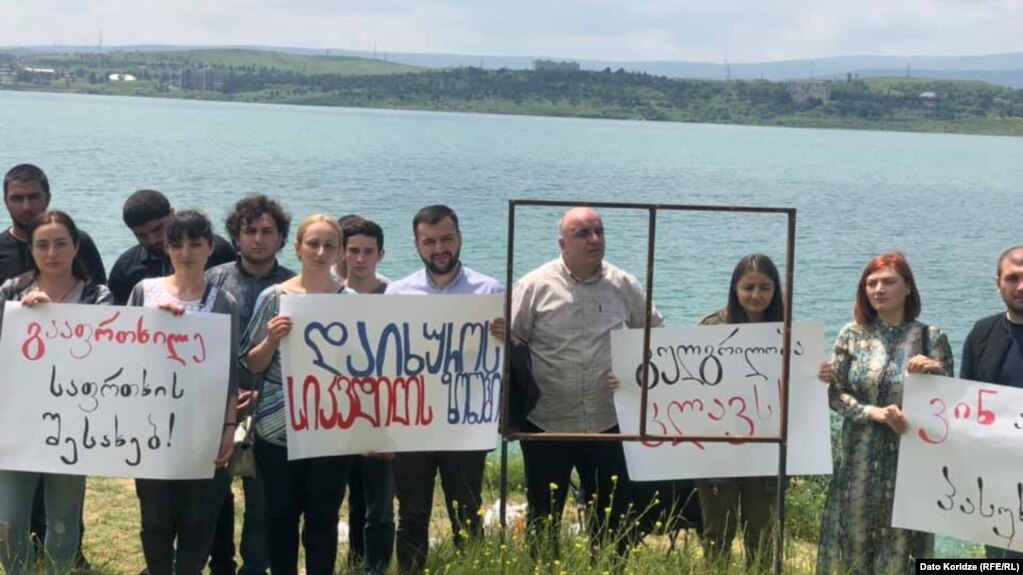
Against the death of citizens on water bodies

2018

This AI-generated translation may not be completely accurate.
Against the death of citizens on water bodies
In 2017, several young people drowned in the Tbilisi Sea, among them 15-year-old Tsotne Tsqitishvili — the son of Aleko Tsqitishvili, Executive Director of the Human Rights Center. He had entered the water from an improvised beach near the so-called “Waterfall” area and was unable to get out.
That same year, Aleko Tsqitishvili and the mother of another victim sued Tbilisi City Hall and Georgian Water and Power(GWP), demanding that the municipality take adequate safety measures at the site — including solid barriers, surveillance cameras, and warning signs.
In 2018, alongside the lawsuit, a public campaign titled “Swim Safely” was launched by Anna Dolidze, the Human Rights Center, CENN, and the Center for Progress. The campaign identified dangerous swimming areas across Georgia and called for immediate safety improvements and public awareness.
According to a 2018 report by legal scholar Maka Nucubidze, between 2015 and 2017, 352 people drowned in Georgia’s rivers, lakes, and the sea — most of them children and young adults.
On August 1, 2018, campaigners gathered at the Tbilisi Sea near the tower area where the Iori River flows into the reservoir — considered one of the most dangerous spots due to makeshift recreational zones and the absence of warning signs or barriers. They also worked to raise public awareness through articles and an investigative film titled “Death Zones in Georgia” produced by Studio Monitor.
On May 28, 2019, activists returned to the site with banners reading “Warn About Danger,” “Close the Death Zones,” and “Indifference Kills.” That summer, students from CENN’s Green Camp joined the campaign, placing banners on damaged structures reading “Our friend died here. Swimming is deadly!” and “No one protects you here! Don’t become a victim. Swimming is prohibited.”
Meanwhile, the court case continued. Judge Natia Buskadze personally inspected the area and confirmed that access to the dangerous site was not properly restricted. After two years of litigation, the court partially upheld the plaintiffs’ claim — ordering Tbilisi City Hall to install fencing and warning signs, though it denied the request for a lifeguard post, reasoning that lifeguards are required only where swimming is officially permitted.
Both sides appealed: Tsqitishvili sought compensation for moral damages, while the city and GWP attempted to overturn the ruling on safety measures.
Despite the appeal, in 2020 warning signs were installed around the “Waterfall” area, followed by permanent barriers in 2021. Similar warning signs were later placed every 100 meters around the entire Tbilisi Sea perimeter.
The legal battle concluded on November 20, 2024, when the Supreme Court ruled in favor of Aleko Tsqitishvili, upholding the requirement for Tbilisi City Hall to maintain barriers and warning signs and ordering the city to pay 25,000 GEL in moral damages.