Protest in Chela against the dismantling and reinstallation of the minaret

2013

This AI-generated translation may not be completely accurate.
Protest in Chela against the dismantling and reinstallation of the minaret
In the Samtskhe-Javakheti region, the small village of Chela in the Adigeni municipality is inhabited by ethnic Georgians — some Muslim families resettled from Adjara and some Orthodox Christian families originally from the Racha region.
In July 2013, a minaret imported from Turkey was installed next to the local mosque in Chela. On August 20, the Adigeni Municipal Council decided that the minaret had been erected illegally, without authorization from the local authorities, and therefore should be dismantled.
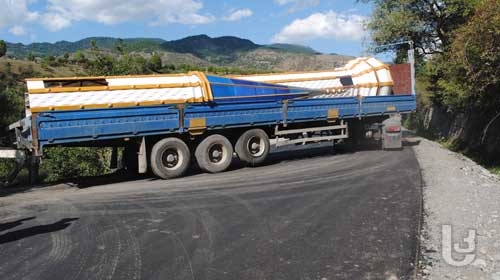
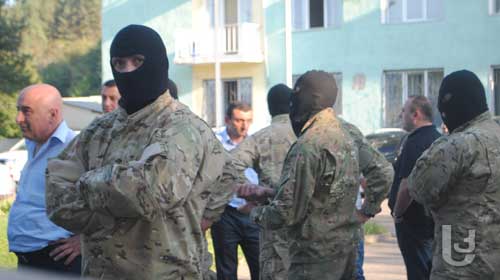
On August 26, police blocked the road leading to the village, restricting movement in the area. According to the newspaper Samkhretis Karibche, around 2 p.m. a helicopter appeared over Chela, followed by dozens of law enforcement officers, special forces, police vehicles, and cranes. Locals recounted that the mosque was surrounded by heavily armed special police units who began dismantling the minaret. Gunshots were fired into the air, and clashes broke out between residents and police.
Amid the protests of local residents, government officials oversaw the dismantling, which quickly escalated into a confrontation between police and villagers. Several people were beaten, around twelve were detained, and taken to the Akhaltsikhe police station. After removing the minaret, police forces withdrew from the village.
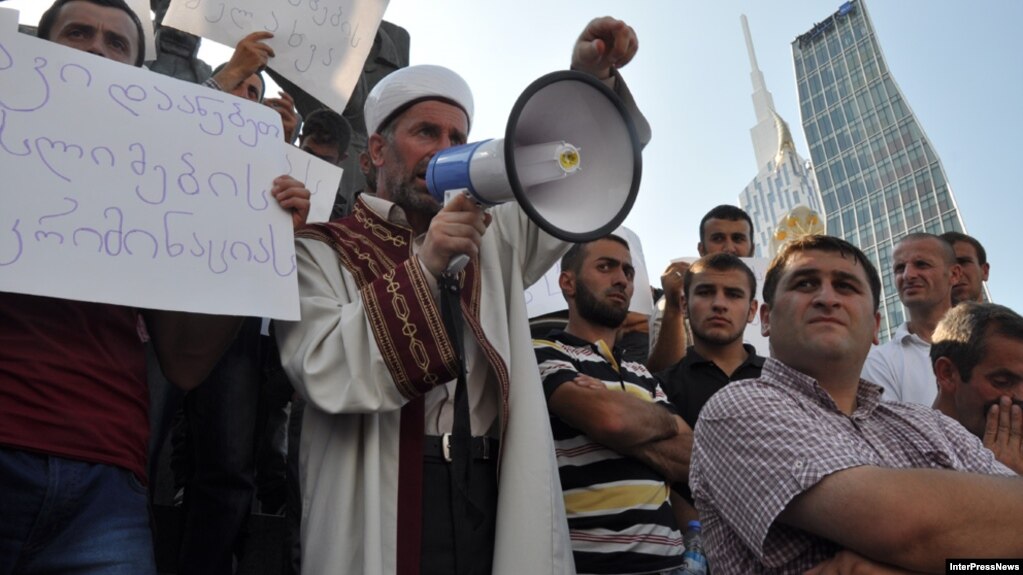
Members of the local Muslim community then traveled to Akhaltsikhe, continuing their protest in front of the regional police headquarters.
“Where have you seen a place of worship torn down in the 21st century?” one demonstrator shouted at police guarding the station’s fenced perimeter.
At one point, protesters attempted to enter the police compound, prompting officers to detain several people.
Initially, officials justified the dismantling by citing the Adigeni Council’s decision, which declared the structure illegal. However, it later emerged that the Revenue Service of the Ministry of Finance had ordered the action.
The Revenue Service issued a written statement explaining that the minaret had been dismantled for expert examination to verify whether its declared weight and classification matched the customs data recorded when it was imported into Georgia on July 14. The Service claimed there was “reasonable suspicion” that incorrect classification of the structure had been used to reduce import taxes.
Civil society groups called the explanation legally groundless and illogical, publishing detailed analyses to refute it.
Some of the protesting Muslims spent the night outside the regional police building. Numerous NGOs, the Union of Georgian Muslims, and the Evangelical-Baptist Archbishop of Georgia, Malkhaz Songulashvili, condemned the dismantling. The Georgian Patriarchate also issued a statement, calling the event an “attempt to incite religious confrontation.” Protests demanding the return of the minaret were also held in Tbilisi and Batumi.
The Revenue Service stated that the minaret would be returned to Chela once the inspection was complete.
In response, on August 29, members of the Christian community in Chela launched their own protest, opposing the reinstallation of the minaret.
By the following morning, August 30, the Christian protesters announced that they would end their demonstrations. “With the bishop’s blessing, we will not hold the protest. We also have no intention of going against the law or the state,” one participant told reporters.
That day, villagers awaited the return of the minaret. It arrived around midday but was placed in storage about two kilometers from the village, guarded by the Protection Police. Later that evening, representatives of the Muslim community who had been in Batumi returned home.
The minaret issue resurfaced in November of that same year. On the night of November 28, 2013, the minaret was reinstalled in Chela.
Life in the village soon returned to normal. “During Ramadan we invited our Christian neighbors to dinner. Love saved us — otherwise, there might have been bloodshed. Now our relations are very warm,” a local resident told Samkhretis Karibche. Christian residents echoed this sentiment, saying that “what happened belongs to the past.”
Prior to the Chela incident, several other religion-based conflicts had occurred in Georgia — in Tsintskaro and Nigvziani in November 2012, and in Samtatskaro in June 2013. Human rights organizations argued that the authorities failed to respond adequately to any of these incidents. “Not a single case of threats, obstruction of religious rituals, persecution, or hooliganism against Muslims resulted in accountability for perpetrators. The state’s inadequate, ineffective, and discriminatory actions became the main reason that anti-Muslim harassment developed a recurring pattern,” they stated, labeling the dismantling of the minaret a grave violation of religious freedom.
Following the reinstallation, the Social Justice Center (formerly EMC) described the collaboration between civil society and state institutions that made the restoration possible as a positive example.
“EMC believes that, given the seriousness of the human rights violations linked to the dismantling of the Chela minaret and the scale of public protest that followed, the reinstallation represents a political decision by the authorities and a unique case. We hope that this positive precedent will serve as a model for ensuring freedom of religion in Georgia,” read the organization’s statement.